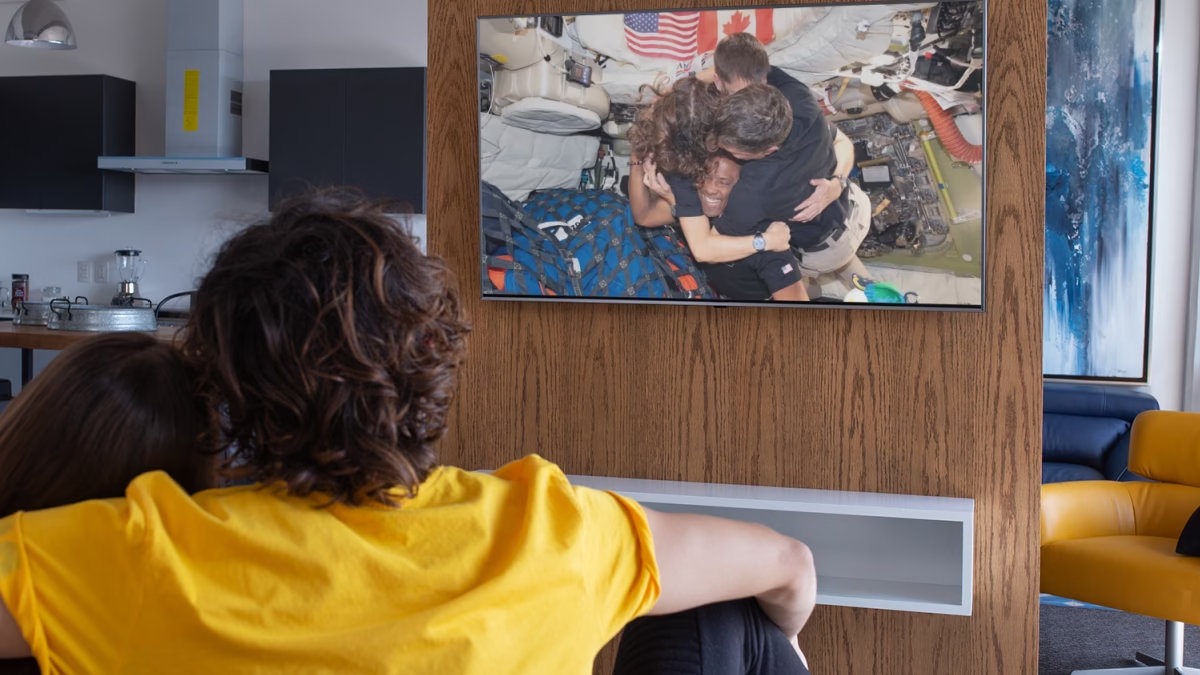
Something happened to us over those ten days. And I don’t think we’re talking about it enough.
Collective joy is necessary for recovery. Really necessary. And for ten days in April, the moon, four astronauts, NASA, and a floating jar of Nutella gave us exactly that.
Let me explain.
What Collective Joy Actually Does
Our nervous systems have been through it.
The weight of what’s happening in the world right now is real. The threats, the cruelty, the exhausting feeling that the floor might give way with our next breath. Our bodies were not built to hold this much for this long. We are tired in a way that sleep doesn’t fully fix. We are collectively exhausted and spent, hanging on by a thread.
And when we live there long enough, something starts to narrow. Our world gets smaller. We stop reaching out. We stop looking up. We start managing instead of living. We mistake surviving for being okay.
Collective joy blows that open.
The kind where millions of people feel the same wonder at the same moment. It tells our nervous systems something that nothing else quite can. You are not alone in this world. Other people are still capable of wonder. Strangers on the internet are weeping over a Nutella jar and meaning it completely. The world still has things worth making playlists for.
There is actual science behind this. When we experience joy in community, our brains release oxytocin. The same bonding chemical is released in moments of physical closeness and safety. We are literally, biologically reminded that we belong to each other. That we are part of something. That the world is bigger than our fear.
This isn’t silly. This is medicine.
Enter the Moon
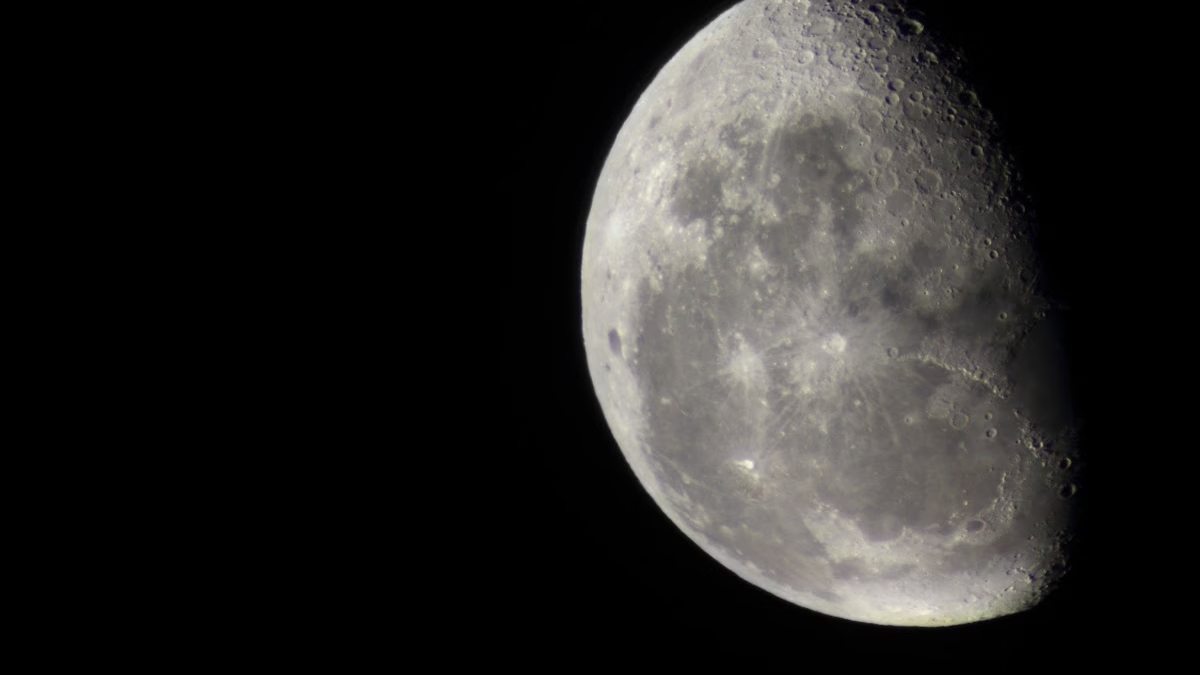
I am not a space person. My entire aerospace education comes from Space Camp (1986) and a Tang commercial. But the moon? The moon has always felt different. Dreamy. Ancient. Mystical. The place where poems are born.
On April 1st, four astronauts lifted off from Kennedy Space Center. Reid Wiseman, Victor Glover, Christina Koch, and Jeremy Hansen began a 10-day journey that took them farther from Earth than any human beings have traveled in over fifty years. They went around the far side of the moon. They looked at craters no human eyes had ever directly seen. They named one for Wiseman’s late wife, Carroll.
And we watched every single bit of it. Together.
I watched the launch from my couch. I was alone, and then I was texting friends, and then I wasn’t alone at all. People kept the NASA channel open on second monitors at work. Watched updates on their phones while making dinner. The launch aired live on Netflix. Watch parties popped up at space museums. Strangers on the internet refreshed the same feed at the same moment.
We were all in the viewing room.
The Ten Days, in No Particular Order of Importance
Mission Control played a wake-up song for the crew every morning. A tradition from the Apollo era. Chappell Roan, Queen and David Bowie, John Legend, Denzel Curry. When they cut off “Pink Pony Club” before the chorus, Wiseman complained. Koch said she was singing it in her head all day.
A jar of Nutella floated across the live broadcast. The label perfectly forward, rotating slowly in zero gravity. Nutella responded: “Honored to have traveled further than any spread in history.” Correct response.
Christina Koch posted a photo gazing at the moon, one braid visible in the frame. “First braids to leave Earth orbit. (unconfirmed).” The internet immediately confirmed it.
On April 7th, after the flyby, the four of them shared a group hug inside the capsule. Four humans, floating, holding each other, 236,000 miles from home.
I have looked at that photo more times than I can count.
See photos from all 10 days of the mission here on The New York Times.

8:07 PM
I was on my couch. The coverage started at 6:30 and I was not going anywhere.
The Orion spacecraft splashed down at exactly 8:07 PM Pacific on Friday, April 10th. After 695,000 miles. After ten days. After a six-minute communications blackout during reentry when the capsule was wrapped in plasma at 5,000 degrees and no one could reach them. All anyone could do was sit there and believe in the math.
The math held.
That math traces back to Katherine Johnson, the NASA mathematician whose work on trajectories and reentry calculations shaped the entire American space program. She passed away in 2020 at 101 years old. Her backup procedures helped guide Apollo 13 home after everything went wrong in 1970. Her precision is still working. Still bringing people home. Still landing things exactly on time.
I cheered alone on my couch but it felt like cheering with everyone.
Recovery Needs the Moon
Joy is recovery fuel. Communal joy is the highest-octane version, because it fills the whole room. It fills the group chat. It fills the comment section under Maya Glover’s viral dance video, where her dad is piloting a spacecraft around the moon and she is dancing about it in a t-shirt with his face on it. “This quite literally makes you generationally iconic,” Instagram’s own account commented. And for a moment, generationally iconic was just true, and everyone knew it, and knowing it together made it more true.
This is what recovery is for.
Recovery is rebuilding a life that has room for wonder in it. A life where you can sit on your couch on a Friday night and cry happy tears because Reid Wiseman wore a friendship bracelet to the moon. Because Victor Glover told his daughters he was doing this for them and then he went and actually did it. Because the wake-up song on the last day in space was ‘Run to the Water’ and someone chose that on purpose
Recovery asks us to feel things again. All the things. Including the good ones. Especially the good ones.
For the sober curious and the sober certain, collective joy is especially necessary. One of the deepest wounds that addiction and trauma leave behind is the wound of isolation. The story that we are fundamentally alone. That we are too much, or not enough, or simply not the kind of person the good things happen to.
Collective joy tells a different story. With evidence.
We had ten days of something to be for. Ten days where the alarm in our nervous systems stood down a little. We let ourselves look up. We made the Nutella joke and then caught our breath. Because they saw a total solar eclipse from the other side of the moon. Because the far side of the moon was pink and blue and shimmering and nobody knew. Because Reid Wiseman could barely speak when he heard his daughters’ voices from 250,000 miles away. Because love is apparently visible from deep space if you know where to look.
Christina Koch, back on Earth, said: “A crew is a group that is in it all the time, no matter what, that is willing to sacrifice silently for each other, that gives grace, that holds accountable. A crew has the same cares and the same needs, and a crew is inescapably, beautifully, dutifully linked.”
She was talking about the four of them. She was also talking about us.
Commander Wiseman said it from space: “We really hoped in our soul that we could for just a moment have the world pause and remember that this is a beautiful planet and a very special place in our universe, and we should all cherish what we have been gifted.”
He pulled it off.
So did we.
From Blast Off to Splashdown: Top Moments That Define the Artemis II Mission
Space Camp 1986 – MOVIE TRAILER
Tang Commercial from 1973 – Mars is made from Tang

THIRSTY FOR WONDER: at The Sober Curator, led by Anne Marie Cribben—a passionate recovery coach and spiritual companion based in Washington, DC—offers 1:1 coaching, spiritual guidance, and recovery support rooted in compassion and empowerment. As the creator of The Wellspring: A Celtic Recovery Journey, Anne Marie blends the Celtic calendar with sobriety, connecting participants to ancient wisdom and the rhythms of nature.
A fierce advocate for sobriety as liberation and self-love, she challenges the targeted marketing of alcohol to women and champions authentic, joyful living. Her work goes beyond addiction recovery, fostering a life of vibrancy, purpose, and connection.
SPIRITUAL GANGSTER: at The Sober Curator is a haven for those embracing sobriety with a healthy dose of spiritual sass. This space invites you to dive into meditation, astrology, intentional living, philosophy, and personal reflection—all while keeping your feet (and your sobriety) firmly on the ground. Whether you’re exploring new spiritual practices or deepening an existing one, Spiritual Gangster offers inspiration, insight, and a community that blends mindful living with alcohol-free fun.
How do I reclaim joy in recovery?
Start small and start honest. Joy in recovery doesn’t always announce itself with fireworks. Sometimes it’s a song that makes you roll the windows down. A meal that actually tastes good. A moment of genuine laughter you didn’t have to manufacture. Notice those moments. Name them out loud or write them down. Joy grows where attention goes. And if it feels far away right now, that’s okay. It comes back. It really does.
Where do I find sober community?
Look for people who are building something, not just avoiding something. Online communities, recovery meetings, sober events, spaces like this one — they all count. The goal is to find people who make you feel less alone in the good moments and the hard ones. You don’t have to find your whole community at once. One person who gets it is a very good place to start.
How do I stay present for good moments when I’m used to numbing them?
Gently. We heal at the rate of trust, which means it’s okay to receive joy in small doses. You don’t have to throw yourself into the deep end. Let yourself feel a little, then a little more. If a moment moves you and you don’t know what to do with it, just stay. Just let it be there. You are allowed to feel good things. That permission might need to be renewed daily for a while, and that’s okay too.
What if collective joy feels overwhelming or unsafe?
Trust what your body is communicating to you. That signal is important and worth listening to. Then ask yourself if there’s a way to participate that does feel safe. You don’t have to go to the watch party at the museum. You can watch from your couch. You don’t have to be in the crowd to be part of the moment. Participation has a lot of shapes, and all of them count.
What is collective joy?
Collective joy is the shared experience of wonder, delight, or happiness with other people. It can happen at concerts, sporting events, watch parties, online moments, or even while millions of people follow a space mission together.
Why does collective joy matter in recovery?
Recovery is not only about removing what harmed us. It is also about rebuilding a life that has room for awe, connection, laughter, and meaning. The article frames collective joy as “recovery fuel” because it helps counter isolation.
What does the moon have to do with sobriety?
In the article, the moon becomes a symbol of wonder, perspective, and shared human experience. Watching the astronauts’ journey gave people something beautiful to look toward together, which connects directly to the recovery need for hope and belonging.
How can I find more joy in sober life?
Start by noticing what makes you feel awake, connected, or curious. That might be music, nature, art, space, sports, a group text, or a tiny internet moment that makes you laugh harder than expected. Joy counts, even when it arrives small.
Can online moments create real connection?
Yes. Online moments can become real connection when people are emotionally present together. In the article, people watching NASA updates, texting friends, and reacting to shared moments helped turn a space mission into a collective experience.