She was high when she said yes.
In the spring of 2018, Lena Dunham got engaged to a childhood friend a month after their first kiss. She was on a rotation of pain pills, Klonopin, and weed. She said yes. She doesn’t get into the rest of the proposal in Famesick, her second memoir. She doesn’t get into it because she doesn’t really remember it.
Eight years later, she remembers what she missed.
Famesick, released April 14, 2026, is the first book Lena Dunham has written sober. Her first memoir, 2014’s Not That Kind of Girl, was written from inside the fog. This one is what she found when the fog lifted. And what she found is not a redemption arc with a bow on it. It’s something more honest, and more useful, than that.
A 12-Year-Old’s Prescription, Two Decades of Habit
Dunham was first prescribed Klonopin at twelve. She had severe anxiety and OCD, and the medication did exactly what it was supposed to do. It dialed the noise down. By her early twenties, the dose was roughly the same. The dependency had quietly grown around it, the way these things do, so gradually you don’t notice until you can’t reach the ground anymore. She has described being on Klonopin as feeling like “floating on a cloud,” which is a polite way of saying exactly that.
Girls premiered on HBO in 2012 and became cultural shorthand for a generation. Dunham, by then, was cultural property. By the final season in 2017, she was managing endometriosis, the chronic pain of Ehlers-Danlos syndrome, the particular brutality of being Lena Dunham on the internet, and a steady benzo prescription that had long since stopped being optional. The medication that started as a tool had become her only volume control.
In Famesick, she describes a months-long relationship with a childhood friend, called “Nick” in the book, as a chemical haze. Her mix: pain medications, Klonopin, weed. His: weed, day and night. The proposal happened a month after their reunion. The wedding was scheduled for August 2018.
She didn’t make it to August.
The Hysterectomy, the House Slippers, and the Day Everything Stopped
In early 2018, Dunham underwent a hysterectomy to address her endometriosis. The post-surgical pain medication added another rail to a system already running well past capacity. By April, she could no longer hold it together.
She has told the same story about the day she went to rehab in two places now. First in a 2023 Instagram post on her five-year sober anniversary. Then again, in more detail, in Famesick.
“Five years ago today, I set foot, trembling like a little kid, into treatment for substance misuse,” she wrote. “My parents hugged me goodbye, I changed into house slippers, and there I was.”
That is the entire scene. Hugged. Changed. There.
Anyone who has watched someone they love walk into treatment, or walked in themselves, knows exactly how much weight is sitting inside those three words. There is no drama in that sentence. That’s the point. By the time you get to the house slippers, the drama is already over. What’s left is just the first quiet moment of something different.
She spent 28 days at a cognitive-behavioral therapy program in Los Angeles. Her sober date is April 10, 2018.

The Memoir That Started at Day 30
Dunham announced Famesick in September 2025 and shared something specific about its origin. She started writing it 30 days into sobriety, with her sensitivity dial turned all the way up, the world coming in at full volume for the first time in years.
That is one of the more honest things any sober writer has said about early recovery. The first 30 days are not the inspirational Instagram carousel. They are what came before it. They are loud and raw and disorienting, and most people who have been through them will tell you they were the hardest stretch of the whole thing.
She kept writing anyway. The book that came out in April 2026 is the result of eight years of metabolizing what the Klonopin would not let her see.
This is what TSC means when we talk about the comeback. Not the moment you get sober. The years of work that come after it.
Famesick Names It: Accounting, Not Absolution
Most celebrity sobriety memoirs are written about the past from a comfortable seat in the present. Famesick is different in one specific way. Dunham uses sobriety not as a redemption device but as a lens, and she turns it on the decisions she made while using without softening what she finds.
The clearest example is the joint statement Dunham co-wrote with then-best friend and Girls producer Jenni Konner in November 2017, defending colleague Murray Miller against an accusation of rape from actress Aurora Perrineau. In Famesick, Dunham writes that, based on timestamps, she must have written the statement the day she came home from a hospital procedure. She has no memory of writing it.
“How I managed to make a public statement about, much less a careless, blithe and damaging one about a subject that should only ever have been approached with full-spirited care and precision, confounds me to this day,” she writes.
She does not use her use as an excuse. She says the opposite.
“It does not materially change what happened, the shame I feel about it, or, most crucially, the pain it caused. I was so deep in my own distress, physical, emotional, existential, that I had ceased to be able to imagine or invest in anyone else’s.”
That is what eight years of sobriety sounds like in print. Not absolution. Accounting. The willingness to look at what happened clearly, own it fully, and resist the temptation to let the addiction absorb the blame that belongs to you. That kind of clarity is hard-won. It doesn’t come in year one. Sometimes it takes eight.
The book also revisits her last conversation with Konner. After rehab, Dunham reached out 62 days into sobriety and asked Konner to meet with her in front of a therapist. Three minutes into the session, per Dunham’s account, Konner thanked the therapist for his help and left the room. They have not spoken since.
Sobriety doesn’t fix everything. It just lets you see everything clearly. What you do with that clarity is the actual work.
Life After: London, Marriage, and a Vegetarian’s Logic
Here is what eight years sober looks like for Lena Dunham.
She moved to London after rehab. In 2021, she married British musician Luis Felber. In 2022, she directed two films: Sharp Stick and Catherine Called Birdy, both made with full creative presence. In 2025, she released the Netflix series Too Much, co-created with Felber. She has repeatedly described this stretch of her life as the most peaceful she has ever known.
This is the part of the story that doesn’t get told enough. Not the rock bottom, not the rehab, not the dramatic turning point. The quiet, productive, genuinely good years that come after. The creative output. The stable relationship. The work that is actually yours because you were actually there to make it.
This is what The Sober Curator exists to document. The comeback. The expansion. The life that opens up on the other side of the fog.
Dunham talks about sobriety in the least precious way possible, which is, frankly, refreshing. On the Not Skinny but Not Fat podcast in July 2025, she compared it to being a vegetarian.
“The way I feel about being sober is the same way I feel about being a vegetarian, which is like, it’s the right thing for me. If you wanna eat meat around me, if you wanna get drunk, it’s all good. But for me and for the clarity that I need to live my life, for my health, for my particular way of moving through the world, it’s the right thing for me.”
That is how a person eight years sober talks about not drinking. Not as a war she is constantly winning. Not as a identity she performs. As a preference she has tested, confirmed, and stopped arguing about. There is something deeply settled in that framing, and anyone with real time in sobriety will recognize it immediately.
You stop explaining yourself. You stop defending the choice. It just becomes the way you move through the world.
Sobriety Snapshot
| Sobriety Date | April 10, 2018 |
| Years Sober | 8 years (as of April 10, 2026) |
| Substances | Klonopin (prescribed at age 12 for anxiety and OCD), prescription pain medication, marijuana |
| Turning Point | A 2018 hysterectomy for endometriosis, followed by post-surgical pain medication that escalated an existing benzodiazepine dependency |
| Quote | “The way I feel about being sober is the same way I feel about being a vegetarian. It’s the right thing for me.” |
Sources & Further Reading
- Lena Dunham Recalls Cheating on Jack Antonoff… Biggest Famesick Revelations (Variety, April 14, 2026)
- Lena Dunham says she’s been sober for nearly eight years: ‘It’s the right thing for me’ (CNN, July 8, 2025)
- Lena Dunham on Adam Driver’s ‘verbally aggressive’ behavior on Girls (Variety, April 14, 2026)
- Lena Dunham: How She Found Peace, Recovery, and a New Creative Voice (A Sober Girls Guide, July 2025)
- Famesick by Lena Dunham, released April 14, 2026
In 2014, Lena Dunham wrote a memoir from inside a fog she did not yet have language for. In 2026, eight years sober, she wrote one with the language she finally has.
That’s the whole story. And it’s a good one.
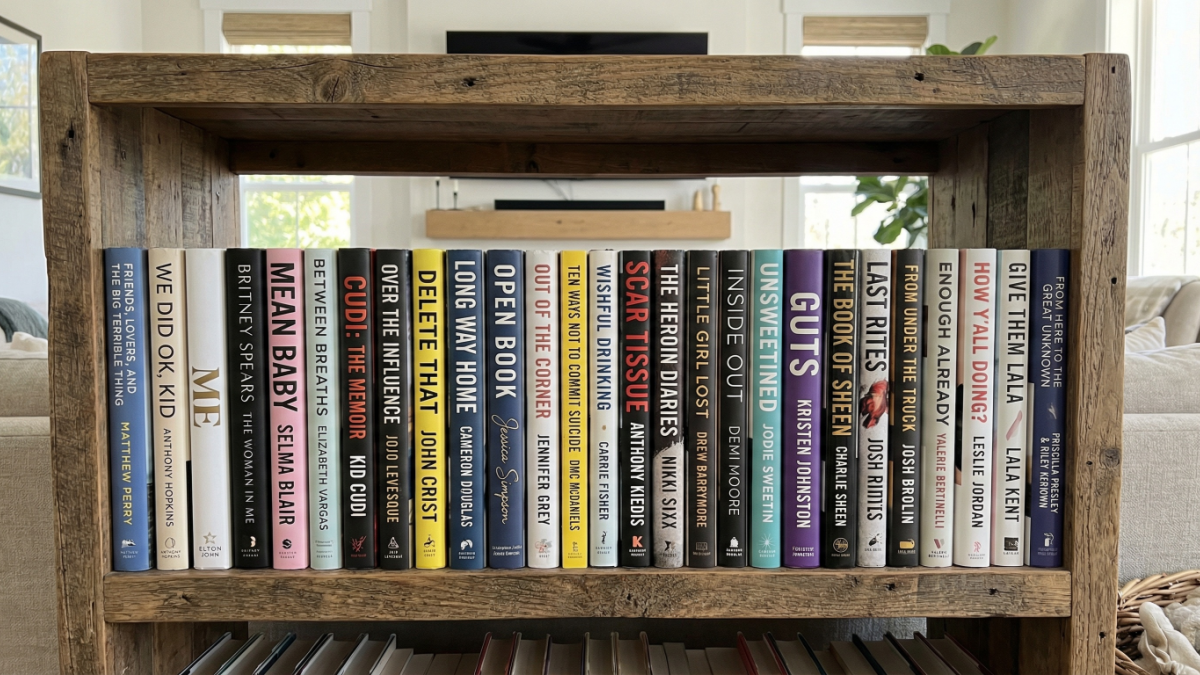
#QUITLIT: Sober Celebrity Memoirs Worth Reading – Books Written by People Who’ve Actually Been There
TSC LIBRARY: Welcome to The Sober Curator Library! This isn’t your average stack of books—we’re talking full-on story immersion, Audible binges, and reviews with personality. Browse our four go-to genres: #QUITLIT, Addiction Fiction, Self-Help, and NA Recipe Books. And if you’re collecting recovery reads like rare trading cards, check out our Amazon #QUITLIT list—Early Sobriety Survival: Books for Your First 90 Days.
📘 Submit a Book for our #QuitLit Library: Welcome to the largest culturally-driven sober book collection on the internet. Memoir, fiction, criticism, quit lit, anything that fits a Gen X or Millennial sober reader past initiation. Submit your book →
All the cool kids go to rehab…

Resources Are Available
If you or someone you know is experiencing difficulties surrounding alcoholism, addiction, or mental illness, please reach out and ask for help. People everywhere can and want to help; you just have to know where to look. And continue to look until you find what works for you. Click here for a list of regional and national resources.

Follow The Sober Curator on Facebook
How long has Lena Dunham been sober?
As of April 10, 2026, Lena Dunham has been sober for 8 years. Her sober date is April 10, 2018.
What did Lena Dunham struggle with?
Klonopin, a benzodiazepine prescribed for anxiety and OCD starting at age 12, escalated into long-term dependency. Pain medication prescribed after a 2018 hysterectomy compounded the problem. She also lives with chronic pain from Ehlers-Danlos syndrome and endometriosis.
What helped Lena Dunham get sober?
A 28-day cognitive-behavioral therapy program in Los Angeles in April 2018. She has also credited her family, ongoing therapy, and a long-term move to London with her husband, musician Luis Felber.
Has Lena Dunham relapsed?
She has not publicly disclosed any relapse. Her sobriety is continuous from April 10, 2018.
Does Lena Dunham talk publicly about sobriety?
Yes, regularly. Most recently in Famesick, on the Not Skinny but Not Fat podcast in July 2025, in CNN coverage, and in her annual Instagram posts on her sober anniversary.
What is Famesick about?
Famesick is Dunham’s second memoir, released April 14, 2026. It traces her rise to fame through the Girls era, her addiction to Klonopin and pain medication, her 2018 rehab stay, and the relationships that fractured during that period, including with Jack Antonoff, Adam Driver, and former best friend Jenni Konner.