


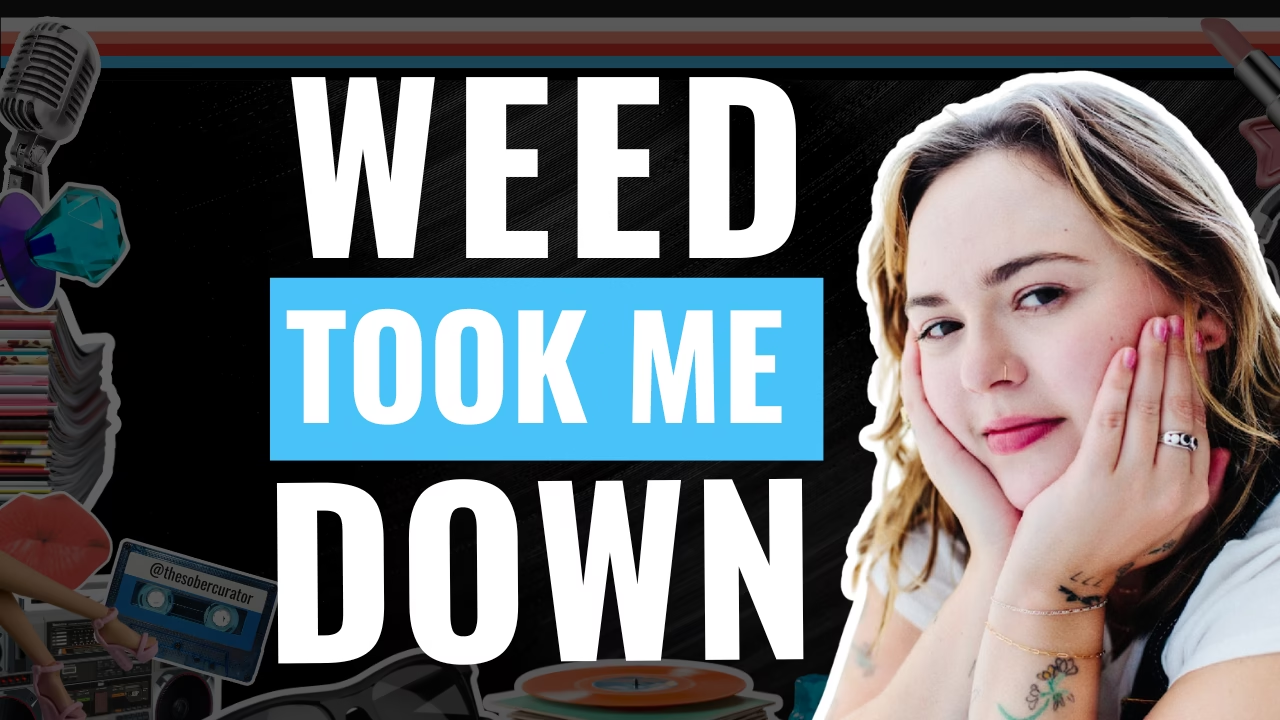

I knew Paulina Pinsky was my people about four seconds into our first conversation. By the time we recorded, I had confirmation: in the fourth grade, with the Los Angeles Ice Theater, she was cast as Miss Piggy on Ice.
Two wigs. A baseball helmet covered in foam. A mesh nose to see through. Her mom took the wigs to a wig store to get them curled.
She has a Miss Piggy tattoo. Her wedding cake topper was Miss Piggy and Kermit. Her first AOL handle was MIZ Piggy 111, because her mom misspelled it and it stuck for 20 years. In her words, she has “dedicated my will and my life over to the care of Miss Piggy.”
Step 3 people, you’re welcome.
I am, technically, Muppet royalty
I had to tell her. My mom’s cousin, Polly Smith, was one of Miss Piggy’s original costume designers at the Jim Henson workshop. Her name is in the credits of the old Muppet movies, and a Miss Piggy costume sketch lives in the Smithsonian’s collection. Ergo, I am a Muppet once removed.
Paulina said it made her want to cry. Tamar and I are now planning to take her to Astoria, Oregon, for a Goonies movie night in the actual Goonies house, because that’s what happens when you get on a Zoom with us.
We also both love Muppet Recovery on Instagram, which remains anonymous and would not give me an interview. I respect it. I will keep asking.
Her first higher power was Elvis
At eight, Paulina was obsessed with Elvis. Not the ’70s jumpsuit. The performer. She saw something divine in the way he lit up a room and understood, without the language for it yet, that the same thing lived in her.
So before every skating competition, she held her TCB necklace (the lightning bolt, Taking Care of Business), squeezed, rubbed her heart, and prayed: “Elvis, let me have the performance of a lifetime.”
“My first higher power was Elvis,” she told us.
I just appreciate it’s not a doorknob, personally.
She wore that necklace from the fourth grade for 11 years straight. The chain snapped when she was 21, right around when her drinking sped up, and she didn’t see it again for 15 years. The day before we recorded, she found it in a box from her childhood bedroom. She’s almost five years sober. I’ll leave that there.
As an adult in recovery, she watches Elvis differently. She credits Baz Luhrmann’s take on Elvis with showing both things at once: the man who could conjure something ineffable on stage, and what happened to that magic as the drugs took over.
Weed took her down
About 30 minutes in (on the recording it was closer to 45, we’re chatty), I asked Paulina why marijuana addiction is her lane. She’s writing about it for us, and it’s a topic we haven’t covered nearly enough.
“Weed took me down,” she said.
She smoked every day from the day she started. She was convinced it was medicine, because she’d been told it was natural and not addictive. Meanwhile, she was pulling on a high-THC vape so hard it sparked, and using a torch for dabs.
“I really feel like the public was lied to,” she said. She’s not mad at people who use. “I’m mad at the marijuana lobby who has spread misconceptions that keep us using in a misinformed way.”
Here’s the part I can’t stop thinking about. Paulina was functional. Jobs. A relationship. And every morning was the same loop: I want to smoke to write, I can’t write stoned, I want to smoke. “I’m stoned in the bathtub by 11, you know? And to me, that is addiction because I couldn’t get through the day without smoking.”
On potency, she’s not exaggerating by much. Federal testing of seized cannabis found average THC around 4% in 1995 and around 12% by 2014, and concentrates run far higher. That’s NIDA’s data, not a scare tactic.
Dependence or addiction? She says it doesn’t matter
Her first piece for us asks whether there’s a difference between weed dependence and addiction, and whether it matters. Her answer, on the podcast: look at the habit, not the label.
“If you can’t go into a social situation, if you can’t go to the grocery store, if you can’t sit alone without getting high, that is worth interrogating.”
I told her that what I see in the people I love who smoke every day isn’t what they’re losing. It’s what they’re not getting. The bigger job. The next chapter. She pushed back on my word choice (I said “lazy,” and I walked it back), and she was right. Her version is better: “marijuana addicts are incredibly bright people, but they resign themselves to a fate that is not what they think it is.”
Tamar brought the science. She interviewed neuroscientist Judith Grisel, author of Never Enough: The Neuroscience and Experience of Addiction, whose own drug was weed before she quit and went on to study addiction for a living. Paulina’s reaction: “I quit smoking weed and then I became a doctor in neuroscience? Like, that’s exactly what I’m saying.” She wants to review the book for her column. I want her to.
The question
Paulina’s not here to tell anyone to quit. She has a friend with no addiction history who noticed she was smoking too much, stopped, broke up with her boyfriend, moved out, and now has a thriving clowning career. (Paulina recently discovered she’s a clown too. Keep up.)
Her test is one question, and it works on anything: “Is it helping me or is it harming me? That’s it. And there doesn’t have to be judgment in that.”
50 going on 13
The longer I stay sober, the more I want the things I loved before I ever drank. I can’t walk past a Lego store. I have a sticker book album again. I want a Ms. Pac-Man in my dining room. I’m 50 going on 13, and I’ve never been happier about it.
Paulina gets it. She works The Artist’s Way over and over (she runs cohorts, grab the book here if you want to start on your own). In sobriety she came back to ice skating after 11 years. Above her desk: a photo of her in The Lion King on ice, an eight-year-old photo booth strip, a third grade Annie Oakley photo (her mom rented a Civil War rifle for it, and the school had opinions), and the photo strip from her wedding. Same girl every time.
“And I get to honor her, and I don’t have to pretend that she’s anybody different than who she is.”
Then she asked the question I want every sober-curious person reading this to sit with: “Why do you think you have to be high to be yourself?”
Where to find Paulina
Read her on Substack at Newly Sober and Process Over Product, follow @paulina_pinsky and @paulinaplease, and find her Artist’s Way cohorts and writing coaching at paulinapinsky.com. And find her here, at The Sober Curator, where she’s officially family. Come meet the rest of us in BACKSTAGE.
So tell me: what’s the thing you loved before you ever drank or used, and have you gone back to it yet?
The Sober Curator Podcast is available across all major platforms
👉Watch or listen to the show on Spotify
👉Listen to the show on Apple Podcasts

SPEAK OUT! SPEAK LOUD! Weed Dependence vs. Addiction: What’s the Difference—and Does It Matter?

SOBER POP CULTURE: Nostalgia, Memes, and Sobriety – How Muppet Recovery on Instagram Became a Beloved Gem

HAPPY EVERY HOUR: The Sober Curator Will Show You That Alcohol-Free Recipes are the Bees Knees! Featuring DRY Vanilla Botanical Bubbly
SOBER POP CULTURE at The Sober Curator is where mainstream trends meet the vibrant world of sobriety. We serve up a mix of movie, podcast, fashion, and book recommendations alongside alcohol-free cocktails, celebrity features, and pop culture buzz—all with a sober twist.
We’re here to shatter the “sobriety is boring” myth with a mash-up of 80s neon, 90s hip-hop edge, early 2000s bling, and today’s hottest trends. From celebrity shoutouts to red-carpet style inspo, this is where sober is as chic as it is fun. To the celebs using their platform for good—our Sober Pop Trucker hats are off to you!
Resources Are Available
If you or someone you know is experiencing difficulties surrounding alcoholism, addiction, or mental illness, please reach out and ask for help. People everywhere can and want to help; you just have to know where to look. And continue to look until you find what works for you. Click here for a list of regional and national resources.

Follow The Sober Curator on Pinterest
Is weed addictive?
Yes, it can be. Cannabis use disorder is a recognized diagnosis, and higher-potency products raise the risk. On The Sober Curator Podcast, writer Paulina Pinsky, almost five years sober, described smoking every day from the day she started while believing it was medicine: “I couldn’t get through the day without smoking.”
What’s the difference between weed dependence and addiction?
Paulina Pinsky’s view, from her Sober Curator article “Weed Dependence vs. Addiction,” is that the label matters less than the habit. If you can’t go into a social situation, go to the grocery store, or sit alone without getting high, she says that’s worth looking at, whatever you call it.
Is weed stronger than it used to be?
Yes. Federal testing of seized cannabis samples found average THC potency around 4% in 1995 and around 12% by 2014, according to data published through the National Institute on Drug Abuse. Concentrates such as dabs and vape oils are far stronger than flower.
How do I know if I’m smoking too much weed?
Paulina Pinsky’s one-question test: “Is it helping me or is it harming me?” She notes you don’t need a diagnosis or a 12-step program to ask it, and there doesn’t have to be judgment in the answer.
Can you be sober from weed if you still drink?
Paulina Pinsky says that in her own experience, weed and alcohol were linked: she realized after getting sober that she’d been drinking throughout, and that marijuana was moderating her drinking. She says people with a family history of addiction can “make anything a weapon.” Talk to a medical professional about your own situation.
Who is Paulina Pinsky?
Paulina Pinsky is a Los Angeles writer, writing coach, and Artist’s Way facilitator, and a contributor to The Sober Curator. She writes the Substack newsletters Newly Sober and Process Over Product and was a guest on Season 2 of The Sober Curator Podcast.
