


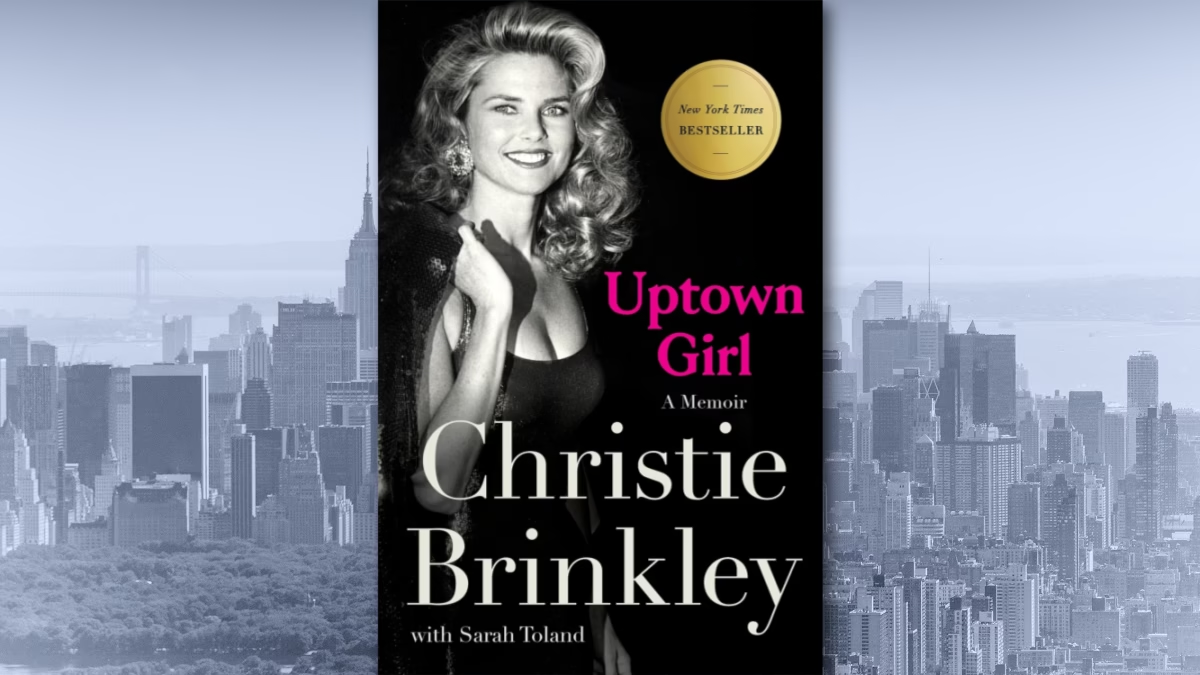

Let’s get something out of the way: I did not pick up Christie Brinkley’s memoir for the recovery content. I picked it up because I was a kid in the eighties and the “Uptown Girl” video was basically my first religion. The garage. The coveralls. That hair, which I tried to replicate with a curling iron and a can of Aqua Net and achieved something closer to a Pomeranian. I wanted the gossip, the runway stories, the Sinatra hotel room, the Vacation stuff. I wanted a beach read.
Reader, I got one. And then somewhere around the middle of it, the beach read turned around and looked me dead in the eye.
Because for those of us in recovery, there’s a genre of reading that isn’t fun so much as necessary — the story told from the other side of the bottle. We know our own side cold. The using, the excuses, the elaborate architecture of denial we built and lived in for years. What we don’t always let ourselves examine is what it was like to be married to that. To wake up next to it. To keep loving it after it stopped loving you back. Uptown Girl is that story, told by the most famous face of a generation, and the sentence she waited thirty years to put on paper is the one that stopped me in my tracks:
Booze was the other woman.
The setup
Everybody knows the video. What we didn’t know — what she kept quiet for decades — is what the marriage behind it actually ran on. Grand gestures on the good days, sure; the man wrote her a hit song and then put her in the video for it. But on the bad days there was a husband who would slip out of bed in the middle of the night and roll home at dawn, and a wife who learned to lie there and count the hours.
Brinkley describes doing everything a person can do from the wife’s chair — building the home, the body, the entire life into something he’d want to stay for. Saying I love you loud and often, as if volume could compete with a bottle. She is clear that she never wanted to leave. She’s equally clear that his drinking was bigger than the both of them, and that it was starting to look like he’d rather be with her — the other woman, the one that came in a glass — than with the actual Uptown Girl.
If you’ve ever sat in an Al-Anon room, you just heard forty people exhale at once.
The scenes that will get you
Brinkley has said the Joel chapters were the hardest to write, because she still cares about their friendship, and you can feel her wrestling with that loyalty on the page. What she lands on isn’t the big tabloid stuff. It’s the small, specific, stupid stuff — which, if you’ve lived with a drinker, you know is where the real damage lives.
There’s the night he stood at the stove eating spaghetti out of the pan, then turned on his own family and accused them of eating his dinner. There’s the hotel in Honolulu, where she confronted him about rumors of an affair and locked him out — and he pounded the front door, then went around back and pounded the patio glass, and finally put a chaise longue through it.
Here’s the part that makes it Quit Lit and not Page Six: what she did next. Scared, betrayed, furious — she went to the hotel guards, told them the door was an accident, and asked them not to report it. She didn’t want it to become a news story. She was protecting him. From consequences. While the glass was still on the floor.
I read that paragraph three times. Not because it shocked me, but because I’ve been that door. I have had people I loved sweep up the glass and tell the guards it was nothing. Brinkley just wrote the partner’s side of that transaction better than I’ve ever heard it said in a meeting, and she did it in about four sentences.

The Al-Anon lens: loving someone who’s already left
What makes this a recovery read and not a celebrity pile-on is that Brinkley never plays the victim and never plays the saint. She writes about the parade of psychiatrists, psychologists and doctors they tried. She calls drinking what it is — a disease — and talks about how badly she wanted a way to help him before the person she loved turned into a stranger at the bottom of a glass. She names the disease. She does not use it as an excuse for him, and she doesn’t use it as a weapon either.
And then she says the thing I keep coming back to: that if the drinking hadn’t been in the room, she thinks they were probably soulmates.
Sit with that if you did the drinking. Not “she left because I was a monster.” She left because the booze was, and it didn’t leave when she asked it to. For me, that reframe was worth the price of the book. It’s a lot easier to hate yourself for being a monster than it is to accept that you were a person somebody loved, who let something else drive.
The grace note
Here’s what I didn’t expect from a memoir with this much Aqua Net in it: a picture of amends. Joel has been open about his own rehab stays over the years and has said he stopped drinking entirely a few years back. And he gave Christie his blessing to tell all of it — the good, the bad, the flying furniture. Two people who once couldn’t be in the same hotel on a bad night, now friendly enough to let the truth go to print.
That’s not nothing. That’s the whole promise, actually — that we’ll come to know a new freedom and a new happiness, and that we won’t regret the past nor wish to shut the door on it. Or, in Billy’s case, throw a lounge chair through it.
The verdict
Is Uptown Girl a recovery memoir? Not by design. It’s a life story with a recovery story caught in the middle of it — which, if we’re honest, is how most of our people would tell theirs too. The Joel years are a fraction of the book, and if you come to it wanting a full reckoning with addiction, you’ll leave wanting more. Brinkley is a storyteller, not a clinician, and she’s generous with her ex in a way some readers will find frustrating.
But what’s here is honest, un-bitter and quietly instructive: a masterclass in how the partner of a drinker keeps the show running, keeps the secret, and keeps loving right up until loving isn’t enough. It’s also, and I cannot stress this enough, a fun read, and sometimes we need our medicine mixed into something that goes down easy.
For the sober, for the sober-curious, and for anyone who has ever been the other woman’s understudy: read Uptown Girl. Then call the person who stayed, or the person who couldn’t, and say the thing: Tell them that must have been so difficult. Tell them you see them. Tell them you support them.
Yeah, that’s right, you got to “Tell Her About It!”
#QUITLIT SOBEES SCORE: 4 out of 5

MOVIE NIGHT: Billy Joel’s Battle With Alcohol – A Review of “And So It Goes”
WALK YOUR TALK Because the best thing you can wear is clarity, confidence, and a killer sense of style.
WALK YOUR TALK is The Sober Curator’s style destination for those redefining what it means to live vibrantly alcohol-free. From runway-ready ensembles to effortless everyday glam, we celebrate confidence, clarity, and the joy of dressing boldly without the pre-funk or party drinks.
More than a fashion column, Walk Your Talk highlights curated finds from our #ADDTOCART section, spotlights sober-owned small businesses, and showcases unique merch that makes your alcohol-free journey unapologetically chic. We proudly partner with the Break Free Foundation, bringing sobriety’s brilliance to the runway during New York Fashion Week and beyond.
🛍️ Submit a Product for Review: NA beverages, sober-friendly tools, alcohol-free brands, apparel, and accessories built for the way our audience actually lives. Submit your product →

TSC LIBRARY: Welcome to The Sober Curator Library! This isn’t your average stack of books—we’re talking full-on story immersion, Audible binges, and reviews with personality. Browse our four go-to genres: #QUITLIT, Addiction Fiction, Self-Help, and NA Recipe Books. And if you’re collecting recovery reads like rare trading cards, check out our Amazon #QUITLIT list—Early Sobriety Survival: Books for Your First 90 Days.
📘 Submit a Book for our #QuitLit Library: Welcome to the largest culturally-driven sober book collection on the internet. Memoir, fiction, criticism, quit lit, anything that fits a Gen X or Millennial sober reader past initiation. Submit your book →
#QUITLIT: Sober Celebrity Memoirs Worth Reading: Books Written by People Who’ve Actually Been There
