



Recovery Without the Redemption Arc. Nobody wants to hear that the accident didn’t fix him.
That’s the version we’re trained to expect. A man loses the use of his legs, sees how fragile everything is, and gets sober out of gratitude. Clean living as a thank-you note to fate. Roll credits. It’s a tidy arc, and it’s also, according to John Callahan’s own memoir, mostly a lie. He spent 1972 to 1978 — six years — drinking himself half to death from a wheelchair before he ever got sober. The crash didn’t save him. It just changed what he was drinking through.
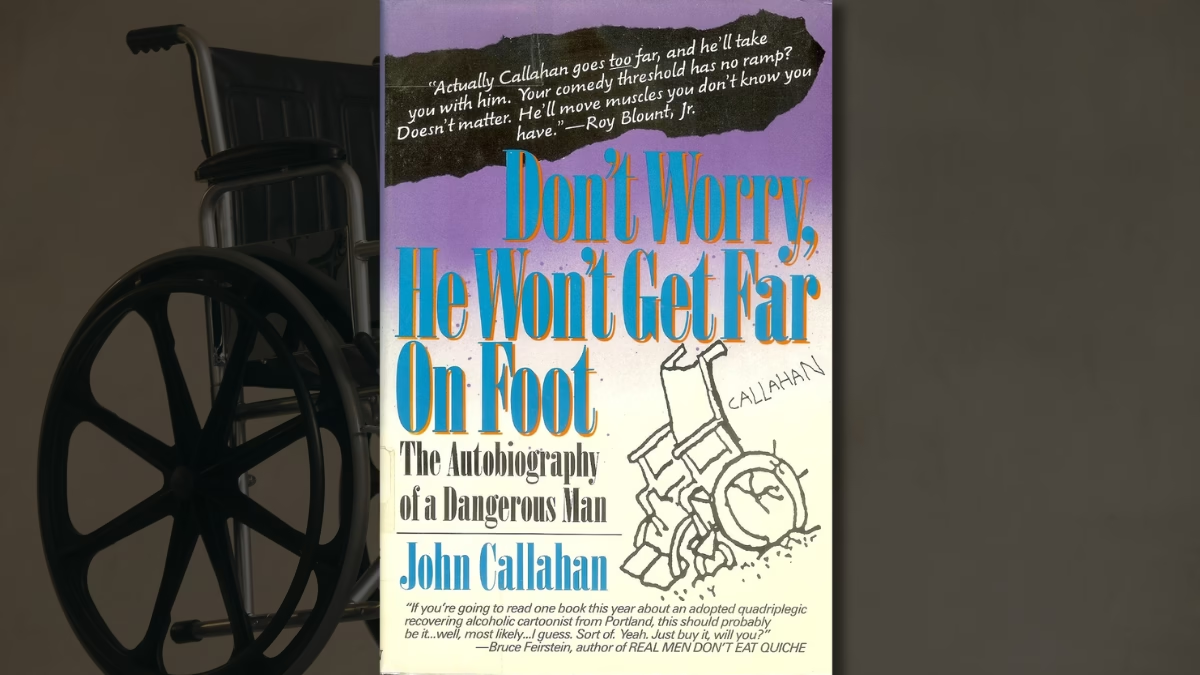
Don’t Worry, He Won’t Get Far on Foot is Callahan’s 1989 memoir, co-written with David Kelly, and it’s one of the strangest, funniest, most quietly brutal recovery books you’ll come across. Callahan was a quadriplegic cartoonist — the guy behind those cartoons so dark and un-PC that entire advocacy groups organized letter-writing campaigns against him. He kept the hate mail. Filed it. Some of it he framed. That detail alone tells you what kind of book this is.
The Myth of the Single Rock Bottom
Here’s the misunderstanding baked into almost every addiction story Hollywood has ever told: that catastrophe is the cure. Get hit hard enough by consequences, and the drinking stops. It’s a satisfying idea because it makes addiction “make sense” — cause, effect, lesson learned. Except that’s not how it works, and Callahan is living, snarling proof.
At twenty-one, he was a passenger in a Volkswagen driven by a guy he’d met hours earlier at a party in Long Beach. Both of them were wrecked — Callahan had been drinking heavily since he was twelve. The driver mistook a utility pole for an off-ramp and hit it at ninety miles an hour. The car folded like a soda can. Callahan’s spine was severed. He woke up a quadriplegic.
And then he kept drinking. For years. Friends wheeled him to bars. He learned to hold a cup in the crook of his arm. The wheelchair didn’t stop the addiction — if anything, it gave the drinking a fresh, bitter “why”. Pain, humiliation, dependency on caretakers for basic dignity. Alcohol doesn’t care how good your reasons are. It just wants back in.
This is the part that inspirational-story culture skips, because it’s inconvenient. Trauma doesn’t burn addiction out of a person. Sometimes it just hands addiction a better excuse.
Why This Keeps Showing Up in Recovery
If you’ve spent any time in the rooms, you already know someone living a version of this. The guy who lost his marriage and still wasn’t done. The woman who got the diagnosis, sat in the hospital parking lot, and drove straight to the liquor store anyway. From the outside, it looks like willful blindness. From the inside, it’s something closer to physics — the disease doesn’t negotiate with your circumstances, no matter how dramatic they get.
What makes this dangerous is the shame loop it creates. If tragedy is supposed to be the wake-up call, and the wake-up call doesn’t come, a person starts to believe something’s uniquely broken in *them*. Not the disease — them. Callahan writes about this period with a kind of scorched honesty that doesn’t flatter him. He wasn’t a tragic hero biding his time until sobriety. He was a drunk in a wheelchair, and the wheelchair didn’t make him special. It just made the stakes higher.
What Was Actually Still His
Callahan couldn’t feel his hands. He drew anyway, wedging a pen between both fists and moving his whole arm to make a single line. He didn’t get his body back. What he got, eventually, was a fierce, almost aggressive claim on the one thing that stayed his: what he found funny, what he was willing to say out loud, what he refused to sand down for anyone’s comfort. That’s not resilience-poster material. It’s closer to sovereignty over the small remaining territory that was still his to run.
And there’s a Step 1 parallel sitting right next to it, close enough to touch. *We admitted we were powerless.* Callahan had about as literal a lesson in powerlessness as a human being can get, and it still took him six more years to admit the “other” powerlessness — the one over alcohol — because that admission is a different animal entirely. Physical limits you can see. Physical limits announce themselves. Addiction lies to you in your own voice.
There’s a psychological wrinkle in here too, the mind adapts to almost anything, including catastrophe, faster than we expect. Researchers call it hedonic adaptation — the return to a baseline mood even after something enormous happens, good or bad. It sounds cold written out like that, but it’s actually the reason people survive things that should flatten them. The cost is that adaptation doesn’t discriminate. It’ll normalize a wheelchair. It’ll also normalize a fifth of vodka a day from that wheelchair, if you let it, because the brain isn’t grading your circumstances for how much they *should* have taught you. It’s just adjusting. Quietly, automatically, with no interest in whether the new normal is one that’s going to kill you.

The Part That Might Make People Uncomfortable
Some readers, early on my be taken aback by Callahan’s cartoons, that can offensive to a lot of people — jokes about disability, addiction, blindness, race, all rendered in a style that refuses to soften anything. Some readers find the whole project morally exhausting before they even get to the recovery parts. Why should I root for a guy who’s punching down?
Although perhaps offensive, the material is worth sticking through as it is real character development. Callahan wasn’t punching from a safe distance. He was drawing his own condition, over and over, with the same unblinking cruelty he aimed everywhere else. He didn’t exempt himself. There’s a difference — not a total one, but a real one — between mockery that punches down and mockery that refuses to treat “anyone”, including its author, as too fragile to laugh at. You don’t have to find it funny. But it’s not the same move as a comedian who’s never been in the room he’s joking about.
And underneath the discomfort, there’s a genuinely useful recovery idea: humor as defiance instead of denial. AA culture is full of gallows humor for a reason — not because pain isn’t serious, but because taking yourself with total, humorless solemnity is its own trap. Ask anyone who’s sat through a meeting where someone finally laughs about the thing that nearly killed them. That laugh isn’t minimizing. It’s evidence the thing no longer owns them completely.
There’s a version of “using humor as a coping tool” that changes into something else. Deflection wearing a comedian’s mask. Plenty of people in recovery have learned to joke their way clean out of an actual feeling, and a room will let them do it for years before anyone names it. Callahan’s own book doesn’t fully resolve this tension, and neither should this review pretend to. Somewhere between “laughing at the unbearable thing” and “laughing so you never have to feel the unbearable thing” is a line that moves depending on the day, the person, and how honest they’re willing to be with themselves about which one they’re doing. That’s not a flaw in the book. It’s just the truth being messier than a tidy takeaway wants it to be.
No Bow on This One
Callahan didn’t die redeemed in some final, wrapped-up sense. He died in 2010, decades sober, still drawing, still infuriating people, still — by most accounts — a genuinely difficult person in some rooms and a genuinely loyal one in others. The book doesn’t pretend sobriety turned him into someone easy. It turned him into someone “present”, which is a smaller claim and a truer one.
If you’re waiting for your own catastrophe to arrange itself into a lesson — don’t. Read this book instead. Or don’t even do that. Just take the one part of it that’s a core life lesson: the accident doesn’t do the work. You do, on some Tuesday nobody’s going to make a movie about.
That’s more than three decades of proof, drawn one line at a time, with a pen his hands could barely control.
Sober one day, then another. That’s the whole method — Callahan’s, and everyone’s who’s ever actually stayed clean.
#QUITLIT Sobees Score: 4 out of 5


MOVIE NIGHT: ‘Don’t Worry, He Won’t Get Far on Foot’ Offers An Authentic Look At Recovery

TSC LIBRARY: Welcome to The Sober Curator Library! This isn’t your average stack of books—we’re talking full-on story immersion, Audible binges, and reviews with personality. Browse our four go-to genres: #QUITLIT, Addiction Fiction, Self-Help, and NA Recipe Books. And if you’re collecting recovery reads like rare trading cards, check out our Amazon #QUITLIT list—Early Sobriety Survival: Books for Your First 90 Days.
📘 Submit a Book for our #QuitLit Library: Welcome to the largest culturally-driven sober book collection on the internet. Memoir, fiction, criticism, quit lit, anything that fits a Gen X or Millennial sober reader past initiation. Submit your book →

MOVIE NIGHT WITH THE SOBER CURATOR: is your go-to guide for films and documentaries that intricately weave addiction, recovery, and mental health into powerful storytelling. Think of us as your bee-zy movie critics, curating a hive of must-watch titles that inspire, educate, and spark conversation.
Our review archives are neatly organized into Drama, Dramedy, and Documentary categories, making it easy to find your next captivating watch. Whether you’re in the mood for a heartfelt indie, a laugh-through-the-tears comedy, or a thought-provoking doc, we’ve got you covered.
You’ve got mail from The Sober Curator
Resources Are Available
If you or someone you know is experiencing difficulties surrounding alcoholism, addiction, or mental illness, please reach out and ask for help. People everywhere can and want to help; you just have to know where to look. And continue to look until you find what works for you. Click here for a list of regional and national resources.

Subscribe to The Sober Curator on YouTube
What is Don’t Worry, He Won’t Get Far on Foot about?
The memoir recounts cartoonist John Callahan’s experiences with alcoholism, the 1972 crash that left him quadriplegic, his continued drinking and his eventual recovery. It also explores how he built a career from cartoons known for their dark, controversial humor.
Is Don’t Worry, He Won’t Get Far on Foot a true story?
Yes. The book is John Callahan’s memoir, written with David Kelly. It was first published in 1989 and later inspired the 2018 film directed by Gus Van Sant and starring Joaquin Phoenix.
When did John Callahan get sober?
Callahan stopped drinking in 1978, approximately six years after the crash that severed his spine. He remained sober until his death in 2010.
Is the book different from the movie?
Yes. The 2018 film is based on Callahan’s memoir but shapes his life into a cinematic narrative. The book provides Callahan’s own abrasive, darkly humorous account of alcoholism, disability, recovery and becoming a cartoonist.
Why were John Callahan’s cartoons controversial?
Callahan used deliberately provocative humor to address disability, addiction, race, religion and other subjects. His work attracted both praise and criticism because he refused to treat himself—or nearly anyone else—as exempt from satire.
