



Hi, everyone! Welcome to the November issue of my Financial Sobriety column. I’m Greg, a former financial adviser, author of the forthcoming book “12 Steps to Financial Sobriety” and leader of The Sober Money Club financial support group. I’m so glad you’re here.
Let’s dig in.
Dear Greg,
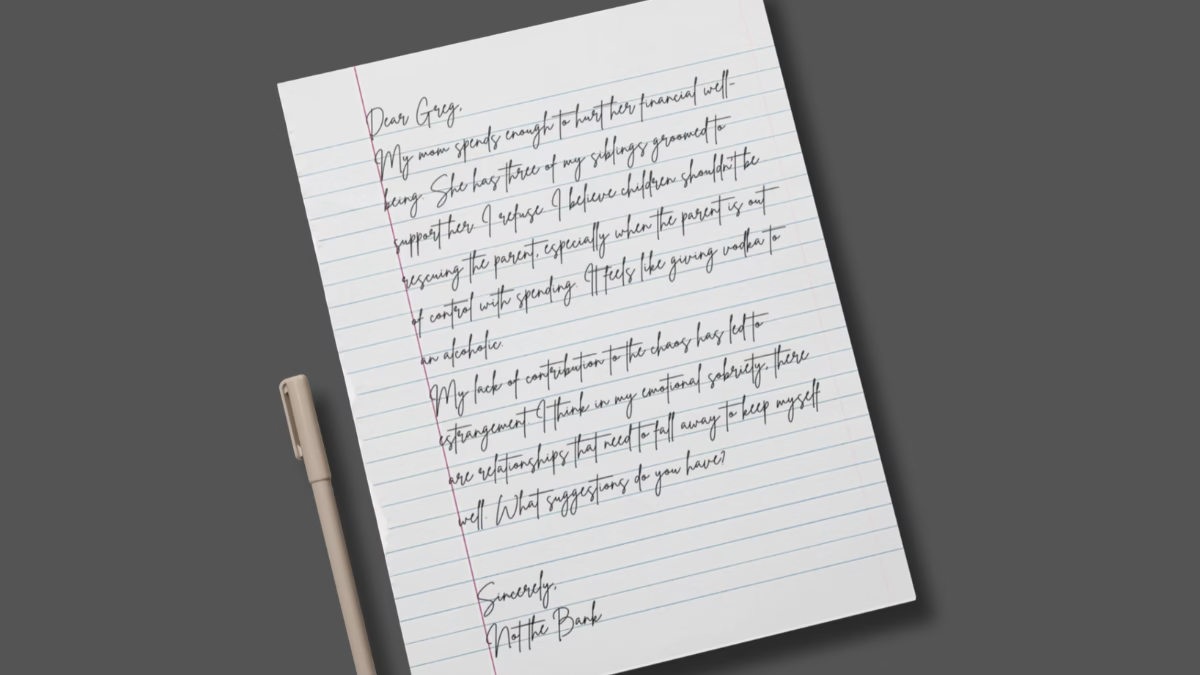
My mom spends enough to hurt her financial well-being. She has three of my siblings groomed to support her. I refuse. I believe children shouldn’t be rescuing the parent, especially when the parent is out of control with spending. It feels like giving vodka to an alcoholic.
My lack of contribution to the chaos has led to estrangement. I think in my emotional sobriety, there are relationships that need to fall away to keep myself well. What suggestions do you have?
Sincerely,
Not the Bank
Hey, Not the Bank,
First, the vodka line. You’re not wrong. Most of us in recovery have been the alcoholic in that sentence or the person pouring. Either way, we know how it ends.
You’re not being cruel
Money handed to someone in a spending spiral just funds the next lap, or the next hit, until they need another. And another.
There’s a name for what you may be seeing: financial enabling. Brad Klontz and Sonya Britt found it’s one of several disordered money behaviors that can be predicted by the beliefs we absorb about money growing up. It sits in the same family as compulsive buying and problem gambling. It’s a pattern, not a personality flaw. And patterns don’t break while someone keeps paying for them.
I can’t diagnose your mom from a letter. But you should know you’re not imagining things. A Stanford study published in 2006 estimated that 5.8% of U.S. adults experienced compulsive buying. Whether or not that’s her story, the three Cs of Al-Anon still apply. You didn’t cause it. You can’t control it. You can’t cure it.
Boundary or punishment?
Here’s the gut check I want you to run. A boundary protects you. A punishment is designed to change her.
One says, “I won’t fund this.” The other says, “I won’t fund this until you learn your lesson.” The first one puts the focus on what you can control.
So ask yourself honestly: Is my “no” about my wellness or about winning? If it’s the first, you’re on solid ground. If some of it is the second, that’s not a moral failure. It’s a resentment, and you know what we do with those. We write them down.
Underneath most resentments is fear. The Sober Curator’s piece on what codependency teaches us about choosing yourself makes the same point: Fear is usually what’s driving the bus.
Say no to the money, not the person
Saying no to the checkbook doesn’t have to mean saying no to your mom. Unless she’s made money the price of admission.
So decide what is on the table. A phone call. A birthday dinner. A ride to a free appointment with a nonprofit credit counselor. Then say it once, plainly:
“Mom, I love you. I’m not going to give you money. I’m happy to [fill in your yes].”
Don’t defend it. Don’t explain it three times. In Al-Anon, they call this detaching with love.
About your siblings
You won’t convert them. Don’t try. They’re making their own choices, maybe out of guilt, fear or a role they were handed as kids. Their yes isn’t a verdict on your no.
And you are far from alone. In a national survey by Cornell sociologist Karl Pillemer, 27% of U.S. adults surveyed reported being estranged from a family member. His research also notes that some estrangements are necessary and healthy.
Letting relationships fall away
You asked whether some relationships need to fall away to keep yourself well. Sometimes, yes.
But notice something. From your letter, the distance came as a consequence of your boundary. It wasn’t a door you slammed. You don’t have to lock the door. You can just stop paying the cover charge to get in.
Give yourself room to grieve, too. Losing the mom you hoped for is a real loss, even while she’s still here. Take it to your sponsor, your therapist or your home group. Dr. Sarah Michaud’s “Co-Crazy” is a good read on holding boundaries without losing yourself. And The Sober Curator’s mental health section has more support resources.
What I suggest
Keep the boundary. Keep it kind. Keep your side of the street clean. And let her consequences be hers.
That’s not abandonment. That’s respect.
Until next time,
Greg
Read last month’s column: Is 51 Too Old to Make Financial Changes?
Preorder my book, “12 Steps to Financial Sobriety,” and join my weekly financial support group.
LIFESTYLE: Financial Sobriety – A New Column About Taking Money One Day at a Time, Too
ENTERTAINMENT: The 20 Best Sobriety Substacks to Follow in 2026

SOBER LIFESTYLE: Sober lifestyle is about more than not drinking—it’s about how you actually live.
From fashion and identity to advice, creativity, relationships, sober dating ideas, and everyday routines, this page brings together The Sober Curator’s lifestyle coverage for people building a life that feels good without alcohol at the center.
Sometimes life gets really shitty. Resources are available. Please use them if you need them.
If you or someone you know is experiencing difficulties surrounding alcoholism, addiction, or mental illness, please reach out and ask for help. People everywhere can and want to help; you just have to know where to look. And continue to look until you find what works for you. Click here for a list of regional and national resources.
If your life or someone else’s is in imminent danger, please call 911. If you are in crisis and need immediate help, please call: 988.

