
It is 3:30 in the morning on day four of the Munga, and Simon Dyson is eating a cold cheeseburger wrapped in foil in a farmyard in the middle of the Karoo. The two brothers who own the place handed it to him. He will tell you it was the greatest cheeseburger of his life, and he has lived in three countries, so he has a sample size.
They let him sleep two hours in a tent in the yard. At five, they walked him back to the trail, told him to look up, and left. The Milky Way was sitting directly over his head. He stood in the dirt for fifteen minutes until the brothers came back because the GPS tracker showed him stalled and they wanted to make sure he wasn’t dead.
He wasn’t dead. That would come up later in the day. At 5 a.m. he was a sober engineer from Plymouth, Michigan, staring at a sky he never would have seen from the bottom of a bottle.
The engineer who tried to fix his son
Simon grew up in Coventry, in the English Midlands, in a family of engineers, so at 18 he assumed he had one option and took it. Ford sent him to Germany, then Spain. On February 16, 2000, he moved to the United States for what was supposed to be two years.
His twins were born on the Fourth of July, 2002. Billy was born second, with complications in the birth canal that cut off his oxygen long enough to cause extensive damage to his frontal lobes. Seizure disorder. Nonverbal. Billy has cerebral palsy and is on the autism spectrum.
“It’s supposed to be a day of celebration,” Simon says. “A day of independence. But Billy became very, very, very dependent.”
So the engineer did what engineers do. He threw everything at the problem: speech therapy, occupational therapy, every specialist he could find. When that didn’t fix it, he worked. Relentlessly. His stated goal, and he says it without flinching now, was to make enough money to buy his family’s happiness.
That didn’t work either. Neither did the half marathons, marathons, half Ironmans, and full Ironmans that followed. “I wanted to feel worthy. And I also wanted to feel pain.” Every finish line came with a medal. Every medal went into a shoebox in the corner of his closet. The shoebox stayed in the corner. He never looked at it.
“And when none of that worked,” he says, “I turned to my old friend. Alcohol.”
He was, by his own account, really good at it. Every retired professional drinker reading this just nodded.
He went to meet CEOs. He met God instead.
In 2022, Simon saw a LinkedIn post about the Purpose Summit, a leadership conference at Notre Dame. What he registered was “CEOs and CFOs.” He booked it as a networking play, one more lever toward the money that would finally fix everything.
On day two, a man named Roger Norberg asked him why he was there. Simon could not bring himself to say “to meet CEOs and CFOs,” so he said, “I don’t know.” Roger put a hand on his shoulder and asked if he could pray for him. Out loud. In public. Simon spent the entire prayer checking whether anyone was watching. The next morning he lit a candle at the campus grotto, started crying, and left before anyone could see.
Then he sat in a room of roughly 700 executives and listened to Nick Vujicic, the Australian-born speaker who was born without arms or legs, describe a school janitor who kept insisting he had a story worth telling. Nick kept saying he didn’t. Until he did. Then Nick looked out at the room and said there was one person in the audience with a burning ember inside them, and that person knew who they were.
“I felt as if Nicholas and I were the only two people in that whole room,” Simon says.
He skipped the line, checked out, and walked into the lobby just as Nick was being wheeled in. Simon knelt on the floor and said, “I’m that guy.” Nick rested his head on Simon’s head, because that is how a man with no arms hugs you, and asked if he wanted prayer. This time Simon said yes.
He drove home to Michigan in silence. The next day he told his brother James, a pastor in England, everything. James started laughing. “We’ve been praying that you would meet somebody far more significant than CEOs and CFOs.”
After Notre Dame, it got darker
This is where a lesser profile would fade to a montage. In the month after Notre Dame, Simon’s drinking went to levels he did not know he was capable of. His phrase: “the bottom of the bottom of the bottom.”
When there was nothing left, he woke up on a Sunday, picked a church at random, and showed up late so he could sit in the back and bolt at the first sign of trouble. A greeter took his hand and walked him to a single chair at the very front. He went back for three weeks.
What he found there, he is careful to say, is not the faith you might be assuming. “I found faith in myself. And I found belief in me.”
Then he went to his doctor. You can lie to yourself, your friends, your family, and your physician. You cannot lie to a liver panel. His enzymes said he was dying.
He stopped drinking on July 22, 2023.
He quit his job on January 1st and signed up for the hardest race on earth
On January 1, 2024, Simon quit his corporate job. When a friend in the UK was diagnosed with motor neurone disease, what Americans call ALS, and started the Matt Gallagher Foundation to get equipment to other patients, Simon wanted to do something for it. It had to be hard.
So he signed up for the Munga: roughly 1,000 kilometers of nonstop mountain biking from Bloemfontein across the Karoo desert, five days to finish, sleep optional. It bills itself as the toughest race on earth. Simon would argue second toughest, behind receiving a terminal diagnosis.
He trained for 18 months, rode 8,000 miles, and started the race the Wednesday before Thanksgiving 2025. Twenty hours a day. Sleeping on floors. When a storm hit on day two, a farmer in a pickup appeared out of nowhere, shouted “follow me,” and his wife fed Simon, made him a bed, and woke him at 10 p.m. when the weather cleared. That became the pattern. Farmers, in the middle of nowhere, taking in a filthy stranger.
On day four, after the cheeseburger and the Milky Way, his heart rate spiked and he got violently ill. He stripped down to his bike shoes and sat in the dirt convinced he was going to die. A race truck came by, handed him something mixed with Powerade, and talked to him for an hour. Then told him he had two hours to make the next checkpoint.
He rode like he’d never ridden.
He hit a rock. Went airborne. Landed on his head in the dirt.
He lay there for a moment. Then he smiled. And he said out loud, to no one, to everyone, to himself: “It’s gonna be okay, Simon.”
He duct-taped the sole back onto his shoe, straightened his handlebars, and checked in with two seconds to spare. The owner of the nature reserve walked up to him. “Simon, we’ve been following you,” he said. “You’ve already won.”
Simon walked into the reserve, watched springbok and impala bounding around, and cried.
852 kilometers
The next section drops 4,000 feet into the Tankwa basin, where it hits 125 degrees and nothing lives. Simon looked at it and knew. He stopped at kilometer 852, sat in the dirt, and waited for the pickup. The Munga finishes at the Doolhof wine estate in Wellington. The finish line was a wine estate. The win was already behind him.
It took nine hours in that truck to reach the finish line.
Somewhere in those nine hours, he decided what to do with the rest of his life.
“I’m gonna buy a farm. And I’m gonna call it Billy’s Farm of Hopes and Dreams.”
The name is not cute. “As a caregiver to a special needs child, there are two things I know have happened throughout my life,” he says. “You lose hope. And you stop dreaming.”
Donkey School
Billy’s Farm of Hopes and Dreams is now an IRS-approved 501©(3), and anyone who has filed a Form 1023 knows that letter is a trophy. The farm will sit in southern Michigan. Chickens, bees, donkeys. The eggs and honey get given away. No entry fee. “This is not a zoo.”
Every Friday he volunteers at a sanctuary with 150 donkeys to learn farming, because, in his words, he doesn’t know anything about anything. He calls it donkey school. He leaves on Fridays, he says, “so alive.”
The clock is real. Billy ages out of school at 26, in two years, and for an adult with his level of disability, Simon says, the system’s answer is a group home and a social worker every six months. His answer is: not on my watch. His five-year picture has five houses on the farm, adults with special needs collecting eggs every morning, and caregivers for the caregivers, so a parent can walk a donkey to a tree, sit, and cry into its fur if that’s what the day requires.
“Caregivers,” he says, “just want to be seen.”
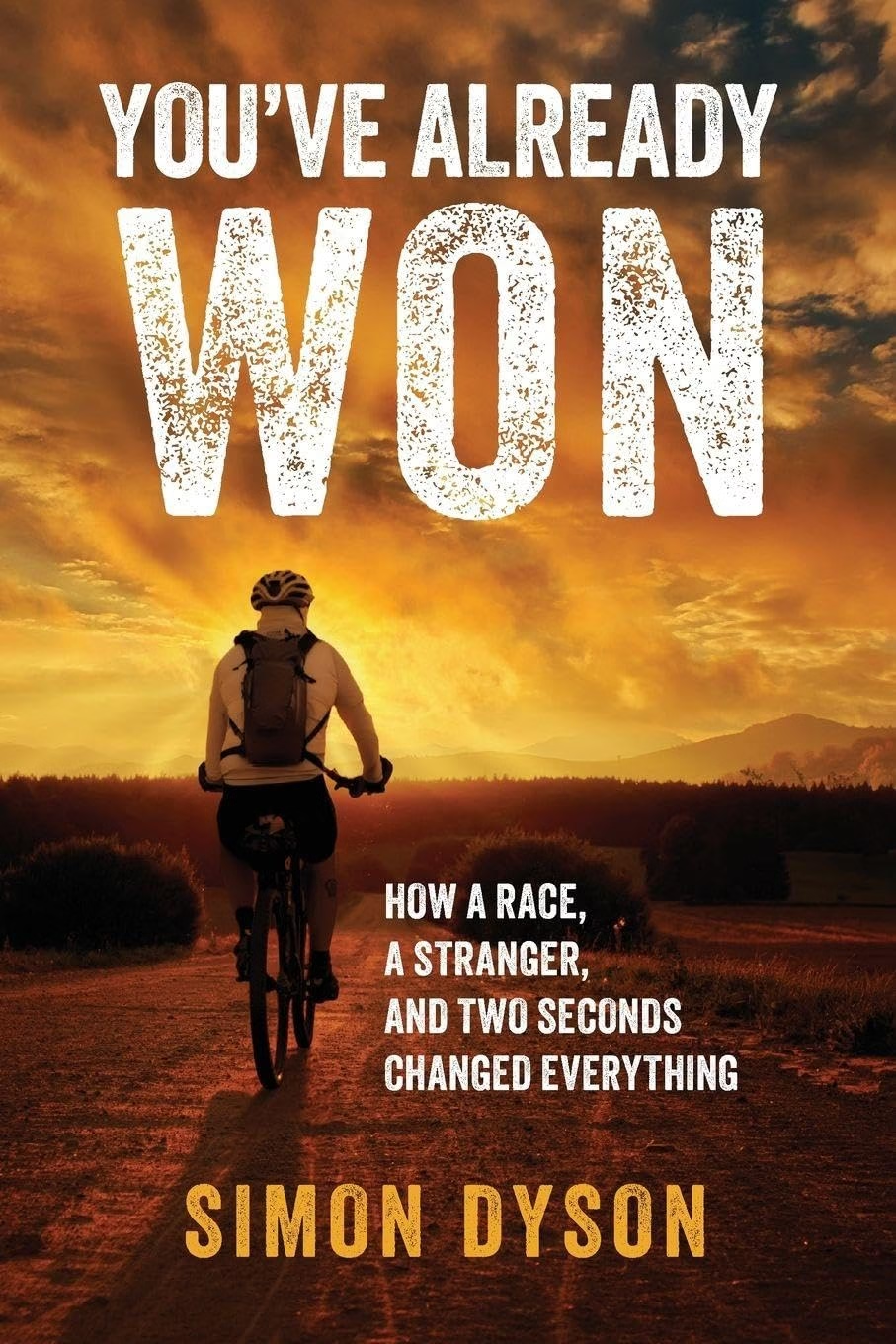
His memoir, You’ve Already Won, came out in July 2026. Every penny of net proceeds goes to the farm. Five years ago he was chasing wealth because wealth buys things and things buy happiness. “And more bought me nothing.”
Now? “I feel like I’m the richest person I know. And I’ve absolutely got the least.”
Ask him where he was five years ago and you get a man throwing medals in a shoebox. Ask him where he’ll be in five and you get donkeys, eggs, and a house full of people who are not going anywhere. That is not a recovery story. That is what the plot looks like after the recovery story ends, which has always been the only part worth reading.

SOBER SPOTLIGHT at The Sober Curator shines a light on extraordinary individuals making a positive impact in the recovery community. From advocates and authors to entrepreneurs and everyday heroes, these stories celebrate the people who inspire change, give back, and lead by example in sobriety.
Know someone whose story deserves to be told? 🌟 Pitch a Sober Spotlight Profile features for sober people who are doing, building, or making something specific. The bar is what you have done, not the fact that you got sober. Submit a spotlight pitch →
TSC LIBRARY: Welcome to The Sober Curator Library! This isn’t your average stack of books—we’re talking full-on story immersion, Audible binges, and reviews with personality. Browse our four go-to genres: #QUITLIT, Addiction Fiction, Self-Help, and NA Recipe Books. And if you’re collecting recovery reads like rare trading cards, check out our Amazon #QUITLIT list—Early Sobriety Survival: Books for Your First 90 Days.
📘 Submit a Book for our #QuitLit Library: Welcome to the largest culturally-driven sober book collection on the internet. Memoir, fiction, criticism, quit lit, anything that fits a Gen X or Millennial sober reader past initiation. Submit your book →

Recovery isn’t the end of the story.
Recovery has been framed as survival. Staying sober as maintenance.
We’re interested in something else.
Not just getting through life — but actually engaging with it.
Identity.
Culture.
Celebration.
Taste.
Expansion.
This is the room where the conversation finally aligns with who you’ve become — and where you’re going next. LEARN MORE AND JOIN TODAY →
You’ve got mail from The Sober Curator

Resources Are Available
If you or someone you know is experiencing difficulties surrounding alcoholism, addiction, or mental illness, please reach out and ask for help. People everywhere can and want to help; you just have to know where to look. And continue to look until you find what works for you. Click here for a list of regional and national resources.

Subscribe to The Sober Curator on YouTube
Who is Simon Dyson? Simon Dyson is a British-born engineer, full-time caregiver to his son Billy, and author of the 2026 memoir You’ve Already Won. He got sober on July 22, 2023, and founded Billy’s Farm of Hopes and Dreams, a 501(c)(3) farm sanctuary planned for southern Michigan.
What is Billy’s Farm of Hopes and Dreams? Billy’s Farm of Hopes and Dreams is an IRS-approved nonprofit farm being built in southern Michigan for adults with special needs and the caregivers who support them. The plan includes donkeys, chickens, bees, respite for caregivers, and no entry fee. Net proceeds from You’ve Already Won fund the farm.
What is the Munga? The Munga is a nonstop, semi-supported mountain bike race of roughly 1,000 kilometers across South Africa’s Karoo desert, from Bloemfontein to Wellington, with a five-day cutoff. It is widely billed as one of the toughest endurance races in the world. Simon Dyson rode 852 kilometers of the 2025 edition before withdrawing.
Is You’ve Already Won a sobriety memoir? Yes. You’ve Already Won covers Simon Dyson’s drinking as a response to caregiver burnout, his sobriety date of July 22, 2023, and the endurance race that led him to found Billy’s Farm of Hopes and Dreams. It was published July 11, 2026.