


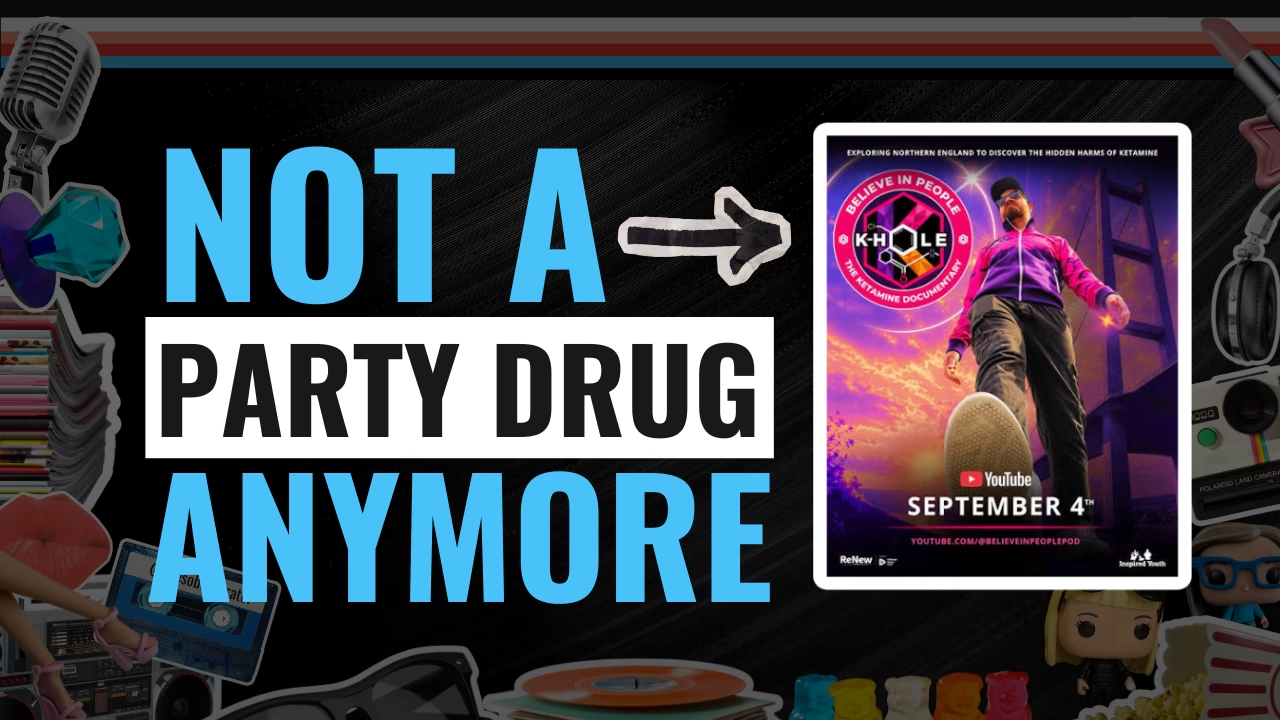

“They’ve gone from experiencing that supernova of pleasure to a supernova of pain, and now they’re trapped in that cycle.”
Matt Butler
I met Matt Butler a little over a year ago when I was interviewed for the award-winning podcast Believe in People. We had a great interview, and I left with a lot of respect for how he conducts an interview. I felt like I was sitting and talking to a friend, not being interviewed for a podcast. Matt has worked in the substance misuse field for over ten years. As the Service User Involvement Lead for the Believe in People Podcast, he is dedicated to amplifying the voices of service users and tackling the stigma they face. After I watched the documentary: K-Hole: The Hidden Harms of Ketamine, I wanted to sit on the other side and interview him, so he could tell the world about this video, to tell his part of the story.
You can watch our interview here.
The team at Believe in People decided to make K-Hole, because the topic of ketamine kept coming up in stories on their podcast. (Big shout out to Robbie and the whole team at Believe in People) They wanted to do a deep dive on the topic, not just a one-off podcast. “Ketamine has always kind of sat on the fringes, shielded by its rave-scene reputation as a harmless party drug,” Matt explained. A podcast episode could only share one person’s story, and he wanted a more “well-rounded perspective” so they made the documentary interviewing three people with lived experience, plus families and clinicians. Matt wanted to avoid scare tactics, “I’m not saying to the young people, stop using ketamine.” This documentary is hopefully going to share information, not scare people. We especially want to educate the professionals. “There is not enough information out there and many professionals don’t know the right questions to ask.”
Making this documentary changed Matt. He went into it with very little knowledge about ketamine, but learned a lot. Matt explained:
I think the shocking thing, really, for me was seeing how many young people this was affecting. Over the last decade, ketamine use among 16 – 24 year olds has increased almost five-fold. In the UK, we have a thing that we call ‘a bag for life’. You know, when you go to the supermarket, instead of getting a plastic bag every time, you’ve got ‘a bag for life’, a cloth one that you take with you to the store, you know for environmental sustainability. Well, there was a ketamine campaign called ‘A Bag for Life’, and that was related to people having to use stoma bags, because their bladders were so shredded. I had a couple of volunteers who’d come in that had these bags, and they were in their early 20s, and I was like, so is this irreversible? Can they not do something? And they’d say, nope, this is for life now.
On the day he filmed Amber on Morecambe Beach, she had nearly two years clean, but she explained that the big problems do not go away. “She kept disappearing to the toilet often, and one time came back in a complete change of clothes. Off camera, she told me she has to wear an adult nappy now because of her destroyed bladder. She is waiting for reconstructive bladder surgery, but says it’s just something that I’ve accepted as part of my life now.”
Another conversation that impacted Matt was with Finley. Finley justified his use with “it can’t be that bad, because doctors use it.” Matt explained that: “Pharmaceutical-grade ketamine and street ketamine are not the same. They’ve got the same name, but they’re not the same substance, not even close.” I asked Matt
what people most underestimate about using ketamine? He said it was partly the speed; he has met users with bladder damage after only three months of use. And also, partly who it hits: “These people weren’t people that had come from traumatic backgrounds, it’s not the usual trauma we see with a lot of opiate use, you know, it cuts against the usual trauma narrative.”
Matt is a committed harm reduction advocate. Although as anyone in the field knows, the harm reduction approach can get pushback from “normies.” A student once asked him whether handing out clean needles just encourages drug use. His reply was that someone with an opiate addiction will use either way, and prevention costs the taxpayer less than emergency care. The same objections come up with every harm reduction service, that it enables addiction, that it brings neighborhood problems, that the money belongs in abstinence-based treatment, and that “using more safely” feels like giving up on someone. Matt admits that for ketamine addiction, the standard advice (go slow, don’t mix drugs, watch for pain when urinating) “does sound a little bit wishy-washy” when the damage can be permanent and can come on so fast. For ketamine, he argues, there has to be a more practical approach, like getting people into urology and specialist pathways early.
That is one of the reasons that he saw the documentary as a good tool to educate the professionals. And the response to the K-Hole suggests the message is landing. The film has passed half a million views. ReNew Hull, the drug and alcohol service provided by the health and social care charity Change Grow Live.
has seen more referrals for ketamine, including from families seeking their own support, and there is now a dedicated ketamine worker with lived experience working to support users, family members and professionals.
When the documentary came out, Matt said he would have been happy with 30,000 to 50,000 views. So, when I asked what success would look like in a year, he laughed and said: “We’re already there!”
If you or someone you know has been impacted by ketamine use, or if you just want more information, please watch K-Hole. You can contact Matt on the Believe in People Contact Page, or on his Instagram Page.
Ketamine Isn’t a Party Drug: Inside the K-Hole Documentary
K-HOLE: The Ketamine Documentary | The Hidden Harms of Ketamine

MOVIE NIGHT WITH THE SOBER CURATOR: Top 11 Substance Use Disorder Documentaries to Add to Your Playlist

Welcome to The Sober Curator’s ultimate hub for SOBER ENTERTAINMENT & EVENTS —a vibrant space where living alcohol-free is anything but boring.
In the TSC Library, explore book reviews across three standout genres: #QUITLIT, Addiction Fiction, Self-Help, and even NA Recipe Book reviews.
On-screen? The Mindful Binge TV series reviews, Movie Night movie reviews, and Recovery Podcastland + Network podcast roundups all use our signature Sobees Scoring System, so you know exactly what’s worth your time.
More ways to get inspired:
- Music: Discover tunes to motivate your sober lifestyle
- Sober Sports: Stay in the loop on active, exciting events
- Sober Events: Find alcohol-free happenings in your community
- Sober Pop Culture & Celebrities: Get the latest buzz on sober stars and trends
From binge-worthy shows to can’t-miss events, this is your go-to destination for entertainment that fits your alcohol-free life.
All the cool kids go to rehab…
Resources Are Available
If you or someone you know is experiencing difficulties surrounding alcoholism, addiction, or mental illness, please reach out and ask for help. People everywhere can and want to help; you just have to know where to look. And continue to look until you find what works for you. Click here for a list of regional and national resources.

Follow The Sober Curator on TikTok
What is “K-Hole: The Hidden Harms of Ketamine”?
“K-Hole” is a UK documentary presented by Matthew Butler and produced by Inspired Youth in partnership with Believe in People. It brings together people with lived experience, families and professionals to explore ketamine-related harm, recovery and support. Ketamine Harm, Recovery and Support
Can ketamine cause permanent bladder damage?
Yes. Ketamine can damage the bladder and urinary tract, and some damage can be permanent. Symptoms can include painful or frequent urination, urgency, leakage and blood in the urine. Anyone experiencing these symptoms should seek medical assessment promptly and tell the clinician about their ketamine use. Stopping use and seeking support early can help prevent further damage. baus.org.uk
Is medically supervised ketamine the same as street ketamine?
The active drug can be the same, but the circumstances differ substantially. Pharmaceutical products have controlled quality and dosing, while street products may have uncertain strength or contain other substances. Medical supervision also includes assessment and monitoring. Medical use is not risk-free, and its existence does not make nonmedical use safe. FRANK
Where can I watch the documentary and find support?
Visit the official K-Hole documentary page to watch the film and find related resources. UK readers can also explore Change Grow Live’s ketamine information and support options. A documentary or contact with its presenter does not replace medical care for symptoms or individualized addiction support.
