


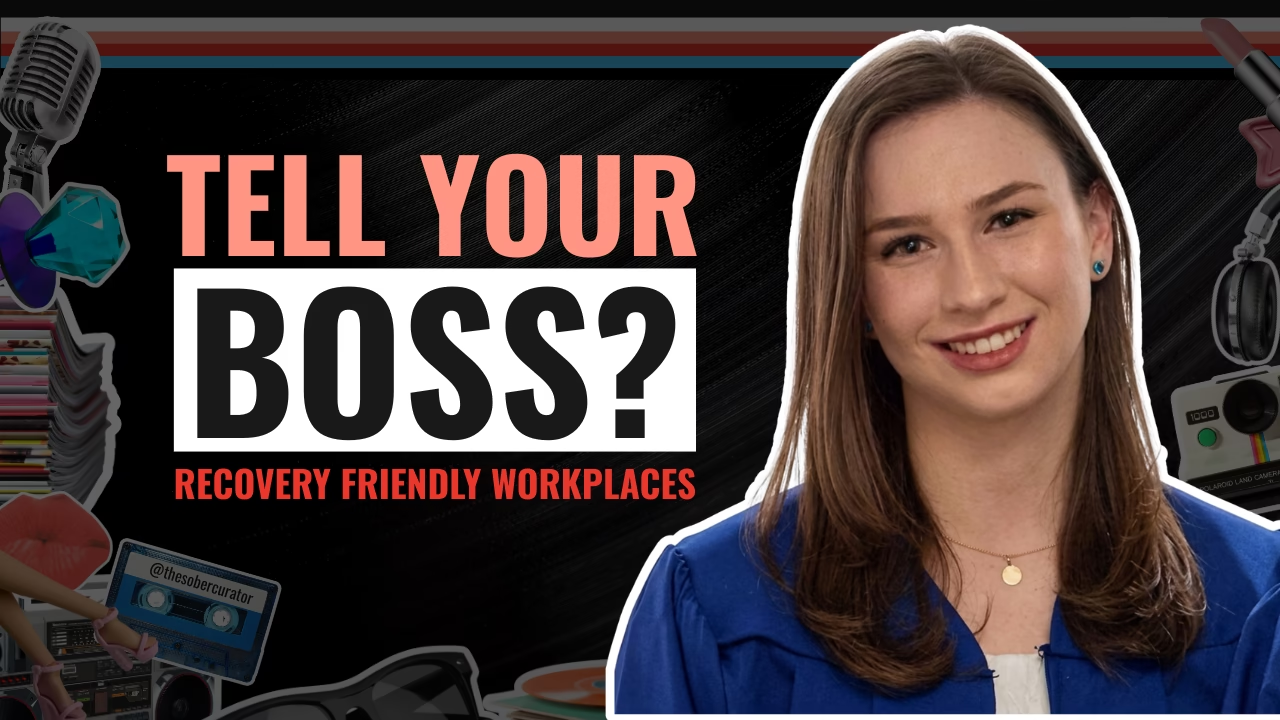

Eliza runs the National Recovery Friendly Workplace Institute, which certifies employers as recovery friendly. If you have heard the federal term “recovery-ready workplace,” that’s the same idea with government wording on it. The two are used interchangeably.
Here’s how it got here, and I love this origin story.
New Hampshire has been one of the hardest-hit states in the country for fatal overdoses. Governor Chris Sununu had run a ski resort before he ran the state, and he’d seen firsthand what the gap looked like from an employer’s side. Resources cluster in cities. Workplaces don’t. There’s a workplace in every rural town in America whether or not there’s a treatment center within 90 miles of it.
So he started Recovery Friendly Workplace as a state program. It worked well enough that the White House noticed. Under the Biden-Harris administration it went into the National Drug Control Strategy, and the Department of Labor published the Recovery-Ready Workplace Toolkit: exhaustively researched, genuinely useful, and more than 100 pages long.
Eliza’s read on that, which is the funniest true thing in the episode: the odds of a small business owner going to the Department of Labor website, reading a 100-page toolkit, and then knowing what to actually do with it are approximately zero.
That gap is the entire reason her organization exists. Take the research, turn it into a certification a real employer can complete, and build the state-level infrastructure that connects a business to the recovery community in its own zip code.
And it is genuinely bipartisan, which in 2026 is a sentence I almost never get to type. It started under a Republican governor, expanded under a Democratic administration, and the Trump-Vance administration has kept it in the National Drug Control Strategy with the number of certified employers as a metric of success. Employers, as Eliza points out, love a project that isn’t going to get cancelled when the map changes color.

How certification works
Four pillars:
- Culture
- Hiring, retention and advancement
- Benefits
- Education and awareness
Every activity inside a pillar carries a point value. The employer uploads documentation showing they’ve actually done the things, hits the required points in each of the four, and the Institute reviews submissions monthly. Then they get help communicating it, internally and externally, including a badge that shows up on LinkedIn pages. There’s an “I work for a recovery friendly workplace” version for employees, too, which is a small thing that I suspect matters enormously to whoever gets to post it.
It starts with an interest form at rfwinstitute.org. Fair warning, she says the site is mid-facelift, so give it grace this month.
The parts that jumped out at me:
Fair chance hiring. Not using background checks to knock people out before the interview, and having an actual process for what happens when something substance-related does come up, so a candidate gets looked at as a whole person instead of a checkbox.
Flexible scheduling. Her example is exactly right: if someone needs a meeting at lunch and the meeting is 10 minutes away in each direction, does this workplace bend or does it not?
Advertising substance-free options at every work event where alcohol is present. Not just having them. Advertising them.
Should you tell your boss?
This is the question, so let me be very clear about my position: take it seriously, and take your time.
I came up in an older-school, church-basement, anonymity-forward corner of recovery where you got hit in the face with the Big Book about this. So I was never the person announcing five days publicly. If you are that person and it works for you, fantastic, genuinely. It just was never me.
You cannot really un-tell people. That’s the whole calculation. And in a sales job, where my entire function was making people comfortable enough to want to do business with me, sobriety wasn’t always the thing that accomplished that. I know that someone else’s discomfort says more about them than it does about me. I also know I had a number to hit.
So: make a pro and con list. Sit with it. And know that you never have to do it at all.
Eliza’s clarification matters here, and it’s the practical takeaway of the whole episode. You do not have to disclose anything to advocate for this. You can walk into HR with nothing but the numbers: how many employees in this country are in recovery, how many are actively struggling, what turnover costs, what productivity looks like on the other side of support. Speak the employer’s language. Talk about the bottom line. Nobody has to know why you care.
Although about half the certified employers she works with got there because a person in recovery raised their hand first. Her version of that conversation: I think that we should work on this, and here’s why. Because you know I’m a fabulous employee, and did you know that I’m also in recovery?
That’s a hell of a sentence to be able to say.
Now, the one time I did it: 2016, interviewing at KING 5 in Seattle. Ten years sober. I volunteered it. I said I’m in long-term recovery from substance use disorder, and here’s what that means for you: sometimes a longer lunch because I’m at a meeting, sometimes I show up to the outing, do my part, and leave before the drinks portion.
I did it because you’re interviewing the company just as much as they’re interviewing you, and I wanted to watch what their faces did. They were lovely. I took the job. And in a building of about 200 people I quietly became the person management came to when a staffer or a family member was struggling. I never had a sign on my desk. Word just gets around, and I loved being that person.
One honest caveat that we glossed on the record: the legal picture is more nuanced than “they can’t hold it against you.” The ADA does protect people in recovery who are not currently using illegally, and alcoholism is treated as a covered disability, but current illegal drug use is not protected and employers can still hold everyone to the same performance standards. This is a real protection with real edges. Talk to an employment attorney about your actual situation, not a podcast.
The part every manager needs to read
If you plan events, build culture, or manage people, this section is for you.
It is fine if there’s alcohol. Nobody is asking for a dry office. What we’re asking is that you notice the rest of the room.
Make the alcohol-free options good. I am a Diet Coke girl. Give me a fountain Diet Coke and I am happy, happy, happy. But plenty of my friends want the elevated thing with the garnish, in real glassware, so they feel like they’re at the same party as everybody else. The non-drinkers want elevated drinks too. This is a line item, not a philosophy.
Conferences are the worst offender. Endless happy hours and total disregard for the fact that a conservative third of the room isn’t drinking, for a hundred different reasons.
Steal this one. A certified employer Eliza works with makes the first hour of the holiday party completely alcohol-free, with leadership required to be present. Which is brilliant, because the actual value of the holiday party is face time with the people who decide your career. Put that hour first and dry, and now the person who is six weeks sober gets the same shot at the C-suite as everyone else, and can leave at the top of hour two having gotten exactly what they came for. Another one made a company-branded mocktail. Another put a full NA bar at their conference.
Not every bonding activity has to be a wine tasting. Coffee tasting. Tea tasting. Dirty soda tasting. Cheese, per Sarah, and Sarah is right.
And the gifts. During COVID, Eliza says, companies were mailing wine flights to employees’ home addresses with no idea who was on the other end of the shipment. When I was a magazine publisher I got a mountain of holiday alcohol every December and just passed it around the office, noting each time that the sender knew literally nothing about me. That’s the real cost of a default gift: it announces that nobody asked.
What she wants to be able to say next year
Eliza’s benchmark for the next 12 months is simple and I appreciate an executive with a number. She wants all 50 states running some level of recovery friendly workplace program, so that wherever you work, there’s a path to a local resource. And she wants the count of nationally certified employers to grow, but on purpose, slowly, by companies actually rebuilding their policies.
Her words: not just for a stamp on the window, but really integrate it into their culture and their practices.
Her specific figures for how many states, employers and employees are engaged right now are in the episode. We’re confirming them against the Institute’s latest report before we print them here.
Two things before you go listen to the full episode
Backstage with The Sober Curator is where we keep this conversation going. Virtual events every month, and right now a weekly AI group that has honestly become an AI support group for me personally, because I have a new addiction and it has a chat window. Come find us BACKSTAGE.
And if you own a sober business, get in the Rolodex. Our business directory is free, it does not matter what you do, construction or accounting or law or candles, and we currently have around 50 listings. I want that number to be absurd. I would rather give my money to a sober business owner every single time. Add your listing for FREE.
The Sober Curator Podcast is available across all major platforms
👉Watch or listen to the show on Spotify
👉Listen to the show on Apple Podcasts
Check out our curated articles on rethinking drinking in the workplace:
- 5 Tips on Sobriety in the Workplace & Social Navigation
- My Boss Disappears on Benders. What Can I Do?
- Does Being Sober Help or Hurt Your Career? The Professional Upside of Sobriety
- Worklife After Sobriety: How to Find a Job and Keep It
SOBER EVENTS at The Sober Curator keeps you in the loop on alcohol-free gatherings happening nationwide. From sober comedy shows and non-alcoholic tastings to festivals, retreats, and sporting events, we highlight vibrant, community-driven experiences from coast to coast. Our goal? To keep you entertained, inspired, and connected—no matter where you live. Need more sober time than one event? We’ve got your back with our Sober Retreat Calendar.
📅 Submit a Sober Event: NA tastings, sober socials, recovery conferences, fitness meetups, alcohol-free festivals, virtual gatherings, and events of all kinds. Anything that gives our readers something worth showing up for. Submit your event →
🏝️ Submit a Sober Retreat Recovery-focused, wellness, spiritual, creative, and adventure retreats. Listings start free. Featured and Sponsored placements available for retreats that want full editorial coverage. Submit your retreat →
We know you’re a skimmer. We wrote a newsletter for skimmers.
Short intros. Quick hits. Headlines that tell you exactly what you’re getting. Read it in the school pickup line, on the treadmill, or while pretending to listen on a conference call.
The Sober Sip: three times a week, zero fluff.
Resources Are Available
If you or someone you know is experiencing difficulties surrounding alcoholism, addiction, or mental illness, please reach out and ask for help. People everywhere can and want to help; you just have to know where to look. And continue to look until you find what works for you. Click here for a list of regional and national resources.

Follow The Sober Curator on LinkedIn
What is a recovery friendly workplace?
A recovery friendly workplace is an employer that has deliberately built its culture, hiring practices, benefits and internal education to support employees in recovery from substance use disorder, as well as employees with loved ones who are struggling. The federal government uses the term “recovery-ready workplace” for the same idea. The National Recovery Friendly Workplace Institute treats the two as synonyms and certifies employers against a national standard.
How does a company become a certified recovery friendly workplace?
Start with the interest form at rfwinstitute.org. After an orientation conversation, the employer works through four pillars: culture, hiring/retention/advancement, benefits, and education and awareness. Each qualifying activity carries a point value, and the employer submits supporting documentation showing they’ve reached the required points in every pillar. The Institute reviews submissions monthly and provides certified employers with a promotional package, including badges for the company’s and employees’ LinkedIn pages.
Do I have to tell my employer I’m in recovery to bring this to them?
No. You never have to disclose your own recovery to advocate for a recovery friendly workplace. The Institute provides one-pagers and materials built around the data and the business case, so the pitch can be made entirely on productivity, retention and turnover. That said, roughly half of certified employers got there because an employee in recovery raised their hand first.
Is it illegal for an employer to discriminate against someone in recovery?
The Americans with Disabilities Act protects people with a history of substance use disorder who are not currently engaging in illegal drug use, including people in or who have completed treatment, and alcohol use disorder is generally treated as a covered disability. Current illegal drug use is not protected, and employers may still hold all employees to the same performance and conduct standards. This is a real protection with real limits, and it varies by state and situation. Talk to an employment attorney about your specific circumstances.
How do I survive a work happy hour or client dinner sober?
Know your exit before you arrive, order something that looks like a drink so nobody asks, and give yourself permission to do your hour and leave. On the employer side, the fix is structural: make the alcohol-free options good rather than an afterthought, advertise them in advance, and consider making the first hour of any event alcohol-free with leadership present, so the networking value of the event isn’t gated behind the bar.
What are good team building ideas that don’t involve alcohol?
Any tasting format works without the wine: coffee tastings, tea tastings, dirty soda tastings, cheese tastings. The bonding comes from the shared tasting experience, not the alcohol. For gifting, skip the default bottle of wine, which signals to the recipient that nobody asked anything about them.
Where can I find the National Recovery Friendly Workplace Institute?
At rfwinstitute.org. The certification interest form is on the certification page, and the site also publishes a national report on state-level recovery friendly workplace programs.
