


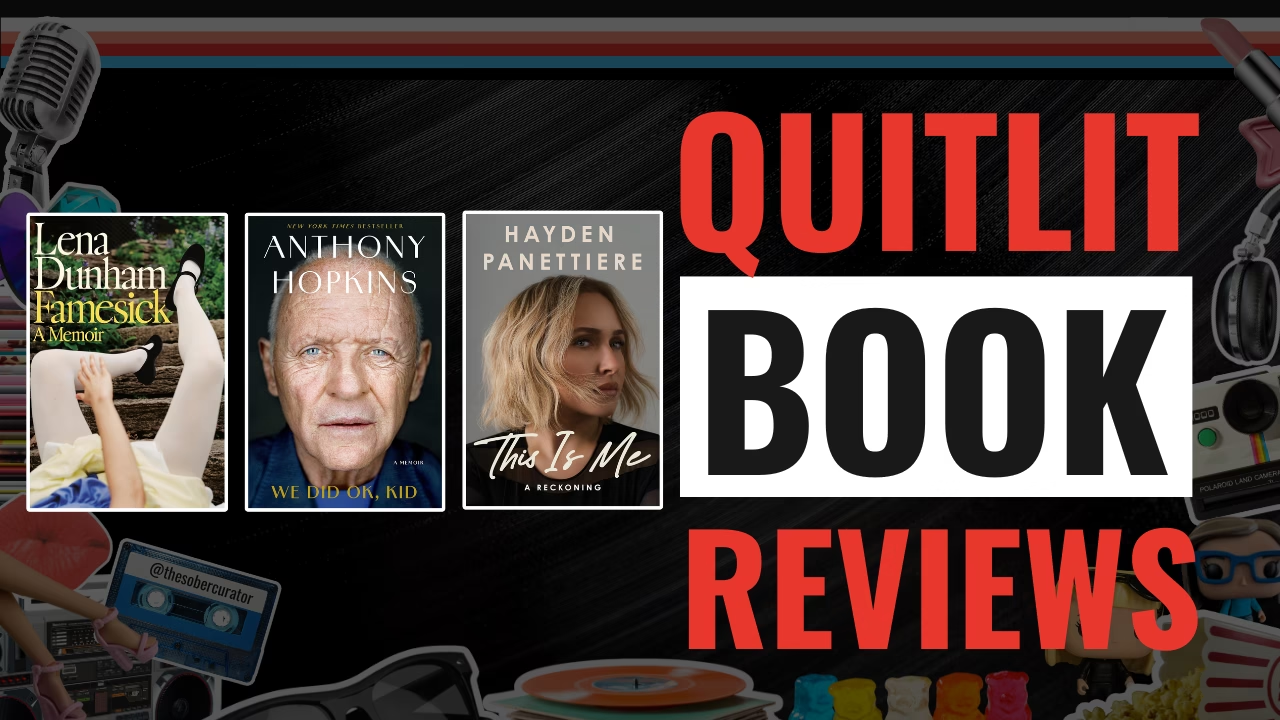

Editor’s note, added August 17, 2026. This article and the episode it comes from were recorded in late July, several weeks before Hayden Panettiere died on August 16 at the age of 36. We are publishing it as recorded rather than editing her out. What our panel said about her book was said with real affection, and we stand behind every word of it.
At the time of this post, her cause of death has not been released. The Greenville Police Department has said its preliminary investigation found no signs of foul play or suspicious circumstances, and an autopsy is pending with the county coroner’s office. We are not going to speculate past that, and we’d ask you not to either.
We recorded a separate conversation about her death and about what this week has stirred up in this community. It’s here: Hayden Panettiere, Brad Pitt, and How We Talk About Recovery When the News Breaks
If this one is landing hard for you, that is a normal reaction and you are not being dramatic. 988 is the Suicide & Crisis Lifeline, call or text. SAMHSA’s National Helpline is 1-800-662-4357, free and confidential, 24/7. And if a hotline isn’t your thing, text one sober person today. Just one. That counts.
Quit lit used to mean one shelf in a bookstore nobody browsed on purpose. You had to want it. You had to walk past self-help, past the diet books, past whatever Malcolm Gladwell was doing that year, and stand in front of a section that basically announced your business to the entire store.
I got sober before quit lit was even a saying. I was on MySpace. With Tom.
This year, three memoirs about getting sober came out from three people who have nothing in common except the thing they were all writing about, and all three of them landed on the bestseller list. Lena Dunham. Sir Anthony Hopkins. Hayden Panettiere. A millennial TV auteur, an 88-year-old knight, and a woman who started acting before she could walk.
Same question underneath all three: what does it cost to numb yourself when the whole world is watching?
So I did what I do. I pulled the biggest readers in The Sober Curator contributor community into a room and made them show up with a book.
First, a confession about the name
Before we got to the books I made everybody sit through a small anniversary. The Sober Curator just turned six, which means we are out of the toddler years and into kindergarten. Not first grade. We’re a little behind, we need extra help, and also I am extremely into arts and crafts and snacktime.
Here’s the part I don’t tell often enough: this site was originally called The Sober Critic. Then I started the Instagram and had a small epiphany somewhere around my third follower. People are going to think we’re criticizing them. Their path. How they got sober. Whether they’re doing it right. Which is the opposite of everything this place is.
So the critic became the curator. But I liked being reminded of it on this episode, because for one afternoon we were absolutely being critics. With scores. Out loud.

Famesick by Lena Dunham

The Sobees: 3.5
Anne Marie Cribbin took this one, and she came in cold. She’s 54, she never watched Girls, and everything she knew about Lena Dunham was secondhand. What she noticed first is that when she told people she was reading it, everyone had a very strong opinion and almost nobody could explain why.
Her read is the most useful thing said about this book anywhere: it is not a before-and-after. If you want the story where life was a wreck and then life was perfect, keep walking. What Famesick actually is, is a book about medical trauma. Endometriosis. Chronic pain. A hysterectomy at 31. Opioids that started as a prescription and became something else.
In Anne Marie’s words: “I think it’s for the person who probably is not looking for, like, a roadmap to recovery.”
Patti Clark liked it more, liked Girls more, and had the sharpest take on the controversy. Dunham wrote it fresh off rehab, and some readers felt that showed. Pink cloud. Not enough meat yet. Patti’s response was basically, so what. “This was prescribed. She was told what to do. She followed what she was told to do.” She came out more sympathetic, not less.
Amy Liz Harrison caught the thing that connects this book to the other two: “how someone can feel unseen and be super hyper-visible at the same time, like that both of those things can coexist.”
Also, I have not read it, and I still had an opinion about the cover. I could not tell you what is happening on it. To me it gives vibes that she has somehow drunkenly fallen down the stairs of her cottage. Anne Marie thought it looked like a child. We’re both right, which is probably the point.
📖 Read Anne Marie’s full Famesick review here.

We Did OK, Kid by Anthony Hopkins
The Sobees: 4
This was mine. I bought it in an airport, which is my highest form of book endorsement, purely on the face and the title. I am that girl. I also have it on Audible because I want it in his voice, and I refuse to use Amy’s skimming hack on it, because I want every word.
I also can’t score it. House rules. I haven’t finished it. Integrity is expensive.
Patti had already written about Hopkins for us when he hit 50 years sober last November, and she connected through the father. Hopkins writes about being told he simply did not have emotions. Patti grew up with a version of the same thing, an ocean and a continent away, and she used his phrase for it: emotional brutality.
Amy Liz found the detail that stopped everybody. Hopkins does not remember the drive from Arizona to Los Angeles that ended his drinking. He had to be told about it afterward. He had to be informed of his own rock bottom.
Which is when the episode went somewhere I didn’t plan.
Patti said what actually broke her about that passage wasn’t that Hopkins might have killed himself. It’s that he might have hurt someone else. And that’s when she told us about the coast road in New Zealand, after her relapse, with her kids in the car.
I echoed it, because I was a habitual drunk driver. This was before Uber, in a town without real taxis, and I told myself I had no choice, which was a lie with a very convincing costume on. I had a trick: I kept a picture of my son on the dash so I’d see it when I got in the car drunk.
Turns out you can turn a picture around.
Times have changed, and thank God. I once got pulled over for drunk driving and the officer said, “All right, young lady, I’m gonna follow you home.” That’s it. That was the consequence.
Patti gave the book a 4 for the writing, with a fair warning that it is dense. In her words, you would need to get your gumboots on, as they say in New Zealand, and sludge through that mud. Amy Liz gave it a 3.75, which caused a scoring incident I’ll get to.
This Is Me: A Reckoning by Hayden Panettiere
The Sobees: 4.25. Highest of the episode.
Tamar Routly took this one on Audible, read by Panettiere herself, and she came to it sideways: she and her wife had just started watching Nashville, roughly a decade after everyone else.
Panettiere started acting at 11 months old. Her mother put her in it and later managed her, which went exactly as badly as you’d expect. Tamar’s framing landed hardest: “you’re not cognitively to a point where you can say, ‘No, Mommy, I don’t wanna act.'” She bought a house while she was on Heroes. She was parenting her own parents. She grew up in front of everyone and never got a vote.
Then Tamar said the thing that made this a Sober Curator episode instead of a book review. She’s had friends come to meetings with her and ask, out loud, how could someone do that to their kids. “That’s what this disease does, and that’s what people don’t understand.”
Amy Liz called this her favorite of the three, and it’s the postpartum depression that did it. The traumatic C-section. The infection. And the part she nearly cried over: Panettiere knew she was blessed and lucky, cognitively knew it, and could not feel a single bit of it, because the depression and the drinking were standing in the doorway. Amy Liz’s read on the birth: the womb is a threshold, a crossing-over place, and nothing says the other side has to be better. Sometimes it’s just the next hard thing.
Tamar gave it a 4.5. Amy Liz gave it a 4, while actively fighting tears, which I found impressive and slightly suspicious.
Nobody got a five. We can’t give everybody a trophy. Not in my lifetime.
What we’re starting here
I don’t do book clubs. I love the idea of them and I cannot handle the commitment, which is probably related to the fact that I’m 51 and have been single my entire life. Make of that what you will.
But this? Everybody shows up with whatever’s actually on their nightstand, some of us overlap, some of us didn’t read the thing, nobody gets shamed. Little book reports with grown women and real scores. That’s a format I can commit to.
So we’re doing it monthly BACKSTAGE with The Sober Curator. JOIN US.
Two things before you go

Mixtape with The Sober Curator is the sixth-birthday present we made for ourselves. A mini zine series inside an actual cassette tape case. It is not a tape. You do not need a tape recorder. Inside are seven tiny magazines that turn real pages, because I have never once been able to leave a good idea alone. Issue one has spirit-free recipes, art journal prompts, guided meditation, a Celtic ritual from Anne Marie, writing prompts from Amy Liz, and my running list of what to read, watch, hear and where to go.
New one every month for six months. BACKSTAGE members get it FREE and just cover shipping. Everyone else can grab a zine subscription. Details here. (Or become a BACKSTAGE member #winkwink)
Cover Story, our first-ever retreat, is November 1 to 4 in Scottsdale. You arrive the day after Halloween, which feels exactly right for a group of people who have opinions about costumes and no interest in a hangover. Hotel, all food and drink, and your own photo shoot with Barbie Hull, who has been photographing me for years. Everyone gets their cover girl or cover guy moment, and we’re building a Sober in Scottsdale zine together while we’re there. Small group on purpose. Think dinner party, not conference. Grab your spot.
And a shout-out for Toni Will, friend of the house, whose book Rebellious Success: Six Truths to Release Perceived Weaknesses and Become Unstoppable is out now. We met her at the Amplify Sober Voices podcast convention in Florida. She is very funny, and she is the general manager of a professional hockey team, which makes me badass by association, the only way I’m ever getting there.
So here’s what I want to know. Three books, three scores, no fives. Which one got robbed, and what’s the quit lit book that’s still sitting on your nightstand with a bookmark in chapter one?
The Sober Curator Podcast is available across all major platforms
👉Watch or listen to the show on Spotify
👉Listen to the show on Apple Podcasts
#QUITLIT: Sober Celebrity Memoirs Worth Reading: Books Written by People Who’ve Actually Been There
SOBER POP CULTURE: It’s a Family Tradition… Multi-Generational Alcoholism

TSC LIBRARY: Welcome to The Sober Curator Library! This isn’t your average stack of books—we’re talking full-on story immersion, Audible binges, and reviews with personality. Browse our four go-to genres: #QUITLIT, Addiction Fiction, Self-Help, and NA Recipe Books. And if you’re collecting recovery reads like rare trading cards, check out our Amazon #QUITLIT list—Early Sobriety Survival: Books for Your First 90 Days.
📘 Submit a Book for our #QuitLit Library: Welcome to the largest culturally-driven sober book collection on the internet. Memoir, fiction, criticism, quit lit, anything that fits a Gen X or Millennial sober reader past initiation. Submit your book →
Your Go-To Guide for All Things Recovery & Sober Living
The Sober Curator’s PILLAR Content Hub is your one-stop guide for sobriety resources, addiction recovery resources, and sober living tips. From non-alcoholic drink guides to sober travel, entertainment, and lifestyle inspiration, our curated cornerstone articles are regularly updated to keep you informed, inspired, and connected. Whether you’re in recovery, sober curious, or supporting someone you love, this hub offers the sober lifestyle guide you’ve been looking for.
SOBER POP CULTURE at The Sober Curator is where mainstream trends meet the vibrant world of sobriety. We serve up a mix of movie, podcast, fashion, and book recommendations alongside alcohol-free cocktails, celebrity features, and pop culture buzz—all with a sober twist.
We’re here to shatter the “sobriety is boring” myth with a mash-up of 80s neon, 90s hip-hop edge, early 2000s bling, and today’s hottest trends. From celebrity shoutouts to red-carpet style inspo, this is where sober is as chic as it is fun. To the celebs using their platform for good—our Sober Pop Trucker hats are off to you!
Resources Are Available
If you or someone you know is experiencing difficulties surrounding alcoholism, addiction, or mental illness, please reach out and ask for help. People everywhere can and want to help; you just have to know where to look. And continue to look until you find what works for you. Click here for a list of regional and national resources.

Follow The Sober Curator on Facebook
What is quit lit?
Quit lit is memoir and nonfiction about quitting drinking or drugs, written from inside the experience. The name is a shortening of “quitting literature.” It used to be a small, easy-to-miss section in bookstores. In 2026 it’s the bestseller list.
What are the biggest quit lit books of 2026?
The three that dominated the year are Famesick by Lena Dunham (Random House, April 2026), We Did OK, Kid by Sir Anthony Hopkins (Simon & Schuster, 2025), and This Is Me: A Reckoning by Hayden Panettiere (Grand Central, 2026). All three landed on the bestseller list and all three approach addiction from a completely different direction.
Is Famesick worth reading?
It depends what you want from it. Famesick is not a recovery roadmap and it is not a before-and-after story. It is a book about medical trauma, endometriosis, chronic pain, a hysterectomy at 31, and an opioid dependency that started with a prescription. If you’re interested in where chronic illness and addiction overlap, read it. If you want a clean redemption arc, skip it. The Sober Curator panel scored it 3.5 out of 5 on The Sobees.
What is Anthony Hopkins’ memoir about?
We Did OK, Kid is a traditional memoir that starts in Hopkins’ Welsh childhood and moves forward, structured around the drive from Arizona to Los Angeles that ended his drinking, a drive he has no memory of and had to be told about afterward. Hopkins reached 50 years of continuous sobriety in December 2025. The panel gave it a 4 out of 5, with a warning that it is dense.
What does Hayden Panettiere’s book cover?
This Is Me: A Reckoning covers Panettiere starting to act at 11 months old, being managed by her own mother, growing up famous with no say in it, postpartum depression after a traumatic C-section, and her drinking. She narrates the audiobook herself. It earned the highest score of this episode, a 4.25.
What are The Sobees?
The Sobees are The Sober Curator‘s 0 to 5 rating system, used across book, TV, film and non-alcoholic drink reviews. The house rule on the podcast is that you cannot score a book you didn’t read or listen to, which is why Alysse recused herself from scoring the Hopkins book.
Does The Sober Curator have a book club?
As of this episode, yes. It runs monthly for BACKSTAGE members.
