Sober is having a moment, okay?
NA beers are outselling their alcoholic cousins in some markets. Dry January went from a niche thing to an entire industry; I think it’s a national holiday month now. And everyone is saying “gray area drinking” like it’s new slang.
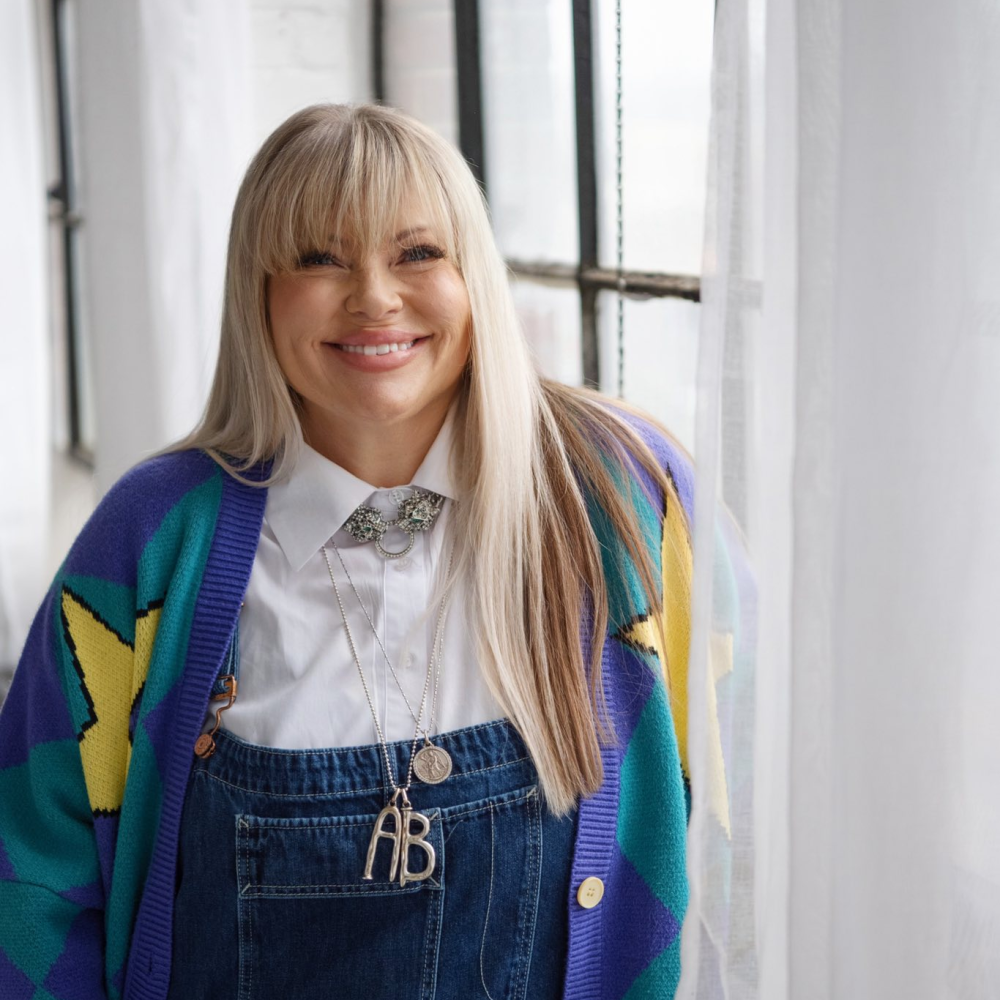
So this week we brought in two people who have been in this conversation from wildly different angles. Ruby Williams spent 20 years in the wine industry. Susan Larkin spent 20 years at Yale School of Medicine, in the department that teaches addiction to medical students. They met as This Naked Mind coaches, became meditation partners, and now host the Sober & Lit podcast, 140 episodes deep.
Two totally different rooms, same landing spot. Tamar wanted to know what the collision looked like.
Let it RAIN
They didn’t meet through coaching. They met in a Tara Brach RAIN meditation course, and I had to ask, because I assumed they were dancing in the rain and we’re from the Pacific Northwest, so.
RAIN is recognize, allow, investigate, nurture. You take a struggle through it: recognize what’s there, allow it, get curious about where it lives in your body, and then nurture that place. Susan’s line for why it matters: “A lot of times we drink because we wanna change the way we feel, and so part of sobriety is learning how to feel our feelings.”
Here’s the part I loved. Susan comes at it from a Christian perspective and invites God into the nurturing. Ruby, in Susan’s words, “is more of a universe person.” Same practice, two belief systems, both of them get something out of it. Tamar said it for our whole community: we don’t care how you got here.
Also Susan, and this is the line of the episode: “We can’t hate ourselves sober.”
Why they renamed the show
It started as Feel Lit Alcohol Free. Lit as in awake, alive, vibrant, not lit as in the other thing (younger listeners have, in fact, assumed “sober and lit” meant they smoke pot; they do not). Then they changed it to Sober & Lit on purpose, and did an episode about it, because they wanted to reclaim the word.
Susan was in the gray-area camp that hated “sober.” “We’re like, ‘Nope, we’re alcohol-free.'” The shift for her was watching the community live out loud: “We don’t have to hide in the shadows. We don’t need to be anonymous. We’re reclaiming the word sober as we’re reclaiming spaces like, ‘Hello, bars. We want alcohol-free options.'”
Tamar’s take, and I’m putting it on a shirt: who really cares what you call yourself? Then she said the thing that she doesn’t say lightly. “For me, I know that if I drink again, I could die. Like, that is just a reality.” Twenty-two years of drinking, and she calls it a career because she worked hard at it. The energy we put into planning, controlling, and recovering from drinking is the energy you get back. Susan: “I think lit means living alive.”
Mommy wine culture, from the inside
Tamar asked the question a lot of you have been waiting for someone to ask: what do two coaches make of the wine mom thing now that it’s been a whole cultural moment people are proud of?
Ruby was in it before it had a name. Play dates where the mommies drank while the kids played. Then a client told her about tea parties where the teacup without the bag had wine in it. Then Ruby’s own version: “I would bring alcohol in, like a water bottle or something with wine in there, and I would take it to his sporting events.” Swim meets. “That’s where it got really scary for me, ’cause I was taking it with me everywhere.”
Susan had a six-year gap between kids, so she watched the culture arrive. When her daughter played T-ball, nobody brought a Yeti of wine to the field. By the time her son was five, in 2005, the parents were leaving the baseball diamond drunk and asking if her kid could sleep over. She drove him. She also went home and drank her own wine in private, so, her words, not Lily White.
Her diagnosis of what the culture did: “What I think mommy wine culture did was normalize three glasses or a bottle of wine a night is normal, because everyone was doing it.” Clients now tell her, “I feel like I’m a normal drinker. I only have, like, three glasses every night.” That’s not a normal amount. Nobody told them, because everyone at the table was doing it, and everyone at the table had a good career and showed up to work, so everyone at the table was fine.
Ruby, from the wine industry: same thing, more bottles. “The more you drank, the more normalized it was.”
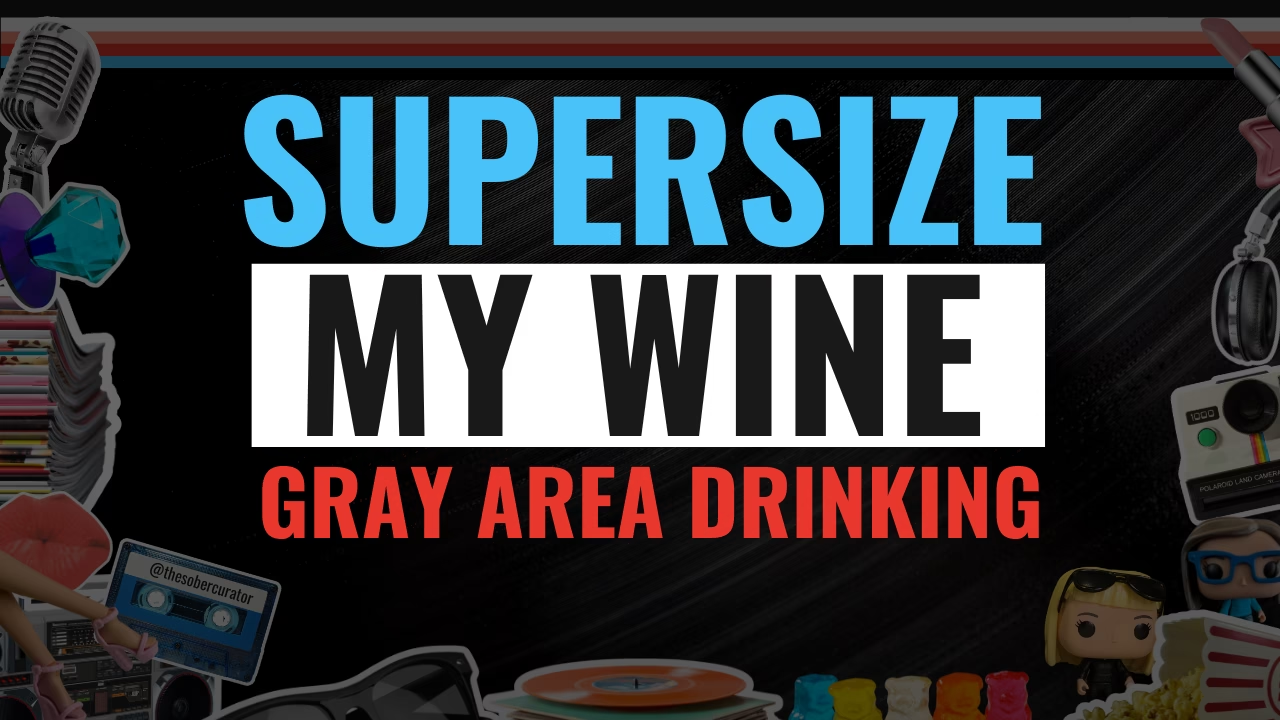
And then the bit that’s going on the thumbnail. Susan, on eating out: “Would you like the six-ounce pour, the nine-ounce pour, or the 13-ounce pour?” Are we at McDonald’s? Tamar: “Supersize my wine, please.” Susan: “Do you have to ask?” Tamar: “Do you have a 20?”
I have a confession about that era, too. I was already sober when the purse flask came out and I’m a little bummed, because I would have used it. I did have a binocular flask. There are now holders you can stick in your shower for your wine glass. You can’t take 10 minutes to shower?
Reverse purse wine: the NA bottles that work
Susan still does purse wine. It’s just the opposite now: she brings non-alcoholic wine to parties that won’t have an alcohol-free option. Her picks: Oddbird sparkling, Tomorrow Cellars, Jøyus, and H2o (Ruby’s pick, the canned one with the sparkling Sauvignon Blanc).
Tomorrow Cellars gets a whole tangent, and it earns it. Tracy Sweeney, the co-founder, was on Sober & Lit (episode 123). Napa County, a winery making only alcohol-removed wine, made like real wine and then stripped of the alcohol, then run through a second scrubbing process because removing the alcohol molecule removes flavor. Ruby, who knows those people, loved the angle: it’s not marketed to sober people so much as to the person who wants a nice dinner and a real glass and none of the consequences. The middle. Susan’s wish: “When I go to a restaurant, I don’t wanna have to bring my wine in my purse.” You can also watch this episode on their YouTube channel.
Then Tamar told the story I needed her to tell on mic. Someone sent her four full bottles of NA wine years ago. She poured the rosé into a tumbler, “’cause why would I have, like, a glass?” Felt the placebo. Had another. Had another. Went to the fridge one more time and found an inch left in the bottle. “That said a lot to me personally.” Ruby had the exact same experience with the Tomorrow Cellars samples: “What is happening to my old neural pathways?”
Susan, meanwhile, has two half-full bottles in her fridge that have been there three weeks, and she forgot they existed. “I used to say I have an elbow problem. I guess I don’t have an elbow problem anymore.”
Which brings us to the barber.
If you go to the barber, you’re gonna get a haircut
Susan’s first sober Thanksgiving, 2013, she bought some NA wine (terrible, back then) and told her AA meeting that morning. They said: bad idea, do not do that. And somebody said the thing you’ve heard: “If you go to the barber, you’re gonna get a haircut.”
She heard them. It was also dejecting, because the NA wine was the thing letting her be part of the celebration instead of sticking out with a water glass. For her it wasn’t a problem. For some people it is. Both are true.
Her landing, which is the most honest position I’ve heard on this: many of her clients say that without NA options, choosing an alcohol-free life would have been much harder, because it gets them through the witching hour. Same relaxation ritual, same glass while dinner cooks, minus the ingredient that was hurting them. “Keep the ritual, ditch the alcohol.”
You have to know yourself. Tamar’s tumbler is data. Susan’s forgotten bottle is data. Nobody gets to decide which one you are except you.
What had to go
Susan’s “pictures with the eyes that move” line, about knowing exactly where the bottle was in the cupboard, got me talking about my house.
Before I got sober, my dining room was Mad Men martini themed. My kitchen was all wine decor, and I was never a wine drinker. My bathroom was tiki. My son had tiki happy hour sheets. He was nine. I was trying to glamorize alcohol in my life; I was trying to make it very Carrie Bradshaw. In early sobriety I told my therapist it was all triggering and I couldn’t take it down because it was expensive and the walls would be empty. She reframed it: not empty walls, a clean slate, a new space to figure out your new decor vibe. I’ve been decorating that clean slate ever since.
Ruby’s purge was the wine-industry version: “rosé all day” shirts in stacks, wine club gifts, corkscrews, “It’s 5:00 somewhere” plaques, and every glass shape in existence, cordials to Italian style. “I just got rid of all my stemware.”
Susan didn’t have decor. She had a reputation. Six months in, during COVID, her dad wanted to send her the wine-of-the-month club from a Napa winery they’d visited together. “Well, Dad, I’m not drinking right now.” He was sweet, then annoyed, the way you get when your perfect gift is refused. His counter: “How about National Geographic?” She now gets National Geographic, she thinks, until the day she dies. It was hard for people to see her any other way, because “nobody saw me as a problem drinker.” That was the whole problem.
(Magazines are back, by the way. Paper is back. So are zines. I went to the post office with two tubs of Sober Snail Mail the day we recorded this.)
What we’re watching, and the week the headlines swung
Susan’s watching “Ted Lasso” (the new season; Rebecca and Keeley and the champagne, if you want an alcohol reference) and “Your Friends & Neighbors.” Ruby just watched “The Madison” and, as an alcohol freedom coach, could not get past a scene where a character drinks with her own therapist.
Ruby also went to our site and bought Hayden Panettiere’s memoir, This Is Me: A Reckoning, because we recommended it. Which put us back in the week the headlines swung: Brad Pitt telling Esquire he’s drinking again, and days later, Hayden dying at 36. We did a bonus episode about it, because you can’t call yourself a pop culture sober media company and not, and because I wanted to be careful. What still sits with me: she did all the things. She talked about it publicly. She got help. And we don’t know the full story, except that there’s a daughter without her mom. Watch the bonus episode here.
Yale, gray area drinking, and the doctor who prescribed wine
Susan’s 20 years at Yale were in the department that teaches addiction. Her read: the medical community understands severe alcohol use disorder and has almost no grid for mild and moderate, which is where every gray area drinker lives. She saw a post the day we recorded: a doctor told someone with anxiety to have a couple glasses of wine to relax. She’s told her own therapist she thought she was drinking too much and heard “sounds like you’re probably fine.” “People are not picking up on the cues where we can help people a lot sooner.”
Ruby’s image for it is the pitcher plant. You think you can climb out for a long time. “I felt like I could take it or leave it one day, and then I really couldn’t.” Her message, and the reason the show exists: “Don’t wait for rock bottom. Don’t wait for you to get a divorce or lose your job or get a DUI.”
Tamar: you hit your bottom when you stop digging, and you can stop digging any time. Some of us just chose to dig a little longer.
The nurse who owed me a drink
My contribution to the healthcare conversation. I have heart disease; I had emergency heart surgery at 40, ten years sober, and once a year I go in and do all the things. My veins are a pain (I’m a pain in other ways too, don’t worry). The first nurse tried three times and called in the specialist, the hole-in-one guy, who walked in and said, “I’ll get this in one, and if I don’t, I owe you a drink.”
I’m at the cardiologist. He missed. “Oh shit, I guess I owe you a drink.”
“Well, that’s awkward, ’cause I’m an alcoholic.”
I wanted to be dramatic about it. Stop making assumptions, in a hospital, literally. Ruby has clients with liver cancer and breast cancer whose oncologists told them to have a glass of wine to relax.
Normal drinkers don’t justify
The most useful thing said all episode is Tamar’s, and it’s a test you can run on yourself tonight.
“If you don’t have any issue with alcohol or any other substances, those people do not justify or spend time trying to explain why they do or do not drink. They just either have a drink or they don’t, but they don’t have to explain it.”
Tamar Routly
The mom wine memes, the people who hate the word sober, the “I only have three”: all justification, and the justification is the tell. Why not just say it? I can’t drink like other people can, and I choose not to now. That’s the whole sentence. Susan’s son, who doesn’t drink and never has, had a bottle of lemonade at his own wedding and made nothing of it. His mother brought a cooler and hid it under the table. That’s the difference.
Susan’s now taking the same argument into the church, where the pastor says “go have some wine” and a gray area drinker who asks for help gets pointed at AA and nowhere else. Someone asked her on Instagram what she thinks about churches serving alcohol at functions. “I don’t know. Would you pass around a pack of cigarettes?” Cigarettes are legal.
BACKSTAGE, and the trench coat
If today made you think differently about the sober trends in your algorithm, this is exactly the kind of conversation we have at BACKSTAGE with The Sober Curator, our private culture club. Think of it as a master class: special speakers on AI, style, whatever the room needs that month. Come find us. And go listen to Sober & Lit. Susan asked you to give us five stars; the least I can do is send you to her.
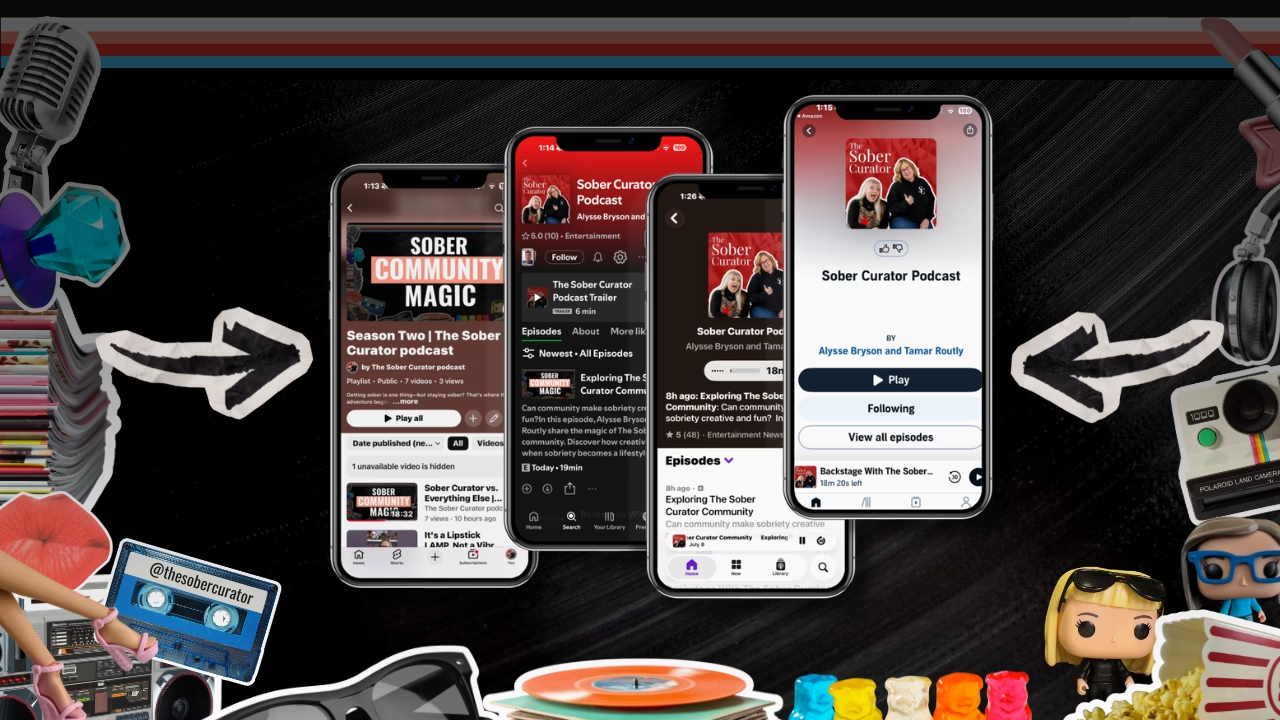
The Sober Curator Podcast is available across all major platforms
👉Watch or listen to the show on Spotify
👉Listen to the show on Apple Podcasts
You’re allowed to enjoy that sober is trendy right now. Roll with it. Keep the trend going. This is the great trench coat you get to wear no matter what comes in and out of style.
A good trench coat and sobriety: always in style.
So tell me. What was your justification?
Nothing in this episode or post is medical advice. If your relationship with alcohol worries you, talk to a licensed professional. Our Alcohol + Substance Use Disorder Guide is always open, and SAMHSA’s National Helpline is 1-800-662-4357, free and confidential, 24/7.
RECOVERY PODCASTLAND & NETWORK at The Sober Curator is your audio haven for all things sobriety and recovery. We’re your bee-zy sober podcast enthusiasts, curating the best shows that educate, inspire, and entertain in the alcohol-free space.
Our archives are neatly organized so you can easily explore Recovery Podcastland—featuring our favorite recovery-based podcasts from across the globe—and the TSC Podcast Network, where we share our own original shows on sober lifestyle, pop culture, travel, entertainment, and more.
Whether you’re seeking practical recovery tips, personal stories, or uplifting inspiration, this is your go-to listening guide. 🎧 Submit a Podcast for Review: Recovery Podcastland coverage and reviews. Shows that earn their place in our audience’s queue. Submit your podcast →

SOBERSCRIBE NOW!
Resources Are Available
If you or someone you know is experiencing difficulties surrounding alcoholism, addiction, or mental illness, please reach out and ask for help. People everywhere can and want to help; you just have to know where to look. And continue to look until you find what works for you. Click here for a list of regional and national resources.
Follow The Sober Curator on X, the artist formerly known as Twitter
What is gray area drinking?
Gray area drinking describes drinking that falls between “an occasional drink” and physical dependence: not rock bottom, not a DUI, but more than the drinker is comfortable with and hard to stop. On the clinical spectrum of alcohol use disorder (mild, moderate, severe), gray area drinkers typically sit in mild and moderate. Susan Larkin, who spent 20 years at Yale School of Medicine, says on this episode that the medical community has “no grid” for that range, which is why gray area drinkers often hear “you’re probably fine” from doctors and therapists.
Is three glasses of wine a night normal?
No. Susan Larkin says the single biggest thing mommy wine culture did was normalize a bottle or three glasses a night, because everyone in the friend group was doing it and everyone was still functioning. Clients regularly tell her “I only have three glasses every night” as evidence they’re normal drinkers. Her response on the episode: that’s not a normal amount.
Does non-alcoholic wine trigger cravings?
It depends on the person, and this episode gives both answers. Tamar Routly poured an NA rosé into a tumbler and drank the bottle. Susan Larkin has had two open NA bottles in her fridge for three weeks and forgot they were there. Susan’s rule for her clients: experiment if you feel like experimenting, and know yourself. For many people, “keep the ritual, ditch the alcohol” is what gets them through the witching hour; for others, the recovery-room line applies, “if you go to the barber, you’re gonna get a haircut.”
What non-alcoholic wines do the Sober & Lit hosts recommend?
Susan Larkin’s go-tos are Oddbird sparkling, Tomorrow Cellars (a Napa winery that makes only alcohol-removed wine, co-founded by Tracy Sweeney, who was on Sober & Lit episode 123), and Jøyus. Ruby Williams adds H2o, a canned wine-infused sparkling with a Sauvignon Blanc option. Susan brings a bottle in her purse to parties that won’t have an alcohol-free option.
What is the RAIN meditation?
RAIN is a self-compassion practice from meditation teacher Tara Brach: Recognize what you’re feeling, Allow it, Investigate where it lives in your body, and Nurture that place. Ruby Williams and Susan Larkin met in a RAIN course and were RAIN partners for years before starting their podcast. Both use it with coaching clients; Susan pairs it with her Christian faith and Ruby with a more universal spirituality, and both say the practice works either way.
Who hosts the Sober & Lit podcast?
Ruby Williams and Susan Larkin, both This Naked Mind certified coaches. Ruby spent 20 years in the wine industry in Napa County and runs Freedom Renegade Coaching; Susan spent 20 years at Yale School of Medicine and coaches at Susan Larkin Coaching. The show, formerly called Feel Lit Alcohol Free, is aimed at women in midlife, has more than 140 episodes, and ends every episode with the question “What are you doing in your life to feel lit?”