



Three years ago, I was in a theater in New York watching my friend Katie Mack’s one-woman show, #UGLYCRY. Her Instagram feed was projected on a screen onstage. The audience was cued to engage with it in real time.
Then, mid-performance, a post scrolled through the feed. Matthew Perry has passed.
I thought, is this part of the show? Why would she take it this dark?
About a minute later my phone started vibrating with every one of you texting me.
The One Where We Went Live
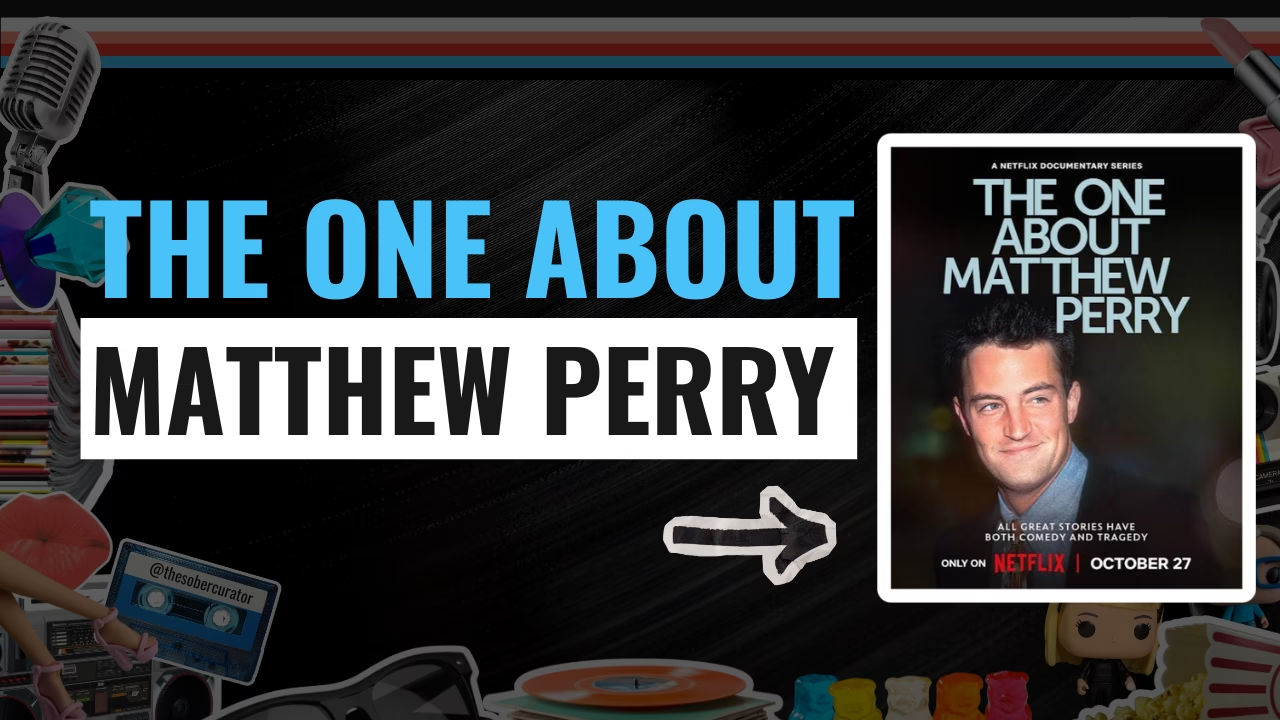
Netflix dropped The One About Matthew Perry on Oct. 27, three episodes, about an hour each, told by his sister and his closest friends. My crew had all three watched before I could finish the group text.
So on Oct. 28, the anniversary, we went live for the first time ever on BACKSTAGE: co-host Tamar Routly and Sober Curators Amy Liz Harrison, Sarah Alaimo and Megan. We’d read his memoir together a few years back and dressed up as Friends characters to talk about it. None of us ever met him.
Sarah said it for all of us. “We definitely didn’t know him, but I knew how he felt.”
Make Me Famous
The doc opens with the prayer. God, make me famous, and you can do whatever you want with the rest.
Sarah felt it in her stomach immediately. He got the prayer answered, and the rest wasn’t so perfect. She also clocked the early foreshadowing: his friends talking about how he always needed to get the laugh. That need for validation from the outside because you never felt it on the inside? Most of us know it by heart.
Here’s what stuck with me. After that prayer, we barely hear him talk about God again. For me, a higher power is a huge part of staying sober. I wondered out loud if that missing connection is part of why he could never stay there. I don’t know. It’s the thread I kept waiting for.
Before Friends
Episode one is a gift if you love him. A forgotten pilot where he works at an airport in the future with aliens. A Dead Poets Society audition he really wanted. And his crew at the Formosa, every night, with their own language, cruising Sunset in a convertible while Matthew blasted Enya and people on the street lost it.
Amy put it perfectly: it’s easier to separate someone from their disease when you see who they were before the progression really begins.
His friends stayed with him to the very end. Tamar noted how rare that is. Most of us alienate everyone.
Fame Doesn’t Fill the Hole
Six months into Friends, with all the fame and the merch and his face on every mug on Earth, he realized it wasn’t going to fill the hole.
That’s the common thread with nearly everyone I know in recovery. We spend our lives thinking the next thing will fill it. He also talks about “going dark,” which is language I use for the stretches of my own life I couldn’t climb out of.
Then the wedding. He comes out of treatment to film Chandler and Monica’s wedding, and his family is there wondering if this is the only wedding they’ll ever see him have. It was. That one crushed me.
Read Something Other Than Your Own Book
The moment that got the whole panel was the Peter Hitchens interview, where the British journalist insists addiction isn’t real, just a choice. Amy said she’d have burst into tears. Matthew didn’t. He held his ground with grace and suggested Hitchens read something other than his own book.
I got mad watching it, then remembered why it matters. A few days earlier, someone from my past reached out asking why the young people she works with can’t “just get it together.” People with letters behind their names still don’t get this. Once it goes in my body, game over. I don’t have an off button. It has nothing to do with a moral compass.
Relapse After Good News
Episode three is hard. The play, The End of Longing, and the haunting last line. The slurred interview afterward. Tamar found that the hardest thing to watch.
People assume a relapse follows something bad. I think it’s just as likely that a relapse happens because something really good has happened. Megan pointed to the moment he gets the news about the final-season paycheck, celebrates, then tells his sober housemate to move out.
Amy reminded us that recovery isn’t a straight line. “It’s not a linear thing. It’s a cyclical thing.” That’s why celebrity relapses aren’t a bad example. They’re an honest one.
And this is the heartbreak for me. I don’t know if I’ve ever witnessed someone want it so bad that couldn’t get it.
Who Gets Justice Without a Documentary?
The sentencing is in there. Multiple people were held accountable. Megan found that somewhat comforting. Sarah didn’t let it rest: if it weren’t Matthew Perry, those people wouldn’t be held accountable. Megan finished the thought. How many other people did they sell to who never got a documentary?
That’s the question I’ll be chewing on for a while.
Another Chip Off the Stigma Block
For six years, The Sober Curator has been archiving in real time the evolution of a community that has mostly been stigmatized and anonymous. Very often it’s the celebrities doing the heavy lifting, one chip off the stigma block at a time.
I don’t love the phrase “some of us have to die so that others can live.” I don’t understand it. But I believe his life will serve a purpose for a very long time, through his wins and his losses, and through the foundation that’s outliving him. This documentary is a piece of history for our community.
Could We Be Any More Sober?
We ended where we should: Ms. Chanandler Bong. Sarah nailed it, and I’m officially calling her as my trivia partner forever. Tamar picked Chandler popping out from under the covers when Monica and Chandler finally went public. Mine is Joey and Chandler napping together. I’m the queen of naps.
Amy lost her Wi-Fi at the very end and held up a Post-it that said “Pivot. Pivot. Pivot.” I can’t think of a better closing line for a sobriety talk show. When life hands you the hard stuff, you keep pivoting.
Be in the Room Next Time
This was our first BACKSTAGE livestream and we’re doing more. BACKSTAGE is our culture club: watch parties like this one, a book club, weekly AI nights for sober humans, and guests like a Notre Dame professor who teaches a course called Addiction on Screen. Come hang out.
So tell me: where were you when you heard?
The Sober Curator Podcast is available across all major platforms
👉Watch or listen to the show on Spotify
👉Listen to the show on Apple Podcasts

We’ve covered Matthew’s story…
- Matthew Perry’s Tragic End: Addiction, Fame, and the Unseen Battles of a Hollywood Icon (2025)
- Remembering Matthew Perry: A Legacy Beyond ‘Friends’, His Fight Against Addiction, and Impact on Recovery Community (2024)
- #QUITLIT: Friends, Lovers, and the BIG Terrible Thing, Memoir by Matthew Perry (2023)
- #QUITLIT REVIEW: Friends, Lovers, and the Big Terrible Thing (2023)

#QUITLIT: Sober Celebrity Memoirs Worth Reading – Books Written by People Who’ve Actually Been There
A Disco Ball is Hundreds of Pieces of Broken Glass, Put Together to Make a Magical Ball of Light. You are NOT Broken, Friend. You are a DISCO BALL!
Resources Are Available
If you or someone you know is experiencing difficulties surrounding alcoholism, addiction, or mental illness, please reach out and ask for help. People everywhere can and want to help; you just have to know where to look. And continue to look until you find what works for you. Click here for a list of regional and national resources.

Subscribe to The Sober Curator on YouTube
What is The One About Matthew Perry?
The One About Matthew Perry is a three-part Netflix documentary series about the late Friends actor, released Oct. 27, 2026, the day before the third anniversary of his death. It is told largely through his sister and close friends, and covers his early career, Friends, his addiction and recovery efforts, and the investigation and sentencing that followed his death.
What did people in recovery think of the Matthew Perry documentary?
On a Sober Curator BACKSTAGE livestream, a panel of people in long-term recovery said the documentary felt like another step against addiction stigma. They highlighted his advocacy, the Peter Hitchens interview, his “make me famous” prayer, and the point that relapse can follow good news as easily as bad news.
Why do people relapse after good news?
Many people in recovery describe relapse risk rising after big wins, not only after losses, because celebration and a sense of being untouchable can lower defenses. On The Sober Curator Podcast, Alysse Bryson said a relapse is “just as likely” to follow something really good, pointing to moments in Matthew Perry’s story.
What happened in the Matthew Perry and Peter Hitchens interview?
British journalist Peter Hitchens argued on air that addiction is a choice rather than a disease. Matthew Perry calmly disagreed and suggested Hitchens read beyond his own book. The Sober Curator panel called it one of the most powerful moments in the documentary.
Is addiction a choice?
Major medical bodies classify substance use disorder as a medical condition, not a moral failing. On The Sober Curator Podcast, Alysse Bryson describes it as the loss of choice: “Once it goes in my body, game over. I don’t have an off button.”
Where can I watch The Sober Curator’s reaction?
The full livestream is a bonus episode of The Sober Curator Podcast on YouTube, Spotify, Apple Podcasts and Amazon Music. Live watch parties happen inside BACKSTAGE with The Sober Curator.
