


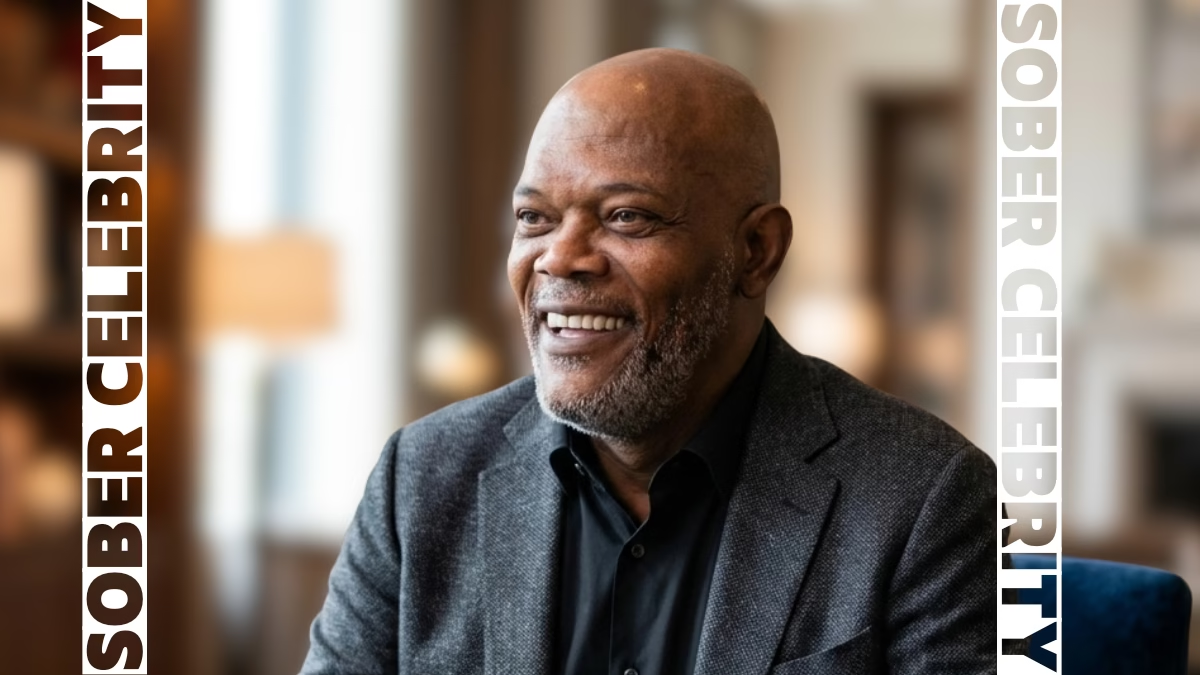

Samuel L. Jackson Has Been Sober Since 1991. The Career You Know Came After.
While Samuel L. Jackson was in rehab in 1991, Spike Lee called with an offer. The role was Gator in Jungle Fever — a crack addict. Jackson had just spent years living a version of that life.
He took the role. He brought something to it that no amount of preparation could have manufactured. He won a special jury prize at Cannes for it, a category the festival created specifically to honor his performance. He was 42 years old and had been a working actor for over a decade.
What happened after that is one of the more documented career trajectories in Hollywood history. What happened before it is what makes the trajectory make sense.
Sobriety Snapshot
| Sobriety Date | 1991 |
| Years Sober | 35 years (as of 2026) |
| Substances | Alcohol, marijuana, cocaine, and LSD |
| Turning Point | His wife and daughter found him passed out on the kitchen floor surrounded by cocaine paraphernalia |
| Quote | “I was a person who used drugs and alcohol to mask a lot of things that were going on inside of me.” |
Source: People
The Struggle: The System He Built Around Using
Samuel L. Jackson was a working theater actor in New York City through the late 1970s and 1980s, doing Off-Broadway work, building his craft, and running a daily routine that he has described in interviews with considerable specificity.
It started at 11 a.m. Beer and marijuana. As the day moved, it moved into LSD and eventually cocaine. He was functioning, in the sense that he was getting work and not losing it entirely — but functioning is not the same as present, and he has been honest about the difference.
His wife, actress LaTanya Richardson, whom he married in 1980, has spoken about watching him during those years. She told him he was intelligent but that he did not bring enough life to his characters, that there was a wall between him and the audience. He has talked about that observation in interviews. At the time, he did not hear it the way she meant it.
He spent years in a cycle that was producing just enough success to sustain itself — enough work to keep going, not enough presence to break through. The talent was there. The access to it was not.
The Turning Point: The Kitchen Floor
In 1991, his wife LaTanya and their daughter Zoe found him passed out on the kitchen floor, surrounded by cocaine paraphernalia. Zoe was around 8 or 9 years old.
He has described this as the moment that broke through everything. Not an arrest. Not a professional consequence. His family, in the kitchen, seeing exactly what he had been managing so carefully to keep them from seeing.
He checked into rehab. He got sober on his first attempt and has stayed sober since. He was 42 years old.
The Spike Lee call came while he was still in treatment. He has talked about that timing — the strange fact that the career he had been building toward was suddenly available to him at exactly the moment he had finally gotten out of his own way.
The Recovery: Feeling the Roles Without the Buffer
His performance in Jungle Fever (1991) is the clearest illustration of what sobriety unlocked. Playing Gator, a character consumed by crack cocaine, required Jackson to access something real and specific and ugly. He had the material. What sobriety gave him was the ability to use it without the chemical buffer that had been keeping him at arm’s distance from his own emotional range.
His wife’s observation about the wall between him and the audience turned out to be the thing he had to solve. Getting sober solved it. Not by making him more pleasant or more available, but by making him more himself — without the layer of management that heavy substance use requires.
Three years later, he played Jules Winnfield in Pulp Fiction. That performance, and that film, changed what people understood about what he could do. He was 45 years old. He had been sober for three years. The filmography that followed — more than 150 films — happened entirely in sobriety.
He has credited his wife throughout his public life as a central reason he made it through and stayed. She did not leave. She confronted him, supported his recovery, and has been present for every year of the 35 that followed.
Life After: 35 Years and Over 150 Films
The numbers are genuinely hard to process. Since getting sober in 1991, Samuel L. Jackson has appeared in over 150 films. One hundred and fifty. He has been part of the Marvel Cinematic Universe as Nick Fury across more than a dozen films. He has worked with Quentin Tarantino, Steven Spielberg, the Coen Brothers, Kathryn Bigelow, and nearly every significant director of the last three decades.
He has spoken about his work ethic in interviews — the discipline of showing up prepared, the ability to maintain the kind of output he maintains because he is not managing a substance on top of everything else. That is not a small operational detail. Staying at that level of productivity for 35 consecutive years requires a brain that is consistently available to the work.
He has also spoken plainly about what addiction cost him and what sobriety returned. “I was a person who used drugs and alcohol to mask a lot of things that were going on inside of me,” he told People. The things that were going on inside of him, once he stopped masking them, turned out to be the exact material that made him one of the most compelling actors of his generation.
Samuel L Jackson On Kicking Drugs Before His First Role, Social Media, New ‘Shaft’ Film + More
Sources and Further Reading
- Samuel L. Jackson on sobriety and his turning point: PEOPLE
- Samuel L. Jackson on his career and recovery: Esquire
- Spike Lee on casting Samuel L. Jackson in Jungle Fever: The Hollywood Reporter
- LaTanya Richardson Jackson on their marriage and his recovery: Variety
- The Sober Curator: Sober Celebrity Spotlight
Spike Lee called while he was still in rehab. He took the role. He won at Cannes. Then he made 150 more films. The career everybody knows started the year he got sober.

THE MINDFUL BINGE: Discover the Truth About Drugs & Addiction in the U.S. with Samuel L. Jackson’s “The Fix” Docuseries
Welcome to The Sober Curator’s ultimate hub for SOBER ENTERTAINMENT & EVENTS —a vibrant space where living alcohol-free is anything but boring.
In the TSC Library, explore book reviews across three standout genres: #QUITLIT, Addiction Fiction, Self-Help, and even NA Recipe Book reviews.
On-screen? The Mindful Binge TV series reviews, Movie Night movie reviews, and Recovery Podcastland + Network podcast roundups all use our signature Sobees Scoring System, so you know exactly what’s worth your time.
More ways to get inspired:
- Music: Discover tunes to motivate your sober lifestyle
- Sober Sports: Stay in the loop on active, exciting events
- Sober Events: Find alcohol-free happenings in your community
- Sober Pop Culture & Celebrities: Get the latest buzz on sober stars and trends
From binge-worthy shows to can’t-miss events, this is your go-to destination for entertainment that fits your alcohol-free life.
A Disco Ball is Hundreds of Pieces of Broken Glass, Put Together to Make a Magical Ball of Light. You are NOT Broken, Friend. You are a DISCO BALL!
Resources Are Available
If you or someone you know is experiencing difficulties surrounding alcoholism, addiction, or mental illness, please reach out and ask for help. People everywhere can and want to help; you just have to know where to look. And continue to look until you find what works for you. Click here for a list of regional and national resources.

Subscribe to The Sober Curator on YouTube
How long has Samuel L. Jackson been sober?
Samuel L. Jackson got sober in 1991. As of 2026, that is 35 years of continuous sobriety.
What did Samuel L. Jackson struggle with?
He has spoken publicly about alcohol, marijuana, cocaine, and LSD. He has described running a daily progression through these substances during his years as a working theater actor in New York City in the late 1970s and 1980s.
What made Samuel L. Jackson get sober?
His wife LaTanya Richardson and their daughter Zoe found him passed out on the kitchen floor surrounded by cocaine paraphernalia in 1991. He checked into rehab immediately and got sober on his first attempt.
What was Samuel L. Jackson’s first role after getting sober?
While he was still in rehab, Spike Lee offered him the role of Gator in Jungle Fever (1991), a crack addict. He took it. The performance won a special jury prize at the Cannes Film Festival, in a category the festival created specifically to recognize his work.
Did Samuel L. Jackson ever relapse?
He has not spoken publicly about any relapse. He got sober in 1991 on his first attempt and has consistently described his recovery as continuous in interviews over the subsequent 35 years.
Does Samuel L. Jackson talk about sobriety publicly?
Yes. He has discussed his addiction and recovery in interviews with People, Esquire, and in various long-form profiles over the years. He is specific about what he used, what the turning point was, and what sobriety made possible in his career and his family life.
