



I have a confession before I have an argument. I loved Instagram in the beginning. I mean, I loved it. My friends’ littles at the pumpkin patch, first day of school photos with backpacks bigger than the kid wearing them, happy faces sunburned pink at the beach. I am, genuinely, the person who wants to know what you had for lunch. Show me the heirloom tomato. I will admire its glorious color like it’s a Renaissance painting.
And I also hate it. Because somewhere along the way, my thumb started moving without me. Twenty minutes gone, thirty, sometimes closer to an hour (or more), and I look up and realize I haven’t engaged with a single piece of content. I’ve just consumed. My brain hurts. My body is tired in a specific, useless way, like I ran a race with no finish line and no medal. The escape I thought would feel like magic turned out to be a hangover with no party attached.
Sound familiar?
I learned there’s a word for this while doing the exact thing the word describes: scrolling. An account popped up on infoxication, and I sat there reading a slide deck about my own brain while my own brain was busy proving the slide deck right. The irony was not lost on me.
The Word Is Real, and So Is the Math
Infoxication, sometimes called information intoxication, was coined by Spanish sociologist Alfons Cornellà to describe what happens when the flood of news, social media, and notifications outpaces what your brain can actually process. It isn’t a diagnosis. It’s a description, and a good one, for a very specific kind of exhausted.
The numbers back it up. A widely cited 2009 report from the International Data Corporation found that most people check their smartphones within the first fifteen minutes of waking up, and researchers have been tracking the fallout ever since. Forty years ago, the average person got information from books, local newspapers, network television, and word of mouth. If you wanted something specific, you drove to a library. Today, estimates put daily media consumption around six hours for adults, and the constant stream of information is enough that psychologists have coined the term “information fatigue syndrome” to describe the anxiety, poor decision making, and shorter attention spans that come with it. Medium + 2
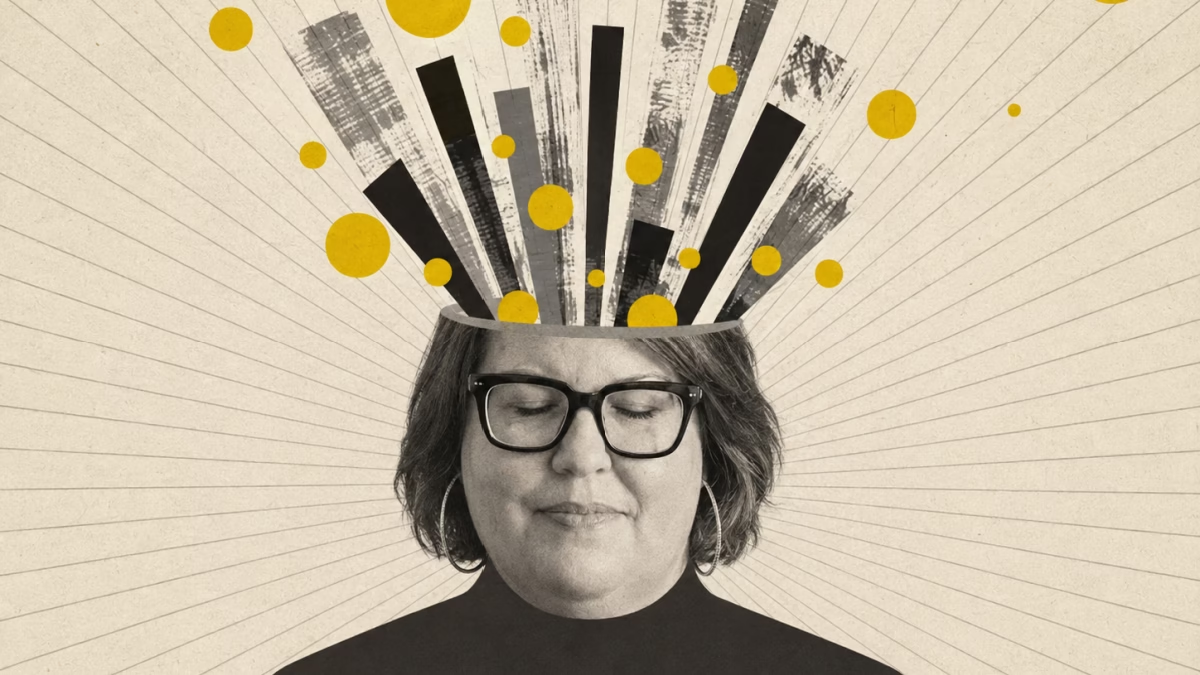
Here’s the part that actually stopped me. Think of it like a funnel. What’s pouring in the top, every headline, every post, every notification, is a fire hose. What your conscious brain can actually catch, hold onto, and use is a teaspoon. We built an information economy that runs at fire hose speed and handed it to a nervous system built to sip.
Your Brain Doesn’t Know the Difference
This is where it stops being a cute metaphor and starts being biology. Social media use lights up the same reward pathway in the brain as substances like alcohol, drugs, and gambling. Every like, every notification, every “you won’t believe this” headline triggers a small hit of dopamine before you even see what’s underneath it. Your brain doesn’t release it because the content was good. It releases it because it doesn’t know what’s coming, and not knowing is its own kind of hook. Psychiatry TimesReachMD
Psychiatrist Anna Lembke, who studies addiction, compares social media platforms to the same circuitry that keeps people hooked on slot machines and cocaine. And the abundant dopamine release can push some people’s baseline down over time, meaning they feel less pleasure when they’re not scrolling. That flat, itchy, slightly hollow feeling after a long scroll isn’t your imagination and it isn’t a weakness. It’s your brain trying to find its balance again after the spike. DartmouthDartmouth
Meanwhile, that constant stress load raises cortisol, and chronically high cortisol damages the part of your brain responsible for memory and learning. Your brain, asked to process too much for too long, gets tired the way a muscle gets tired. Mood swings. Brain fog. Decisions that felt fine in the moment and confusing an hour later. Vocal Media
We built a substance. We just didn’t call it one.
Capacity Isn’t Just a Recovery Buzzword
In recovery, we talk a lot about capacity. How much can you hold today. What’s yours to carry and what isn’t. Boundaries around your time, your energy, the people who get access to you. We got good, some of us, at learning our threshold for what a body and a nervous system can absorb before it starts sending up flares.
What we haven’t talked about enough is that information has a capacity limit too.
I’ll go first. I have developed a real, low grade fear of not being in the know. What to boycott, what’s happening in the world, what issue I’m supposed to have read three articles about by now. It feels irresponsible to look away, like looking away is its own kind of harm. And I keep landing in the same place. I cannot hold unlimited information any more than I can hold unlimited stress, unlimited obligations, or unlimited mimosas at brunch. My nervous system has an edge. Pretending it doesn’t is how I end up wired, foggy, and useless to the very causes I care about.
Staying informed and staying flooded are not the same thing. One makes you capable of acting. The other just makes you tired.
What We Actually Do With This
So here’s my working toolkit. Not a detox, not a purge, just a few boundaries I’m building around my own capacity.
- Run the HALT check before you open the app. Hungry, angry, lonely, tired. If you’re any of those four, the scroll isn’t going to fix it, it’s going to disguise it for twenty minutes and then hand it back to you heavier.
- Let your hands do something the algorithm can’t interrupt. Dishes, dirt, dough, a knitting needle. Recovery taught me that an engaged body quiets a loud brain faster than willpower ever will.
- Say the thing out loud before you check it. Not silently to yourself, actually out loud, even just to the dog. “I am opening this app because I am avoiding the email I don’t want to write.” Naming the dodge tends to kill it.
- Pick one account that would notice if you disappeared. Not the news, not the algorithm, an actual person. If your scrolling has room for real connection instead of just consumption, it stops being purely a drain.
- Give yourself a real world checkpoint. Not a phone timer. A candle that burns for twenty minutes, a load of laundry that needs switching. Something with its own natural stopping point that doesn’t require you to trust your own judgment mid scroll, because your judgment is exactly what’s compromised in that state.
- Treat the itch like a craving, because it is one. Don’t white-knuckle it and don’t shame yourself for having it. Just notice it, name it, and give it ninety seconds. Most cravings, chemical or digital, crest and drop if you don’t feed them immediately.
Capacity awareness saved my drinking life. It might be exactly what saves my scrolling life too. Information isn’t evil, but I am, still, a body with limits, doing my best to only take in what I can actually carry.
RESOURCES FOR THIS ARTICLE:
IDC smartphone stat / info overload health effects: https://yelgerbi.medium.com/we-are-living-in-the-era-of-information-overload-and-its-negatively-impacting-our-health-4a213021a4dd
Information fatigue syndrome / negative effects research: https://bcpublication.org/index.php/EP/article/download/4692/4562/4519
Social media and substance use shared pathways (Psychiatric Times): https://www.psychiatrictimes.com/view/social-media-and-substance-use-what-clinicians-need-to-know
Dopamine mechanisms (ReachMD): https://reachmd.com/news/understanding-the-brains-response-to-social-media-a-closer-look-at-dopaminergic-mechanisms/2470999/
Anna Lembke quote and dopamine deficit state (Dartmouth Undergraduate Journal of Science): https://sites.dartmouth.edu/dujs/2022/08/20/social-media-dopamine-and-stress-converging-pathways/

THIRSTY FOR WONDER: at The Sober Curator, led by Anne Marie Cribben—a passionate recovery coach and spiritual companion based in Washington, DC—offers 1:1 coaching, spiritual guidance, and recovery support rooted in compassion and empowerment. As the creator of The Wellspring: A Celtic Recovery Journey, Anne Marie blends the Celtic calendar with sobriety, connecting participants to ancient wisdom and the rhythms of nature.
A fierce advocate for sobriety as liberation and self-love, she challenges the targeted marketing of alcohol to women and champions authentic, joyful living. Her work goes beyond addiction recovery, fostering a life of vibrancy, purpose, and connection.
#ADDTOCART: Skims Vibes, Therapy Receipts: The Sister-Founded Brand That Stole the Show at OCDcon 2026
Your Go-To Guide for All Things Recovery & Sober Living
The Sober Curator’s PILLAR Content Hub is your one-stop guide for sobriety resources, addiction recovery resources, and sober living tips. From non-alcoholic drink guides to sober travel, entertainment, and lifestyle inspiration, our curated cornerstone articles are regularly updated to keep you informed, inspired, and connected. Whether you’re in recovery, sober curious, or supporting someone you love, this hub offers the sober lifestyle guide you’ve been looking for.
We know you’re a skimmer. We wrote a newsletter for skimmers.
Short intros. Quick hits. Headlines that tell you exactly what you’re getting. Read it in the school pickup line, on the treadmill, or while pretending to listen on a conference call.
The Sober Sip: three times a week, zero fluff.
Resources Are Available
If you or someone you know is experiencing difficulties surrounding alcoholism, addiction, or mental illness, please reach out and ask for help. People everywhere can and want to help; you just have to know where to look. And continue to look until you find what works for you. Click here for a list of regional and national resources.

Follow The Sober Curator on LinkedIn
What is infoxication?
Infoxication, sometimes called information intoxication, describes the state of overwhelm that can occur when we take in more information than we can effectively process. The term has been associated with Spanish researcher and author Alfons Cornellà.
Can too much social media cause mental fatigue?
Research has linked information overload and compulsive social media use with social media fatigue, cognitive strain, emotional stress and anxiety.
Why is social media so hard to stop scrolling?
Social media platforms use unpredictable rewards, personalized content and notifications that engage the brain’s reward systems. Dopamine is involved in reward learning and motivation, which can help reinforce repeated checking and scrolling behaviors.
What does recovery have to do with social media use?
Many recovery skills translate surprisingly well to digital habits. Tools such as HALT, recognizing cravings, setting boundaries, identifying avoidance and choosing healthier forms of connection can also help people become more intentional about scrolling.
How can I reduce information overload without quitting social media?
Try checking why you’re opening an app before you open it, limiting passive scrolling, choosing intentional sources of information, taking physical breaks from your phone and creating natural stopping points for social media use.
