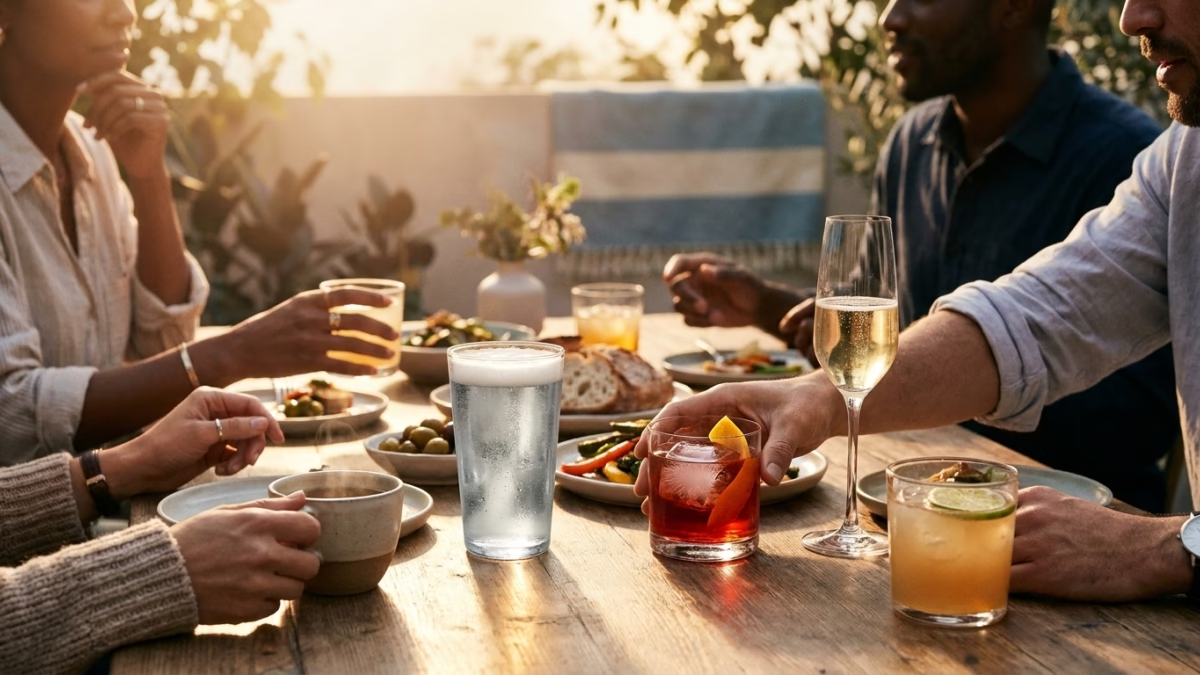
One of the strange things about drinking less is how often the question becomes harder than it needs to be.
You are at a bar. Everyone orders. Now what?
You are having dinner with friends and someone opens wine. What goes in your glass?
It is Friday night, the week is finally over, and you want something that marks the occasion without turning into three drinks and a bad night’s sleep.
The alcohol-free world has become very good at giving us products. There are NA beers, dealcoholized wines, botanical spirits, aperitifs, canned cocktails, sparkling teas, bittersweet sodas, shrubs, and bottles that seem to require a small chemistry degree just to understand what they are.
What we sometimes need instead is a simpler answer:
What works right now?
Because the best non-alcoholic drink at a steakhouse may be completely wrong for a backyard cookout. The thing you want at 5 p.m. before dinner probably isn’t what you want at 10 p.m. when everyone else is having whiskey.
Once you start choosing for the occasion instead of the category, alcohol-free drinking gets much easier.
At a Bar, Order Something the Bar is Good at Making
The worst place to become overly ambitious about non-alcoholic drinks is a crowded bar on Saturday night.
If there is a thoughtful zero-proof menu, great. Order from it.
If there isn’t, don’t feel obligated to invent a twelve-ingredient mocktail while six people wait behind you.
The easiest approach is to look at what the bar already does well. A cocktail bar probably has fresh citrus, good tonic, ginger beer, bitters, herbs, and decent glassware. A beer bar increasingly has at least one NA beer in the refrigerator. A restaurant bar may have an alcohol-free sparkling wine or aperitif that never made it onto the printed menu.
If you’re unsure, ask one simple question: “What non-alcoholic drink do you make that isn’t very sweet?”
That usually communicates more than asking for a mocktail.
Sweetness is the default problem. Remove alcohol from a drink and bartenders often compensate with juice, syrup, or soda. Asking for something dry, bitter, citrusy, spicy, or herbal gives them a much better direction.
There are plenty of good options in our guide to what to order at a bar when you’re not drinking, but the larger point is not to memorize an order. It is to know the kind of drink you want.
A tonic with lime may be enough. So may an NA beer.
You do not have to make your drink the evening’s most interesting conversation.
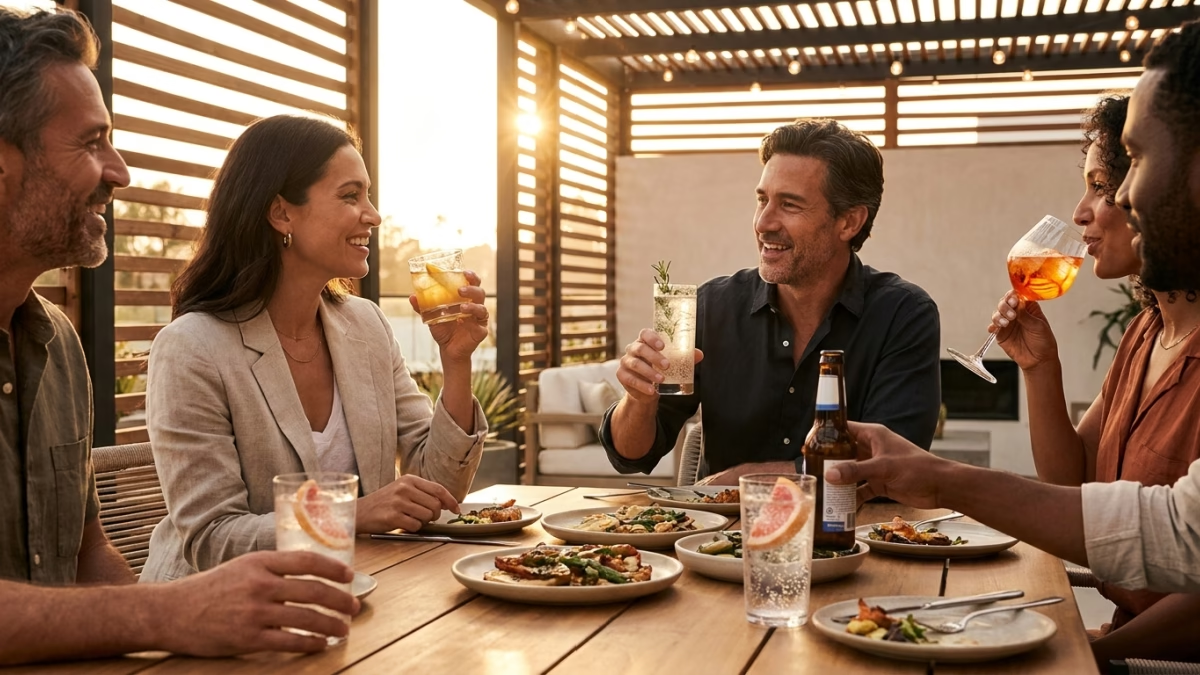
With Dinner, Think About the Food Before the Bottle
Wine has trained us to think this way already.
Nobody says, “What is the universally best wine?” and expects a useful answer. The bottle depends on what is being served, what you like, and sometimes what kind of night it is.
Alcohol-free drinks deserve the same treatment.
With rich or fried food, acidity and carbonation help. That could mean a dry sparkling wine, a tart botanical drink, or even a crisp NA lager.
With spicy food, something cold and relatively clean often works better than an elaborate spirit replacement. A NA wheat beer or lager can make much more sense than a smoky zero-proof whiskey.
For lighter food, a dry white or sparkling alcohol-free wine can work nicely if it has enough acidity and isn’t overly sweet.
The mistake is thinking the drink has to reproduce wine because everyone else is drinking wine.
It doesn’t.
Its job is to belong with dinner.
That can be a much easier standard to meet.
At a Party, Choose Something You Don’t Have to Explain
Parties are where simplicity wins.
If you bring an obscure botanical bottle that requires four mixers, a special garnish, and a two-minute explanation, you have accidentally volunteered to become the bartender.
A cold six-pack of NA beer is easier.
So is a canned spritz. So is a sparkling bottle you can open and pour.
The drink should let you participate in the party rather than create a project.
This is especially useful when you don’t know how much attention you want to draw to not drinking. Some people are completely comfortable discussing it. Others would rather have something in their hand and move on to another subject.
Both are fine.
A recognizable drink in a normal glass makes the second option much easier.
When Everyone is Doing Shots, Flavor Matters More Than Imitation
This is a surprisingly difficult occasion for alcohol-free drinks.
A shot is not just a tiny serving of liquor. It is social. Someone orders a round, glasses appear, everyone raises one at the same time, and the whole thing lasts about ten seconds.
Water solves the problem.
It does not necessarily feel like the same experience.
If you want to participate, strong flavors work better than weak spirit imitations. Ginger, cinnamon, citrus, bitterness, and spice all make sense because a small pour needs enough intensity to register quickly.
That’s one reason people searching for non-alcoholic Fireball alternatives are solving a slightly different problem from someone trying to make an alcohol-free Old Fashioned. They’re looking for cinnamon, heat, sweetness, and that quick social ritual—not necessarily a perfect recreation of whiskey.
You can also skip the shot entirely.
The interesting thing about drinking less is realizing how many drinking rituals are optional once you stop treating them as rules.
On a Friday Night at Home, Make the Drink Mark the Transition
This may be the occasion people underestimate most.
There is no bartender to impress. No party to navigate. No toast.
It is just the end of the week.
For a lot of people, though, the first Friday-night drink used to perform a real function. It said work was over.
That ritual doesn’t disappear simply because you remove the alcohol.
The replacement can be almost anything, but it should feel different from what you’ve been drinking all day. If you’ve had coffee and water since breakfast, opening a cold NA IPA, pouring an aperitif over ice, or making a simple tonic-and-botanical drink creates a boundary between the workweek and the evening.
That boundary is what you’re really after.
This is also where glassware matters more than it seems. Pour the drink. Use ice. Add the orange peel. Sit somewhere other than the desk where you answered emails all afternoon.
The liquid is only part of the ritual.
Late at Night, Don’t Try to Recreate the Bar
A late-night drink has a different job.
It should be slow.
This is where many alcohol-free products struggle because they are designed to be refreshing. Refreshing drinks disappear quickly. You can finish a sparkling water in three minutes without noticing.
A good non-alcoholic nightcap needs more resistance.
Bitterness can provide it. So can spice, smoke, tannin, ginger, tea, or a drink served hot rather than cold.
The goal isn’t necessarily to find a whiskey that tastes exactly like whiskey without alcohol. That remains one of the hardest tricks in the category.
The better question is what made the old nightcap work.
Maybe it was warmth. Maybe it was sipping something slowly. Maybe it was sitting down after everyone else went to bed and having twenty quiet minutes before the day ended.
You can recreate that part remarkably well without recreating bourbon.
At Brunch, Don’t Overcomplicate It
Brunch may be the easiest occasion of all.
Bubbles work.
A dry alcohol-free sparkling wine, sparkling tea, citrus-forward spritz, or even a good tonic with grapefruit can fit naturally beside eggs, pastries, fruit, and coffee.
The danger here is sugar.
Orange juice plus syrup plus sweet alcohol-free sparkling wine can quickly become a glass of liquid dessert. If the drink already contains fruit, look for acidity, carbonation, bitterness, or herbs to keep it balanced.
And if you just want coffee?
Have coffee.
Not every occasion formerly associated with alcohol needs an alcohol-free substitute.
That may be the most useful lesson of all.
You Don’t Need One Perfect Alcohol-Free Drink
People sometimes approach drinking less as though they need to choose their new beverage identity.
They used to be a wine drinker. Now what are they?
An NA beer person? A mocktail person? A sparkling-tea person?
There is no reason to choose.
We didn’t drink the same alcoholic beverage in every situation. Beer worked at a cookout. Wine worked with dinner. A cocktail worked at a bar. Whiskey worked late at night.
Alcohol-free drinking can be just as varied.
Keep a few things you actually like. Learn one easy bar order. Find something that works with dinner. Have an option you can bring to a party without thinking about it.
Then stop worrying about building the perfect zero-proof bar.
The best alcohol-free drink is often simply the one that fits the moment you’re actually in.
And sometimes the right answer is no special drink at all.
Contributor John Lisbonn is the editor of AFSips, a practical guide to non-alcoholic beer, alcohol-free wine, zero-proof cocktails, restaurant ordering, hosting and drinking less without making it weird. Visit AFSips.com.
Additional Articles by Contributor John Lisbonn:
- Stop Searching for the Perfect Alcohol-Free Replacement
- Why NA Beer, NA Wine, and Zero-Proof Cocktails Are Getting Better
- How to Bring Non-Alcoholic Drinks to a Party Without Making It Weird

Welcome to HAPPY EVERY HOUR, your go-to hub for all things NA (non-alcoholic). We review alcohol-free beers, ciders, wines, spirits, RTDs (ready-to-drink), and share NA cocktail recipes that taste just as good—if not better—than the boozy originals. Whether you’re sober, sober-curious, or just taking a break, this is where great taste meets zero proof.
TRIGGER WARNING: People in early sobriety may want to proceed with caution. Always read labels. Please hydrate responsibly … #becausedrunkneverlooksgood.
🛍️ Submit a Product for Review NA beverages, sober-friendly tools, alcohol-free brands, and products built for the way our audience actually lives. Submit your product →
Recovery isn’t the end of the story.
Recovery has been framed as survival. Staying sober as maintenance.
We’re interested in something else.
Not just getting through life — but actually engaging with it.
Identity.
Culture.
Celebration.
Taste.
Expansion.
This is the room where the conversation finally aligns with who you’ve become — and where you’re going next. LEARN MORE AND JOIN TODAY →
You don’t need a sobriety date to be here.
Sober, sober-curious, “just taking a break,” California sober and questioning it… The Sober Sip doesn’t check IDs at the door.
If you want the culture without the lecture, get on the list. Free, three times a week.
Resources Are Available
If you or someone you know is experiencing difficulties surrounding alcoholism, addiction, or mental illness, please reach out and ask for help. People everywhere can and want to help; you just have to know where to look. And continue to look until you find what works for you. Click here for a list of regional and national resources.

Follow The Sober Curator on LinkedIn
Frequently Asked Questions
What can I order at a bar when I’m not drinking alcohol?
If the bar does not have a zero-proof menu, ask what non-alcoholic drink it makes that is not very sweet. Simple options include an NA beer, tonic with lime, ginger beer, a citrus-and-soda combination or a drink made with nonalcoholic bitters.
What are the best non-alcoholic drinks to serve with dinner?
Choose the drink based on the food. Carbonation and acidity can complement rich or fried dishes, while crisp NA lagers often work well with spicy food. Dry alcohol-free sparkling wine, sparkling tea and botanical drinks can pair nicely with lighter meals.
What non-alcoholic drinks are easiest to bring to a party?
NA beer, canned spritzes, ready-to-drink mocktails and alcohol-free sparkling bottles are easy to chill, open and serve. Choose something that does not require several mixers, complicated garnishes or a lengthy explanation.
What makes a good non-alcoholic nightcap?
Look for a drink with bitterness, spice, tannin, smoke, ginger or warmth—qualities that encourage slower sipping. Tea, a warm botanical drink or a bitter aperitif-style beverage can recreate the nightcap ritual without trying to imitate whiskey exactly.
Do non-alcoholic drinks contain absolutely no alcohol?
Not always. In the United States, some beverages labeled “non-alcoholic” may contain small amounts of alcohol, while products labeled “alcohol-free” are generally expected to contain none. Formulations and labeling vary, so anyone who needs or wants to avoid alcohol completely should read the product label carefully.