


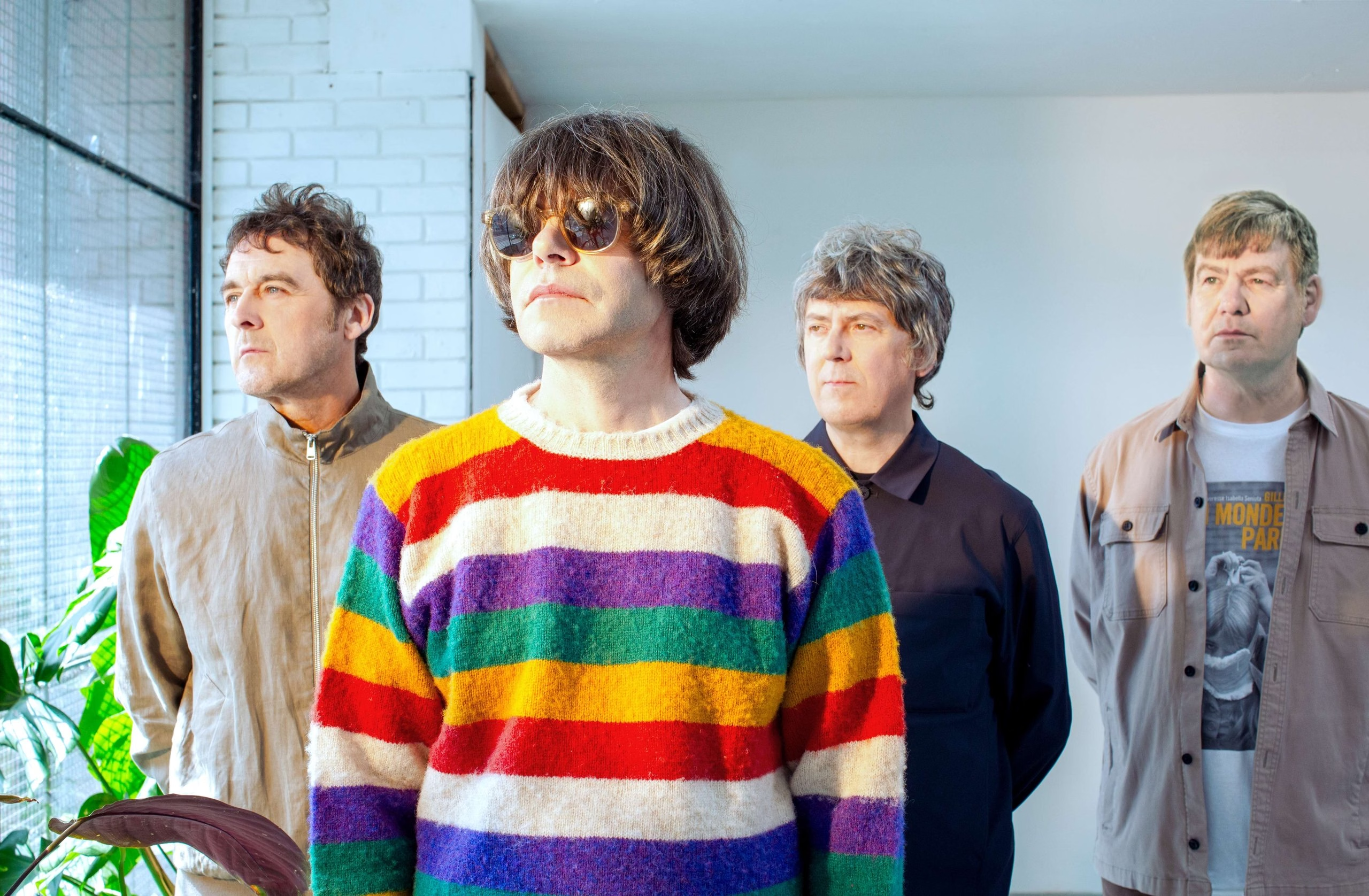

No matter how long a person has been sober, the past can sometimes creep back in without warning, an old ghost rattling around in a room long since locked. During a recent Sober Sit-Down with Tim Burgess, frontman for The Charlatans, the spirits made themselves known about an hour into the conversation.
“Do you mind if we don’t talk about this anymore?” he asked, almost hesitantly. “I’m ready to go out and have some fun now, and it’s sort of taking me back to some dark places.”
Burgess celebrated 20 years of sobriety this year. Revisiting the struggles from another era was becoming too much, especially on the eve of a North American tour in support of the British rock band’s latest album, “We Are Love.” We shut down that line of conversation immediately, but in the lead-up to the moment, the singer had offered some insight into his battles and the road he took toward becoming a healthier person.
Burgess knows exactly when things started to get out of control with his substance and alcohol use. It was the summer of 1996, and the group was in the midst of recording what would eventually become their biggest album, “Tellin’ Stories.” The ensuing success was bittersweet. Keyboardist and Charlatans co-founder Rob Collins had died in a single-car crash near Rockfield Studios in Wales, where the record was being laid down. After completing the sessions with heavy hearts, the band decided not to return to the legendary studio.
“We couldn’t deal with it,” Burgess recalls. “When Rob died at the bottom of the gates that lead into the studio … we finished the album there and then left and never came back.”
Finally, after nearly three decades, The Charlatans returned to the scene that once left them grief-stricken to record “We Are Love,” their 14th studio album.
“We’d missed going there, and when we did go there, we understood how important it was to the band,” Burgess says. “It’s just a great sound. I wanted to do all my vocals there since leaving. There’s just something amazing about the way that it’s all set up to record. It’s fantastic. ‘If walls could talk,’ kind of thing. And from Ozzy to Rush to Oasis, Stone Roses, Coldplay, everyone’s been there. And it was really good to go back. I mean, it’s like we faced the difficulties of the past or whatever, and we paid our respects to the past. I occasionally would see Rob’s car pull up or something in my imagination, or see Jon Brookes, our drummer who died not recently, but 13 years ago, playing football or something like that.”
“There’s this thing that we called ‘hauntology,’” he adds. “I mean, it’s not that we called it; there is a phrase called hauntology and psychogeography, and it was like the place that holds all these memories, and we decided that we were going to use that as part of the fabric of the album. It’s quite a pretentious word for what we were doing, but we chose it, and that’s what we went with.”
Whatever it was, it worked for “We Are Love.” Unlike its guest-heavy predecessor, 2017’s “Different Days,” the new album is mostly kept within the immediate circle of The Charlatans. It was almost as if they didn’t want any additional distractions while attempting the often tricky balance of embracing a tragic past while moving forward. It’s something Burgess is still figuring out.

Michael Christopher: Do you know your sober date?
Tim Burgess: I don’t. No. That’s the funny thing. I know it was April 2006.
Okay, so which album was the first one that you would have been sober making? “You Cross My Path”?
Yes, it was. So “Simpatico” was finished; I think it was after South by Southwest. We came back to London, and we’re having a week doing promo, and I was just … I don’t think I would’ve made the tour, to be honest. I think I got to be that dependent, and it’d been coming for a long time, I think. I always feel that it was almost like 10 years of self-medicating from Rob’s death to about the time I gave up. I don’t think it was quite 10 years, but it felt like that it was enough mourning and self-medicating, and I put it down to that really.
Do you think his death was the genesis of when you started to, I guess, “go off the rails” is the best way to describe it?
I think so. I think so. I mean, drugs had always been a part of the band, and I guess even before the band, clubbing at the Haçienda and all that kind of stuff. But when I think back to those days, it was nothing really compared to what was happening between [the albums] “Tellin’ Stories” and, say, “Wonderland.” And that’s when, in some ways, drugs and alcohol were a part of the creative process, and the creativity was good. And then I think after a certain point, the creativity is swamped a little bit by the excesses.
Leading up to going out and playing “Simpatico,” I was barely functioning. And then a friend of mine just said, “Hey, I’m a heroin addict and I’m going to this clinic to have …” It was an Ayurvedic doctor. He’d been recovering for a while, and he would go and see this Ayurvedic doctor to get medicine and to clean his body and stuff like that with a detox, basically. It wasn’t AA or anything. So I went there, and I told him everything that was going on, and he gave me a 21-day program to stick with. And I thought that’s going to be helpful because I’m going on tour, and I can use this to keep my focus rather than everything else. After seeing the doctor, he gave me loads of medications to take, mostly stuff to cleanse my kidneys and liver and stuff like that. [Laughs.] And that was the beginning of it, really. Being a kind of addict, instead of doing it for 21 days, I did it for about five years. [Laughs.]
Right, that’s the addict mentality.
And I’ve never ruled out AA, but I still haven’t been. Sometimes I think I should.
The 21-day thing, though, that’s not during downtime. That’s when you’re doing a tour.
Yeah, it was funny. I think I had a week to detox to … well, it wasn’t heroin, so it’s not called “cold turkey,” but it’s cold turkey in the sense that I stopped drinking, stopped taking drugs. It was an interesting time. It was an interesting time, I must say. I was at a rock ’n’ roll hotel, and as I walked through the door, determined to clean up, the first two people I saw were [legendary partiers] Shaun Ryder and Bez from the Happy Mondays. [Laughs.]
Oh, God.
And they were inviting me over for a drink, and I was like, “I’m just going to go to my room for a minute.” [Laughs.] And I stayed in my room pretty much for a week. And then we went on tour, which was great. The band knew all about it, but I sat at the back of the bus, and they all sat at the front, and it was a very lonely kind of existence. And I felt really thrilled by the fact that I made this decision, but at the same time I felt like someone who was being “born again” in a way or something like that. I know it’s a very strange statement, but someone who was empty and had to learn a whole new way to live.
Editor’s note: Burgess is describing his own experience. For people who drink heavily or regularly, stopping suddenly can cause dangerous alcohol withdrawal. A health care professional can help you plan how to stop safely.
And you’re learning it in real time. It’s not like you’re sitting at home saying, “Okay, I’m stopping this. I’m going to get myself revved up to now go on tour,” getting that frame of mind. You’re doing it in the moment.
Yeah, yeah, exactly. Exactly. I was on tour.
That’s unbelievable to have done it in that way. It probably made it twice as challenging to do because you’ve got all those temptations there.
I mean, I had support from the band in a separate dressing room with a juicer. [Laughs.] The juicer became my best friend, and they all had a different room with whatever they liked. Because the guy who had taken me to see this Ayurvedic doctor was into this new way of life as well. So me and him would meet up and have juice and take our vitamins and talk about it. So there is someone to talk to for sure, and a companion, if you know what I mean. But I think you need to find people all along the way, really.
It becomes your support system.
Exactly. Yeah.
What was the first time going onstage sober like?
It was terrifying, but at the same time, I knew that this was real. And ever since that, I’ve always thought that whatever I do onstage is real, and it’s not fooling anybody at all. It’s just real energy, and that’s what I always wanted to be able to put out there. But at first I was probably just getting a bit smashed in order to get yourself onstage and sing in front of thousands of people. But I really enjoy the straight edge thing. It’s a new power, really. Well, not new anymore, but that’s what I felt.
How much do you think the addict mentality helped you? I mean, I took it as a challenge. “Okay, not only am I going to be sober, I’m going to be super sober.”
Yeah, of course. Yeah, I felt that, too. And I felt like the inside of an empty egg, and I had to start to fill it with, kind of, new spores of my life growing. And that was really tricky for a few years. And then when I found TM [Transcendental Meditation], that started to really flourish, and life became more one with nature, I think.
So how did TM come into play? How long had you been sober before you discovered it?
About two years, maybe two, three years, something like that. And it was very exciting. I was at a party; it was my own apartment, and everybody was inebriated. And one other person came up to me and said, “Have you ever heard of Transcendental Meditation?” And I said I had because I heard the Maharishi talk about it in all the best moments of any Beatles documentary; the Maharishi coming in and all that time with The Beatles and Mike Love and Donovan was always my favorite bit. And then she started talking about David Lynch, and I was like, “Oh my God, this seems to all make some kind of weird sense, even though I don’t know what it is exactly.” And within three days, I booked myself to go and visit somebody, a guy called Will Trend, who taught me TM on the Isle of Wight. And from then on, everything, life started to become more … it just became new and real, and I guess more 3D, 4D, 5D, whatever.
I think the way you described it to me before was that it kind of slowed things down and made you feel like you have more time.
Maybe. Yeah. If I said that, that’s great. Yeah, I mean, I guess it does because everything … all my favorite moments in a David Lynch film are where it really slows down, and there’s this undercurrent of, I guess, electricity or attention or just something unexplainable, really. But you can explain everything when you’re doing TM, but then when you come out of it, of course, it’s like you leave it. It’s with you the whole time, but it’s harder to explain in a conversation like this than it actually is in your own mind when you’re doing the practice. But he had a good way of putting it into a motion picture.
When you look back at his films after knowing how involved in TM he was …
Yeah, yeah, exactly. It all makes sense. That’s exactly it.
“You Cross My Path” was the first sober record that you did. Was there a worry that you weren’t going to be the same songwriter that you were?
It was exhilarating, really. It was good to get back to basics, really. Giving up drinking just made me … I had to decide what I really loved about life and what I thought that I was here to do. And the thing that got me into this mess really was music in a lot of ways, but not music, everything that came along with it, and actually music was the source of everything good in my life. So I just got back to music, and I think I wrote a lot of the songs just with three chords, and that was just the kind of music that I really grew up on.
There were a couple of songs, like “Oh! Vanity,” that sounded like the best New Order song from the past 20 years.
Yeah, it did. They were my favorite band. I mean, that particular track wasn’t completely intentionally a New Order song at all, but post-punk was where I was thinking.
When you look back at the period where you were, I guess, at your worst is the best way to put it, is there any part of you that says, “That wasn’t me,” or do you own all of it?
No, actually, I don’t own all of it, but I have to own everything that happened while I was doing it. I have to own some of it, but not all of it was me.
The Charlatans’ latest album, “We Are Love,” is available now. For tour dates, visit the band’s official website.

Check out the other interviews by Contributor Michael Christopher:
- Everclear’s Art Alexakis on Sobriety, Survival, and Staying Alive at 63 | A Sober Sit-Down with Michael Christopher
- Michael Des Barres on Rock, Recovery & Radical Sobriety
- Sleaford Mods’ Jason Williamson Opens Up About Sobriety, Addiction, and Finding Clarity in Recovery

MUSIC – PLAY IT AGAIN! Sober Musicians Who Prove Recovery Rocks | Updated 2026
#QUITLIT: Sober Celebrity Memoirs Worth Reading – Books Written by People Who’ve Actually Been There
PLAY IT AGAIN is The Sober Curator’s curated playlist of sobriety anthems—songs that capture the essence of recovery journeys and lift the spirit. From timeless classics to modern hits, these tracks inspire, heal, and motivate, no matter what genre of choice. Each song is handpicked for its power to transport you to another state of mind and remind you why living alcohol-free rocks.
Got a favorite sobriety theme song? We want to hear it! Send your picks to thesobercurator@gmail.com and help us keep the playlist growing.
SOBERSCRIBE NOW!
Resources Are Available
If you or someone you know is experiencing difficulties surrounding alcoholism, addiction, or mental illness, please reach out and ask for help. People everywhere can and want to help; you just have to know where to look. And continue to look until you find what works for you. Click here for a list of regional and national resources.

Follow The Sober Curator on X, the artist formerly known as Twitter
When did Tim Burgess get sober?
Burgess told The Sober Curator he stopped drinking and using drugs in April 2006. He remembers the month but not the exact day. He marked 20 years sober in April 2026.
What was the first Charlatans album Tim Burgess made sober?
“You Cross My Path.” Burgess had finished “Simpatico” before he got sober. When he returned to songwriting, he says, he found himself writing with three chords again, the way he had when he first fell in love with music.
Why did returning to Rockfield Studios matter to The Charlatans?
Keyboardist Rob Collins died near the Welsh studio while the band was recording “Tellin’ Stories” in 1996. When The Charlatans returned nearly three decades later to record “We Are Love,” Burgess says the memories the place held became part of the album.
