Here’s the thing about hitting publish on a podcast where you talk about your life.
You hit the button. The episode goes live. And somewhere in the pit of your stomach, it lands: someone you have never told is about to hear something that, in a fair world, would have come from you first.
Every sober podcaster I know has a version of this feeling. In our house it has a name. We call it Wednesday.
This week Tamar and I sat down to do what we’re calling the cringe episode, and then renamed it, because “The Hazards of Podcasting Sober” is more accurate and slightly less horrifying. If you have ever overshared on a microphone, in a book, in a caption, or at a dinner party, this one is for you.
No blackout excuse
Non-sober podcasters say things they regret too. I’m sure of it. The difference is what happens next.
Because we’re sober, we can’t blame being blacked out on saying something stupid. We just have to own that we said something stupid. Or, if we’re lucky, we get to change our mind mid-sentence on the record. I did exactly that on someone else’s podcast a couple of weeks ago. Made my point, got rebutted, and heard myself say, “Oh, you’re right. I’m gonna walk that back.”
Podcasting is live documentation of learning out loud. It’s a hazard. It’s also the whole point.
Recovery culture taught a lot of us radical honesty, and I think some of us took that a little too literally. We learned to share openly in rooms that were built for it, and then we carried that exact same method onto a podcast, where the room is anyone with an internet connection. Tamar described it as an out-of-body experience: you can see the words leaving your mouth, and you cannot reach them.
The ship has sailed. The sober ship has sailed.
Radical honesty was never supposed to mean unfiltered. It doesn’t help that many of us in long-term recovery also have impulse control issues. Things fly out of my mouth before I decide if they should. When it lands, I feel like a bajillion dollars. When it crashes, I want to hide in a closet and never go on the internet again.
The episode my mom heard first
I’ve got loads of these stories. Here’s the one that still stings.
Years ago, on someone else’s podcast, we were talking about tough lady topics. The kind many of us have lived through. I shared a story my mom knew a portion of. On the podcast, I shared a lot more than the portion.
It was fine that she heard it. I said it on a podcast, so clearly I didn’t care who listened. Except that’s not quite true. What I mean when I say that is that I say things hoping they’ll either help someone or make someone laugh. I don’t always land in either place.
My mom should have heard this information from me first. She should not have ever had to hear it on a podcast.
I’m a slow learner, but I do get there eventually. These days, if I say something on mic that belongs in a conversation with my family first, I call the host afterward and ask them to cut it. Things can be edited. Things also go live that should have been. The real fix is being more intentional with your words, which is hard, because I’m trying to be helpful and I’m trying to be funny, and somewhere in there is probably also a little ego, or something I haven’t healed yet.
I’ll leave that there.
Tamar’s parents read the book
Tamar’s version of this story involves her first book, and it’s a good one.
Both of her parents told her they would read it over the next couple of weeks, no rush. Both of them called the next morning. Not the next afternoon. The next morning. Her mom’s review was one sentence, and it included the words “bend you over my knee” and “really grateful you’re alive today,” in that order.
The more serious part of what Tamar said is the part I keep thinking about. As people in recovery, we did a lot of damage to the people we love. If you’re going to start a podcast about your story, or write the book, there are people in that story who deserve a conversation before they get a chapter. Not permission, necessarily. A heads-up. Otherwise you can hurt someone twice with the same thing.
She had the long conversation with her parents after the book. She reports that they love her again.
Want to read her book? Beyond Recovery: Discover your purpose, embrace your authentic self, and live up to your true potential #ADDTOCART ON AMAZON
Know your audience
I have a handful of go-to terrible dating stories. They are good. They get a laugh every single time. They are in my arsenal.
For years, I was using these stories on first dates. Every time. And I was baffled why there was never a second date.
It took a friend saying “Alysse. No.” for me to understand what was happening. Certain stories land better with certain audiences, and on a podcast, you don’t get to control who that is. The story that kills at a sober meeting can bomb in a job interview, at Thanksgiving, and apparently across a table from a man who was, until that moment, interested in me.
So if you’re going on someone else’s show, do what Tamar said: research who they’re actually talking to, and bring the version of your story that fits the room.
How to pitch a podcast (please)
We only started this show because I was tired of getting emails from people asking to come on a podcast we did not have. In their defense, we review a lot of sober podcasts over in Recovery Podcastland. But it is very obvious when you haven’t done your research.
I had AI pull a list of the top 50 sober podcasts recently. Seven of the 50 had not published an episode in 2026. Podcast dead. Not real, real dead. But nine months is nine months.
So: make sure the show still exists. Learn the host’s name. Tamar has had PR firms pitch her by the wrong podcast name while claiming they were “mesmerized” by an episode. If you were mesmerized, you would have heard her name. Do the legwork so all the host has to do is pick a date.
The tech, briefly
My voice blows out microphones. It took Goldilocks and the three mics to find one that mostly works. Tamar swears by her Shure. Sound matters, and in 2026 video matters almost as much.
The other thing we keep hearing, including at PodFest in January: people want real. I learned this the embarrassing way when I made an AI image of a sober celebrity for an article, got trolled for it, and then heard from the actual celebrity, who asked me to take it down because it creeped them out. Down it came.
Fun fact I’m allowed to share: in 2025, The Sober Curator Podcast landed in the top 20 percent of all video podcasts. Tamar’s theory is the costumes. Alien. Monkey. Princess Leia. Real Housewives. My theory is that I would like some of it to be the content.
Get a co-host
If there is one hazard-reducer I would hand every new podcaster, it’s this one. I cannot imagine recording an episode of just me talking. A conversation is easier, funnier, and far more forgiving when your brain does the Etch A Sketch thing mid-sentence. In our case, that is a recurring segment.
Tamar calls managing our contributors “herding unicorns.” I call us the Land of Misfit Toys. She’s Canadian, so she’s the nice one. Both of us are right, and that is the entire dynamic of this show in two sentences.
Say the true thing
You’re allowed to say the true thing before you’ve rehearsed it into something safe. And if someone finds out secondhand before you got to tell them yourself, that’s not a failure of honesty. That’s just what happens when you recover out loud. You can clean it up afterward.
If I go back and listen to things I said on the record three or four years ago, I’d walk some of it back. I hope I’ve changed since then. That’s the deal. Be unfiltered. Be a little careful. Don’t hurt people who don’t deserve it. And if the thing you’re about to say gives you pause, Tamar’s rule is to pause five seconds longer.
We’ll try it too. Maybe.
Two things before you go…
Backstage with The Sober Curator is where we keep this conversation going, and it’s where the stories you’ve never said out loud tend to come out. Weekly AI meetings, writing courses, guest speakers, and a room full of people who are sober and learning something cool. Think master class, minus the bar. Come backstage.
And because it’s analog summer: The Sober Curator Mixtape is shipping. Seven mini zines inside a real cassette tape case, mailed to your actual mailbox every month. Backstage members get it free and just cover shipping. Get the Mixtape.
If you want to start a podcast, Tamar’s Podcast Impact Studio has Level Up Labs and the Off Script course, and she is the reason this show sounds like a show.
So, your turn. Who found out something about you from the internet before they heard it from you?
Getting sober matters. Staying sober matters more.
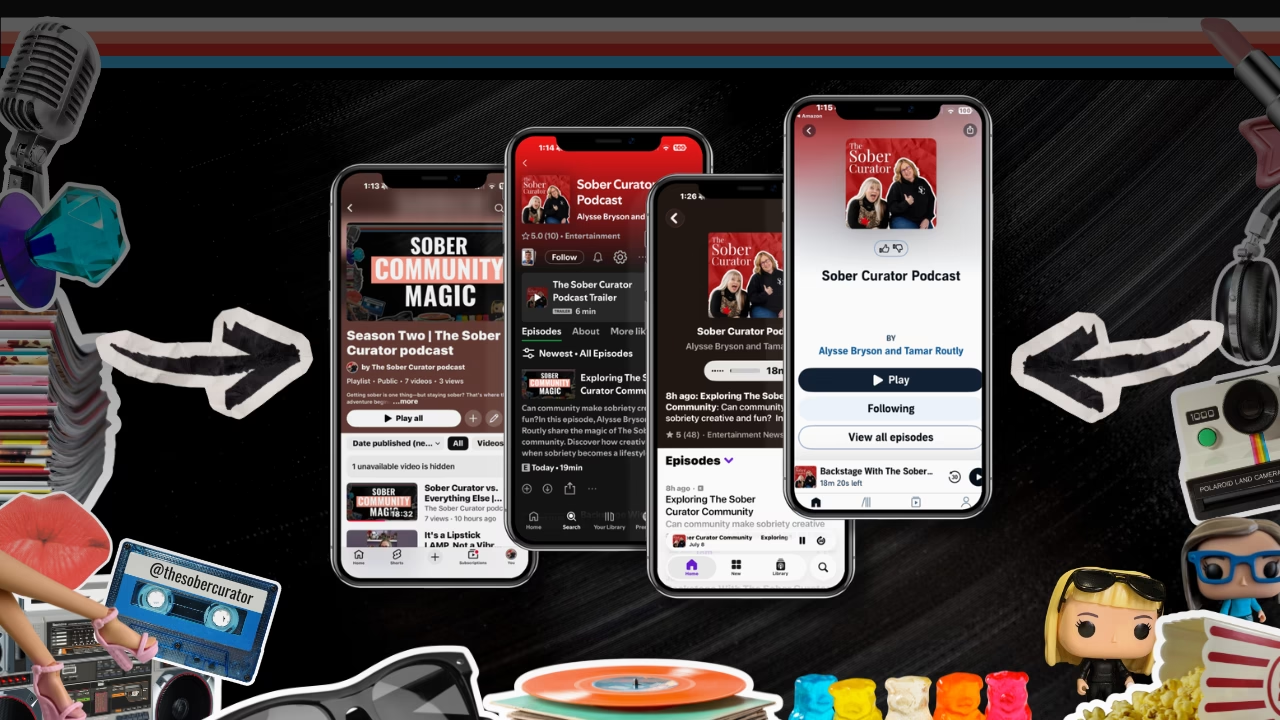
The Sober Curator Podcast is available across all major platforms
👉Watch or listen to the show on Spotify
👉Listen to the show on Apple Podcasts
RECOVERY PODCASTLAND & NETWORK at The Sober Curator is your audio haven for all things sobriety and recovery. We’re your bee-zy sober podcast enthusiasts, curating the best shows that educate, inspire, and entertain in the alcohol-free space.
Our archives are neatly organized so you can easily explore Recovery Podcastland—featuring our favorite recovery-based podcasts from across the globe—and the TSC Podcast Network, where we share our own original shows on sober lifestyle, pop culture, travel, entertainment, and more.
Whether you’re seeking practical recovery tips, personal stories, or uplifting inspiration, this is your go-to listening guide. 🎧 Submit a Podcast for Review: Recovery Podcastland coverage and reviews. Shows that earn their place in our audience’s queue. Submit your podcast →
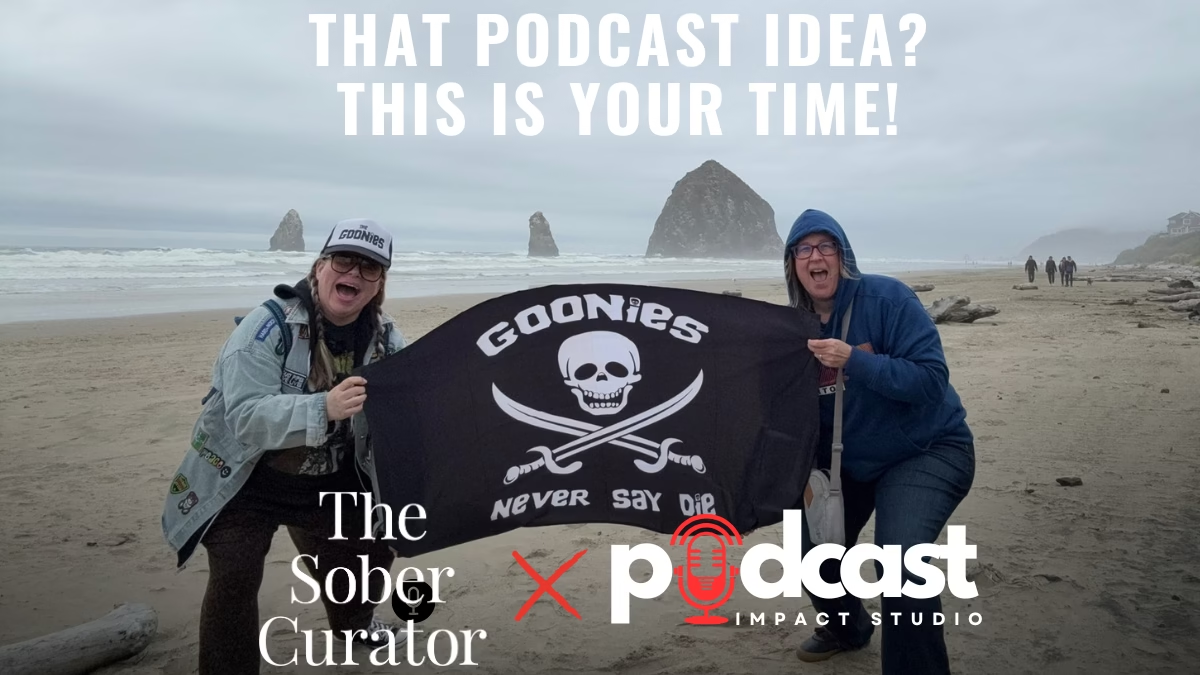
That podcast idea you keep circling? It’s time.
You’ve got ideas. Stories. Opinions. A perspective shaped by lived experience, recovery, and a deep understanding that the world needs more honest conversations. And yet, the podcast is still just an idea sitting in your Notes app.
If that sounds familiar, you’re in the right place.
We are holding space for people who have been dreaming about launching their own podcast but don’t know where to begin or how to do it without burning out, overspending, or losing momentum halfway through episode three. LEARN MORE HERE.
A Disco Ball is Hundreds of Pieces of Broken Glass, Put Together to Make a Magical Ball of Light. You are NOT Broken, Friend. You are a DISCO BALL!

Resources Are Available
If you or someone you know is experiencing difficulties surrounding alcoholism, addiction, or mental illness, please reach out and ask for help. People everywhere can and want to help; you just have to know where to look. And continue to look until you find what works for you. Click here for a list of regional and national resources.

Subscribe to The Sober Curator on YouTube
What is “The Hazards of Podcasting Sober” about? It’s Season 2, Episode 11 of The Sober Curator Podcast, a two-host conversation between Alysse Bryson and Tamar Routly about what happens when you share your recovery publicly: family members hearing stories secondhand, knowing your audience, pitching yourself to podcasts, podcast tech, and why a co-host makes everything easier.
Why don’t sober podcasters get the “blackout excuse”? Because there isn’t one. When a sober host says something they regret on mic, they can’t blame a blackout. They own it, walk it back on the record, or ask for an edit. As Alysse puts it, podcasting is live documentation of learning out loud.
Should you tell family before sharing your recovery story publicly? The episode’s answer is yes, when the story involves them. Alysse’s mom heard part of a story on a podcast that should have come from her daughter. Tamar’s parents read her book before the long conversation happened. Both hosts recommend talking to the people in your story before they meet it in your content.
How do you pitch yourself to a podcast? Do the research first. Confirm the show is still publishing, learn the host’s name, know who the audience is, and customize the pitch so the host only has to pick a date. Alysse notes that seven of the top 50 sober podcasts on a recent AI-generated list had not released an episode in 2026.
What mic do The Sober Curator Podcast hosts use? Tamar recommends the Shure MV series as a reliable mid-budget option. Alysse has gone through several mics because her voice overloads them. The bigger rule: record in a good space, because no one wants to hear you in a tunnel.
How do I join Backstage with The Sober Curator? Backstage is the paid membership community that hosts weekly AI meetings, writing courses, guest speakers, and member perks including The Sober Curator Mixtape, a monthly snail mail zine set that members receive free by covering shipping.