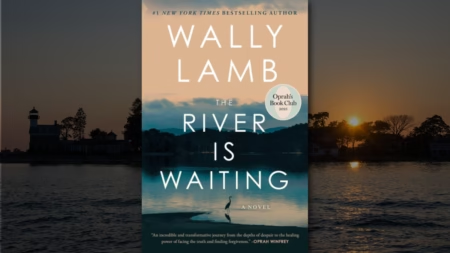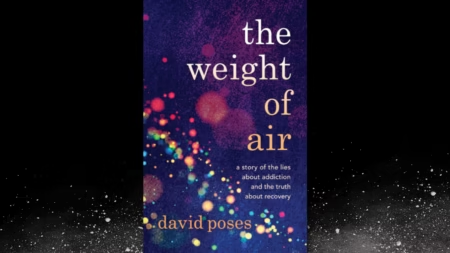
To write your recovery story is an act of courage. Writing a raw memoir, writing ‘Addiction Fiction,’ or crafting a self-help guide for the sober-curious, your work, writing them down, has the potential to change lives. But of course, you will have your first draft, and before you have a polished masterpiece, there will need to be some editing.
Sobriety equals the ultimate glow-up, and your writing should echo that change. This professional book editing process makes sure your message isn’t merely heard, but sensed. It turns the ‘choppy’ aspects of a journal-like draft into an integrated, rhythmic narrative that bounces off the page.
Why Professional Book Editing Is So Necessary for Your Recovery Story
Many authors working in the recovery space begin by writing for themselves. It’s therapy. But when you choose to tell that story to the world, the objective transforms from self-healing to public communication.
This is where book editing services become necessary. A good editor doesn’t correct typos; they protect your voice. In the world of ‘Quit Lit,’ in which vulnerability is central, an editor makes sure your story remains authentic while removing the structural mess that can draw readers away from what they need to know.
They help you push through your ‘muddy middle,’ ensuring the pacing keeps readers engaged from the first glass of water to the final milestone.
Knowing Different Levels of Book Editing
Before you hire a professional, know what level of support your manuscript requires.
Book editing generally can be divided into three big categories:
- Developmental Editing – This is the high-level strategy for your book. What does your arc in recovery seem to be? Are there gaps in your timeline? There’s a developmental editor who studies the ‘big picture’ of your sobriety narrative.
- Copyediting – This is the technical side of things (e.g., grammar, punctuation, style). In the world of recovery writing, consistency is key. A copyeditor keeps your terminology and tone consistent in the text.
- Line Editing – This involves the artistic side of book editing. A line editor works on ‘the flow’ and ‘voice of your prose,’ determining if your sentences land and keep your prose as clear as a sober morning.
Your Unique Voice In Recovery
But one of the biggest fears authors have is that book editing will make them sound like another person. A ‘Unicorn Editor,’ a true professional who really knows everything you need to know about addiction and recovery, won’t rewrite your story for you.
Instead, they bring the polish that lets you be who you are, your real self, and lets you shine through more brightly. When you spend time on book editing, you don’t just change your truth; you lend your truth the professional platform it deserves.
For self-publishing, in particular, where you get complete control over the creative process but also responsibility for the quality of the final product and the form it takes to achieve that artistic output, this is incredibly important.
From ‘Journal’ to ‘Journalism.’
A lot of these powerful memoirs begin as diary entries. They work well for conveying raw emotion, but the format isn’t what readers want when they’re reading. Book editing helps to bridge the gap. An editor can tell you where the reader’s ‘journaling’ is repetitive, and it’s time to add detail to your ‘storytelling.’ They help you determine what to keep in and, most importantly, what to leave out in order to make your main idea stronger.
The Quit Lit Market Competitive Advantage
Both the sober lifestyle and the ‘Quit Lit’ genres are exploding. To be accepted among the thousands of books published yearly for recovery, you must have expert-level work. Publishers or readers can tell the difference between a self-edited draft and one that underwent a rigorous edit. If you want your book to be bought in local bookstores or published online, professional editing is your ticket.
Looking for the Right Editor for Your Sober Path
When you’ve decided you want to hire someone to sort out your arguably most vulnerable moments, it’s not easy. It’s a serious decision.
What you want is someone who:
- Has experience in the recovery or self-help genres.
- Provides a sample edit so you can test their ‘vibe.’
- Honors the nature and sensitivity of the matter at hand.
- Realizes that writing about addiction also demands empathy at a different level from that of fiction.
Conclusion
Your story is worth the polish.
Your arc from addiction to recovery is a work in progress. But by going through the process of professional editing, you’re paying homage to your experience.
You want the world to know your story matters enough to be told well and to be a legacy of your life.

SOBER CONTENT CREATION: On Writing and Recovery – Reflections on Failure from a Writer in Recovery

#QUITLIT: Sobriety and Hope Through Writing in Picture of Me
TSC LIBRARY: Welcome to The Sober Curator Library! This isn’t your average stack of books—we’re talking full-on story immersion, Audible binges, and reviews with personality. Browse our four go-to genres: #QUITLIT, Addiction Fiction, Self-Help, and NA Recipe Books. And if you’re collecting recovery reads like rare trading cards, check out our Amazon #QUITLIT list—Early Sobriety Survival: Books for Your First 90 Days.
A Disco Ball is Hundreds of Pieces of Broken Glass, Put Together to Make a Magical Ball of Light. You are NOT Broken, Friend. You are a DISCO BALL!

Resources Are Available
If you or someone you know is experiencing difficulties surrounding alcoholism, addiction, or mental illness, please reach out and ask for help. People everywhere can and want to help; you just have to know where to look. And continue to look until you find what works for you. Click here for a list of regional and national resources.