The Dark Side of Addiction … and the Light at the End of the Tunnel

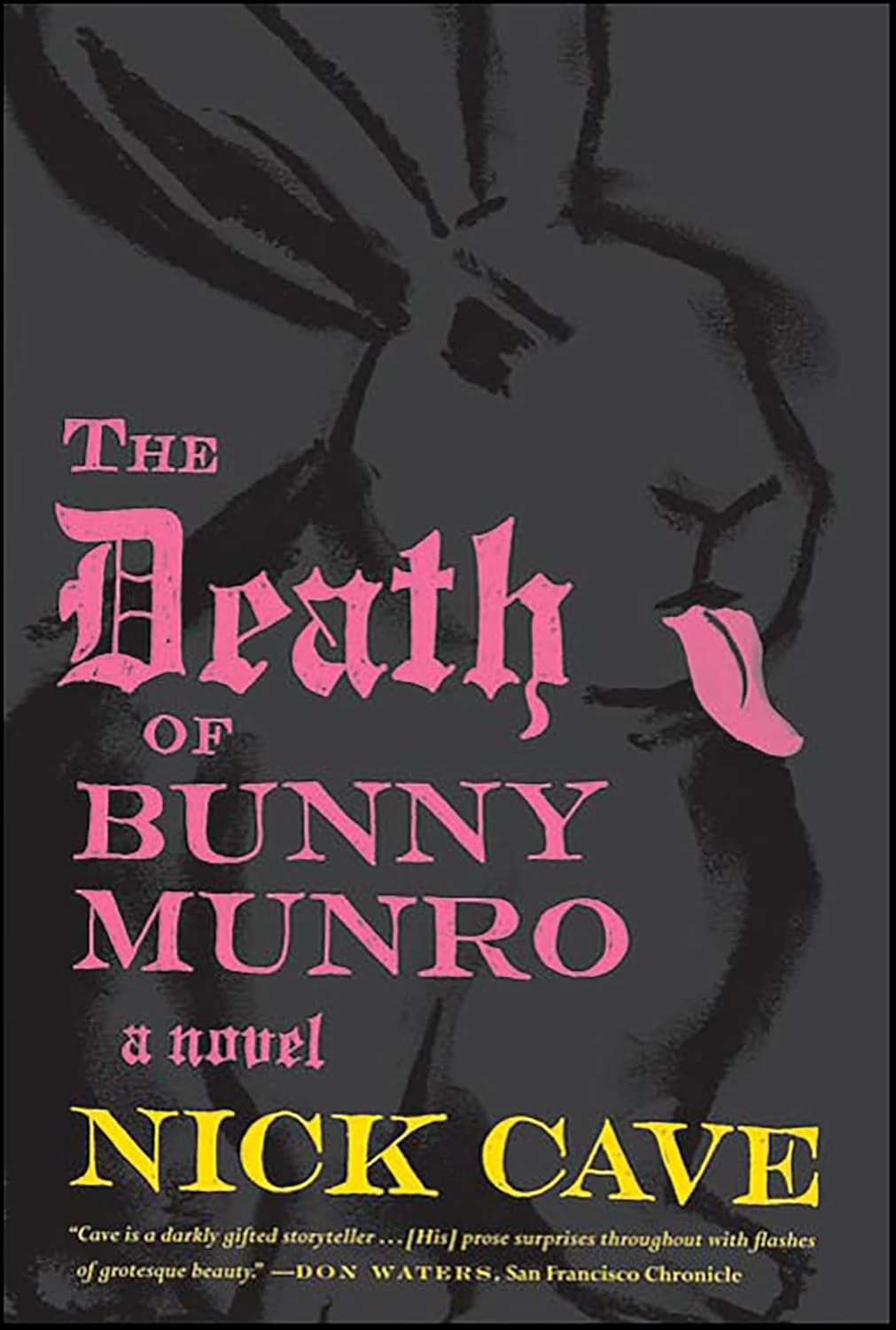
I started writing this piece as a simple review of the book and series ‘The Death of Bunny Munro’ but it turned out to be not that simple. To review this story, I think one has to dive deep into the author, Nick Cave, to see what lies behind it.
A simple review would go something like this:
Nick Cave’s “The Death of Bunny Munro” is a novel and series that looks starkly at addiction. It isn’t treated as a subplot or a psychological quirk; no, it is the force that drives Bunny forward, even as it hollows him out. From the first scene, we are submerged in Bunny’s obsessive sex addiction and alcoholism. But Bunny Munro is not just addicted to substances, but to desire itself: to women, to validation, to the fantasy that the next indulgence will finally fill the bottomless void.
Cave portrays addiction less as a series of bad choices than as a narrowing of perception. And as a man in recovery himself, Cave’s portrayal of Bunny runs deep. Bunny’s inner monologue loops obsessively, repeating the same hungers and justifications until the world around him becomes distorted. He portrays his obsessions and grief as feelings that can only be anesthetized, never processed.
As I watched, I felt trapped inside Bunny’s claustrophobic logic of addiction, where self-awareness exists but never leads to change. As a recovering addict myself, I wanted to scream at Bunny to stop! … especially as we watch Bunny with his son, repeating the same horrible mistakes that Bunny lived through with his own father. Bunny knows he is failing—particularly as a father—but addiction allows him to see every failure as temporary, circumstantial, someone else’s fault. Cave does not romanticize anything about addiction. Bunny’s binges are not glamorous; they are dark, repetitive, degrading, and deadening.
The novel/series offers little redemption, but in its relentless honesty, it delivers a powerful, uncomfortable meditation on how addiction consumes not only the addict but everyone forced to orbit them. The story is told with such brutal honesty and pain that the reader/viewer has no doubt this comes from an addict’s own experience.
The Death of Bunny Munro is not based on a true story; however, Cave has described certain aspects of the plot as autobiographical:
“The thing about Bunny Munro, which I understand perfectly well, is being a human being that is not in particularly showroom condition. I had my dark side, and I was navigating a whole lot of stuff that was very complex and just deeply problematic. And having to look after a child at the same time, and learning the way a parent can try, at least, to keep that part of [themselves] away from the child, and keep the child buoyed up. This was the fundamental driving force in the relationship between the father and son, which I understood clearly. So, I feel, in that respect, it’s very autobiographical. I don’t have his particular predilections, but I do understand him.”
After watching the first episode, I could feel the addict telling the story. An interview with Gaudir Vinil shed light on part of his story:
In the 1980s, Nick Cave experienced a period of severe heroin and speed addiction while living in West Berlin and leading Nick Cave & The Bad Seeds. During this chaotic time, which included arrests for drug possession, the band was known for its intense, often unstable live performances.
In true addict fashion, Cave explains that for approximately 20 years, a period that heavily encompassed his time in Berlin, his life was chaotic and he was “constantly” in search of his next fix.
In a beautiful interview on ‘On Being,’ Cave discusses loss, yearning, and transcendence; he addresses the idea that:
Addiction isn’t just about excess—it’s about absence: the inability to sit with pain, responsibility, or love without reaching for something to dull it.
In an interview with NME (New Musical Express) in 2020, Cave admitted that he wouldn’t have survived his addiction to heroin if he hadn’t gone to Narcotics Anonymous meetings. He speaks openly and honestly about the complexity of sobriety. It is not a straight line nor a simple journey.
In 2018, Cave started his blog, The Red Hand Files:
It started as a simple idea – a place where I would answer questions from my fans. Over the years, The Red Hand Files has burst the boundaries of its original concept to become a strange exercise in communal vulnerability and transparency. Hundreds of letters come in each week, asking an extraordinarily diverse array of questions, from the playful to the profound, the deeply personal to the flat-out nutty. I read them all and try my best to answer a question each week. The Red Hand Files has no moderator, is not monetized, and I am the only one with access to the questions that sit patiently waiting to be answered. Thank you all for being a part of what has become, at least for me, a life-changing, soul-enriching exercise in commonality and togetherness.
Cave’s advice in The Red Hand Files is usually raw and direct.
His advice to one reader who was reluctant to attend NA was:
Personally, I have a lot of time for Narcotics Anonymous, but I do understand your resistance to the idea. I was the same. In my heart, I never really got it — never felt the same connection other people seemed to have. I always felt outside the idea, looking in. I could never fully commit. However, I think it would be fair to say that if it weren’t for NA, I probably wouldn’t have survived my heroin addiction. Narcotics Anonymous was this thing, steady and ever-present, that just never ever went away, a place I could come crawling back to, again and again, year after year, and be accepted and welcomed, welcomed back in. In this respect, I owe Narcotics Anonymous my life. When no one else would have me, Narcotics Anonymous always would … In the end, you find your own way. Ultimately, I found mine, but it took Narcotics Anonymous to show me the way … Reading your letter again, my advice to you — and to me — go to a fucking meeting.
Another letter that really hit me was to a woman who had overdosed:
I don’t know the circumstances of your overdose, but if it is related to drug dependency, then in my experience, people don’t usually overdose just once – they tend to overdose a couple of times, and then all too often die. With that in mind, my advice to you is to get clean.
One simple way to start doing this is to go to Narcotics Anonymous. If you persevere, in time you will have an entirely different problem – not that life is meaningless, but rather that life has almost too much meaning. As the scales fall from your eyes, the world rushes into focus, presenting itself with a kind of vibrational eloquence that can, at first, be almost overwhelming. Everything shimmers, everything clarifies, everything wrestles for your attention. Trees feel super-real, their roots plunged into the earth, their branches stretching to the sky, birds are flesh and blood souls, fragile with life, the sky unfolds and rolls, the ocean crashes, people fascinate, books are beautiful, children are whirling dynamos of chaos, dogs bark and cats meow, flowers shout, your neighbour glows, and God runs like a helix through all things. The world awaits you, humming with meaning. You are alive with potential. You are not dead.
So, Zara, a few things you need to do. Stop fucking around and get your shit together. Get clean and don’t die.
Love, Nick
In conclusion…
I really wanted to scream these words at Bunny Munro as I watched him spiral out of control … Stop fucking around and get your shit together. Get clean and don’t die! Alas for poor Bunny, there was no light at the end of the tunnel.
The Mindful Binge Sobees Score: 4.5 out of 5

TSC LIBRARY: Welcome to The Sober Curator Library! This isn’t your average stack of books—we’re talking full-on story immersion, Audible binges, and reviews with personality. Browse our four go-to genres: #QUITLIT, Addiction Fiction, Self-Help, and NA Recipe Books. And if you’re collecting recovery reads like rare trading cards, check out our Amazon #QUITLIT list—Early Sobriety Survival: Books for Your First 90 Days.

MOVIE NIGHT WITH THE SOBER CURATOR: is your go-to guide for films and documentaries that intricately weave addiction, recovery, and mental health into powerful storytelling. Think of us as your bee-zy movie critics, curating a hive of must-watch titles that inspire, educate, and spark conversation.
Our review archives are neatly organized into Drama, Dramedy, and Documentary categories, making it easy to find your next captivating watch. Whether you’re in the mood for a heartfelt indie, a laugh-through-the-tears comedy, or a thought-provoking doc, we’ve got you covered.

SOBER POP CULTURE at The Sober Curator is where mainstream trends meet the vibrant world of sobriety. We serve up a mix of movie, podcast, fashion, and book recommendations alongside alcohol-free cocktails, celebrity features, and pop culture buzz—all with a sober twist.
We’re here to shatter the “sobriety is boring” myth with a mash-up of 80s neon, 90s hip-hop edge, early 2000s bling, and today’s hottest trends. From celebrity shoutouts to red-carpet style inspo, this is where sober is as chic as it is fun. To the celebs using their platform for good—our Sober Pop Trucker hats are off to you!
Resources Are Available
If you or someone you know is experiencing difficulties surrounding alcoholism, addiction, or mental illness, please reach out and ask for help. People everywhere can and want to help; you just have to know where to look. And continue to look until you find what works for you. Click here for a list of regional and national resources.