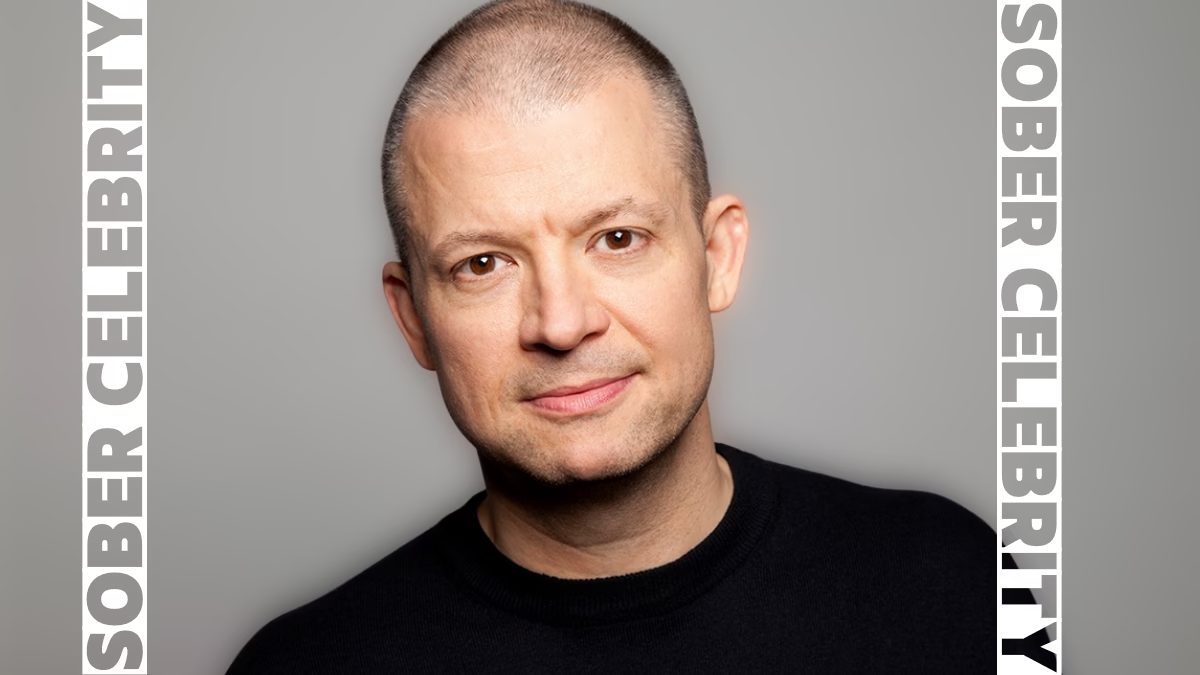
Jim Norton Has Been Sober for Over 30 Years. He’ll Be the First to Tell You It Didn’t Fix Everything. His whole career is built on saying the stuff most people only think in a shame spiral at 3 a.m.
Jim Norton is one of the most respected voices in stand-up comedy — not because he’s the most polished or the most mainstream, but because he goes to places most comedians won’t. The darkness in his material is not performed. It’s reported. He has lived enough of it to fill several careers, and he got sober before most of it happened.
He stopped drinking as a teenager. As of 2026, that is over 30 years without alcohol. What he will tell you, and has told you, in interviews and on stage and in his books, is that sobriety from alcohol was the beginning of the work — not the end of it.
Sobriety Snapshot
| Sobriety Date | Late 1980s / early teens |
| Years Sober | 30+ years (as of 2026) |
| Substance | Alcohol |
| Turning Point | His body and brain gave out before the consequences caught up with him |
| Quote | “Getting sober didn’t make me normal. It just gave me a chance to figure out what normal was never going to look like for me.” |
The Struggle: Starting Young, Stopping Young
Jim Norton grew up in New Jersey and started drinking as a teenager. He has described his relationship with alcohol as immediately compulsive — not a gradual slide but a fast recognition that drinking did something for him that he was not able to replicate any other way.
He was not a slow burn. He drank the way he has described doing most things: all the way, without a natural off switch.
He got sober young enough that his public career — the Opie & Anthony years, the stand-up specials, the books, the Jim & Sam Show — has existed almost entirely in recovery. Most of his audience knows him only as the sober version. What he has been consistent about in interviews is that the sober version is not a tamed or simplified version of who he was. It is a more honest one.
The Turning Point: When the Body Says No
Norton has described his decision to stop drinking as less of a spiritual awakening and more of a physical reckoning. His body and brain were done before the external consequences had fully caught up with him. He did not wait for the floor to come up to meet him. He stopped because continuing was no longer a viable option from the inside.
He has spoken about this in interviews with a characteristic lack of sentimentality. He did not get sober because he had a moment of clarity about the life he wanted to build. He got sober because the alternative had stopped being functional.
That is a specific and underrepresented entry point into recovery, and it is worth naming. Not every sobriety story starts with a dramatic bottom. Some of them start with a quiet, private recognition that the engine is failing — and a decision to stop before the crash.
The Recovery: Sobriety Didn’t Quiet the Noise
Here is where the Jim Norton story gets more interesting than a standard celebrity sobriety profile.
He stopped drinking. The feelings, the compulsions, and the internal chaos did not stop with it. He has been open about the fact that alcohol was one exit ramp on a highway that had several others — and that getting sober meant confronting the highway itself rather than just closing off one lane.
His brain did not quietly settle down. The same intensity that made drinking appealing in the first place was still running underneath everything, looking for somewhere to go. He has talked about this with the same directness he brings to his comedy — without softening it into a recovery narrative that ties up neatly.
What he built instead was a whole toolbox rather than a single hammer. Therapy. Honesty about his compulsions in public and in private. A willingness to keep examining the parts of himself that were uncomfortable to look at. He did not get sober and declare himself fixed. He got sober and started the longer, less linear work of figuring out what was actually going on.
Making Pain Funny: The Sobriety-Comedy Connection
There is a version of this story where getting sober softened Jim Norton’s material. That version did not happen.
What sobriety actually did was give him consistent access to the material without the interference. The darkness in his stand-up — the compulsions, the self-loathing, the specific textures of being a person who does not quite fit the standard social operating system — is all drawn from real experience. Sobriety did not remove the experience. It gave him a clearer line to it.
He has talked about the relationship between his recovery work and his comedy as genuinely connected. The same honesty that recovery asks of you — the inventory, the willingness to look at yourself without flinching — is the same muscle that makes confessional comedy work. You cannot do what Norton does on stage if you are not willing to do a version of it in private first.
The darkness is honest and out in the open now. It always was his. Sobriety just meant he could use it with intention rather than drowning in it.
Recovery does not kill your edge. It kills the part of edge that was really just self-destruction in a more interesting outfit.
Life After: 30 Years of Showing Up Complicated
Norton has released multiple stand-up specials, written two books — Happy Endings and I Hate Your Guts — and spent years as a central voice on Opie & Anthony and later Jim & Sam on SiriusXM. He has been a regular presence on The Tonight Show, Conan, and The Howard Stern Show.
He is not a recovery spokesperson. He does not position his sobriety as the headline of his career. But he talks about it honestly when it comes up, with the same refusal to clean it up that characterizes everything else he does publicly.
He is in his mid-50s. He has been sober for over 30 years. He is still one of the most distinctive voices in comedy, still working, still going to the places most people won’t go.
He got sober as a teenager and became more honestly himself. That is not the simplest version of a recovery story. It is the most useful one.
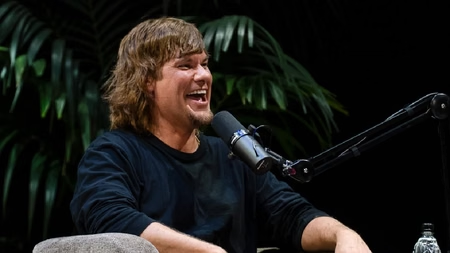
Why Jim Norton Stopped Drinking as a Teenager | Joe Rogan
Sources and Further Reading
- Jim Norton on sobriety and compulsive behavior: The Howard Stern Show
- Jim Norton and Sam Roberts Show: SiriusXM
- Jim Norton stand-up specials: HBO and Comedy Central
- The Sober Curator: Punchlines, Not Pints – 20 Comedians Who Prove You Don’t Need Alcohol To Be Funny
He did not get sober and become wholesome. He got sober and became more honestly himself. For anyone who thinks recovery requires giving up who they are, Norton is the argument that it does not.
SOBER ENTERTAINMENT: Punchlines, Not Pints – 20 Comedians Who Prove You Don’t Need Alcohol To Be Funny

Subscribe to The Sober Curator on YouTube
How long has Jim Norton been sober?
Jim Norton stopped drinking as a teenager in the late 1980s. As of 2026, that is over 30 years of sobriety from alcohol.
What did Jim Norton struggle with?
Alcohol, which he has described as immediately compulsive from the first time he drank. He has also been open about ongoing struggles with compulsive behavior more broadly — making the point that sobriety from alcohol did not resolve the underlying patterns that made drinking appealing in the first place.
Why did Jim Norton get sober?
He has described it as a physical and psychological reckoning rather than a dramatic external event. His body and brain gave out before the consequences fully caught up with him. He stopped because continuing was no longer viable from the inside.
Does sobriety come up in Jim Norton’s comedy?
Yes, though not as a centerpiece. His material draws heavily on compulsion, self-awareness, and the specific experience of being someone who does not operate on the standard social settings. The recovery work he has done is visible in the honesty of his comedy even when sobriety itself is not the explicit subject.
Has Jim Norton written about sobriety?
His two books — Happy Endings (2007) and Monster (2012) — both deal with his interior life with considerable honesty. Neither is a recovery memoir in the traditional sense, but both reflect the self-examination that his recovery has required.
Does Jim Norton talk about sobriety publicly?
Yes. He has discussed it in interviews on The Howard Stern Show, in long-form profiles, and in various podcast appearances over the years. He is consistent in describing sobriety as the foundation of his adult life while being equally consistent about the fact that it did not resolve everything.