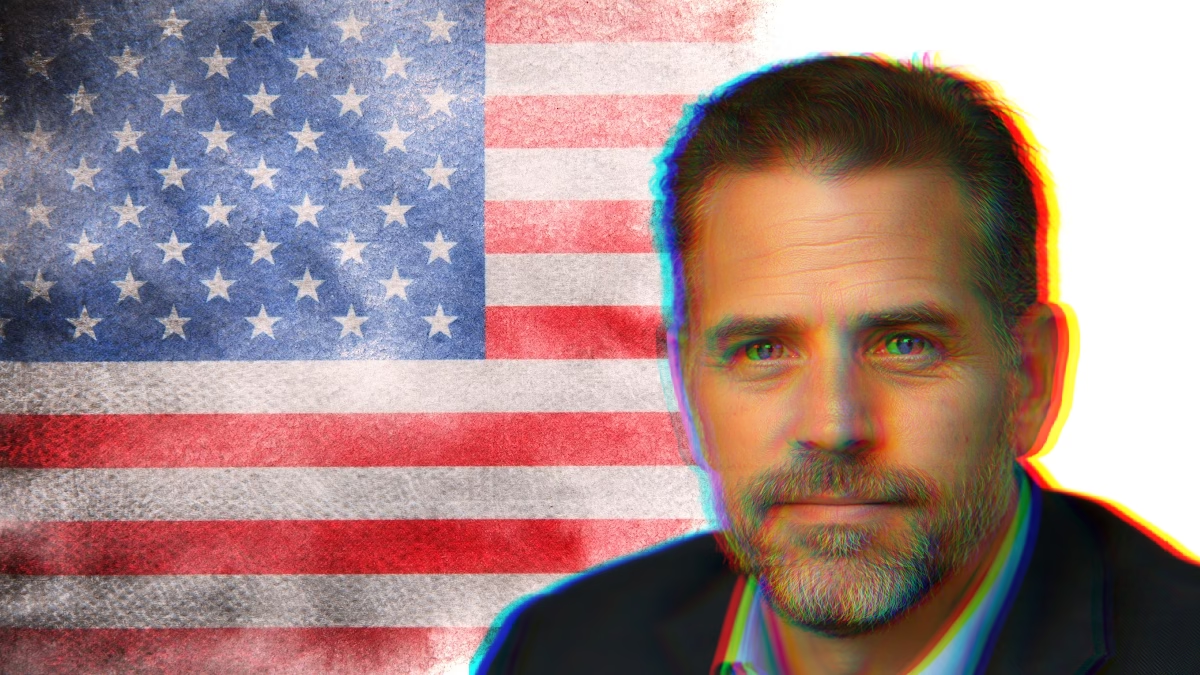
Hunter Biden has become a vocal, unlikely advocate for recovery, delivered from inside one of the most unforgiving spotlights in American politics. During the 2020 election and the four years that followed, he was picked apart in the tabloids daily: “I was literally stripped bare, literally stripped naked in the public square. I had nowhere left to hide. I had no more secrets that I could keep.”
Throughout it, Joe Biden never wavered in his support, often calling his son one of the most decent, honorable, and resilient people he knew. Hunter, meanwhile, has been candid that his own path was anything but linear, an odyssey of recovery, relapse, and recovery again, each round harder than the last:
“I was able to drink and be functional for a long time. Not until 2003, when my brother confronted me… Eventually, I just said I needed help. I went to rehab, and it worked for about seven years, until it didn’t. I relapsed. I was on a plane. The drink cart rolled by. The flight attendant asked if I’d like a bloody mary. I said, hmm. Sure. (And here’s where addiction is insidious. You’re ashamed that you somehow failed because you’ve just relapsed. You don’t want to get honest with yourself about it. And therefore, you don’t get honest with anybody around you about it. And so now you’re hiding something. And I went through from 2010 up until 2019, it was an odyssey of recovery, relapse, recovery in varying degrees that became worse and worse.)”
He’s described the years of leaked material, investigations, and prosecutions as something that stripped away any remaining ability to hide, and in that exposure, he’s been unflinching about the cost to the people closest to him: “In addiction, the first people you harm are the ones who love you the most.”
Few of us have had to be this honest publicly about recovery. Biden testified in federal court that he’s been sober from alcohol and drugs since June 1, 2019. Since then, he’s been reframing his addiction, from scandal into a kind of expertise, choosing honesty and service over concealment. In interviews and on social media, he pulls the conversation past politics entirely, toward resilience and connection.
He’s insistent that addiction isn’t a moral failure but a response, something that works, for a while, before it doesn’t. The echo of Gabor Maté’s work is clear: addictive behaviors often start as a functional way to cope with pain or trauma. Not why the addiction, why the pain.
On more politically minded platforms, like The Left Hook with Wajahat Ali, he lets recovery language bleed directly into political commentary: “Looking at all the secrets in the government at the moment… I learned in recovery that you are only as sick as your secrets, and with a government so steeped in secrets, you’ve got to know that this government is very sick.”
He draws the parallel out further: political rehabilitation and personal recovery, he argues, run on the same principle: exposure over concealment, honesty over image management. “I believe in truth and reconciliation — the lessons we learned from post-apartheid South Africa. There is no way forward unless you’re honest with each other. I learned these lessons in recovery. We have to get honest with ourselves before we’re able to heal.”
His message to the addict who still suffers is that they’re not alone, that addiction is a national condition, not an individual failing, and that honesty is the only way through it. Asked whether staying sober is a daily struggle, his answer resists the expected script entirely: “No, it isn’t. It’s beautiful. Just days are beautiful, beautiful things. I am more grateful for my life, all of it, right now, than I’ve ever been in my entire life.”
What makes Biden’s story unusual isn’t that a public figure got sober; it’s that he’s refused to let sobriety become just another chapter to move past quietly. He’s turned the very thing that was used to humiliate him into the material of his advocacy, arguing that the country’s dysfunction and his own are cut from the same cloth: best dealt with by exposure rather than denial. It’s a strange kind of optimism to find in the middle of a political circus… but maybe that’s the point. Recovery, in his telling, was never a private matter to begin with.
SPEAK OUT! SPEAK LOUD! at The Sober Curator is a celebration of authentic voices in recovery—echoing Madonna’s call to “Express yourself!” Here, readers and contributors take the spotlight, sharing transformative sobriety journeys, creative talents, and new avenues of self-expression discovered along the way. Through videos, poems, art, essays, opinion pieces, and music, we break the silence that often surrounds addiction, replacing it with connection, hope, and inspiration.
Your story matters—and we want to hear it. ✏️ Submit Your Story to Speak Out! Speak Loud! Reader-written essays and opinion pieces. We publish sharp, specific, witty writing about modern sobriety. Submit your story →
Disclaimer: All opinions expressed in the Speak Out! Speak Loud! Section are solely the opinions of the contributing author of each individual published article and do not reflect the views of The Sober Curator, their respective affiliates, or the companies with which The Sober Curator is affiliated.
The Speak Out! Speak Loud! posts are based upon information the contributing author considers reliable. Still, neither The Sober Curator nor its affiliates, nor the companies with which such participants are affiliated, warrant its completeness or accuracy, and it should not be relied upon as such.

Recovery is hard 24/7, 365 – Please know that resources are available
If you or someone you know is experiencing difficulties surrounding alcoholism, addiction, or mental illness, please reach out and ask for help. People everywhere can and want to help; you just have to know where to look. And continue to look until you find what works for you. Click here for a list of regional and national resources. If your life or someone else’s is in imminent danger, please call 911. If you are in crisis and need immediate help, please call: 988.
Follow The Sober Curator on X, the artist formerly known as Twitter
Is Hunter Biden sober?
Hunter Biden has said he has been sober from alcohol and drugs since June 1, 2019. His recovery followed years of treatment, relapse and repeated attempts to get sober.
Has Hunter Biden spoken publicly about addiction and recovery?
Yes. Hunter Biden has discussed his addiction, relapse and recovery in interviews, public appearances and other platforms. He has increasingly framed his experience as something that can be used to talk about resilience, honesty and connection rather than simply as a source of scandal.
What has Hunter Biden said about relapse?
Biden has described experiencing multiple periods of recovery and relapse between 2010 and 2019. He has spoken about the shame that can accompany relapse and how hiding it can make it harder to be honest with yourself and others.
How did Joe Biden support Hunter Biden during his addiction and recovery?
According to the article, Joe Biden remained publicly supportive of his son throughout years of addiction, recovery and intense scrutiny. That relationship illustrates the role family support can play while someone navigates substance use disorder and recovery.
Why does Hunter Biden connect recovery with politics?
Biden has applied ideas he learned in recovery — particularly honesty, accountability and confronting secrets — to his political commentary. Patti’s piece argues that he sees both personal recovery and broader social healing as requiring truth rather than concealment.