



On family stories, old recipes and choosing what we carry forward.
Every November, my father would load my sister, brother and me into the back seat of our red Ford Maverick and take us to visit the dead.
There was one seat belt between three children and no concern whatsoever about it. It was the 1970s, after all, and we were headed out for Cemetery Day.
I don’t know if other families had Cemetery Day. I suspect most children spent their weekends doing something more exciting than visiting the graves of relatives they’d never met. But in our family, this was what we did. My father had people to visit, stories to tell and three children to keep from wandering off among the headstones.
We visited Mt. Olivet and Fort Lincoln cemeteries, stopping at the graves of grandparents, great-grandparents, aunts and uncles. My father would say a prayer and tell us something about each person. Sometimes it was funny. Sometimes it was about their life, their work or the way they died.
Most of those stories have faded from my memory, but I can still hear my father’s voice telling them. He wanted us to know our people, even the ones who had died long before we were born.
One of those people was his grandmother, whom I knew as Grandma.
I know so little about Grandma’s life. I know she helped raise my father after his mother died and that he adored her. When she died on Christmas Eve, he cried himself to sleep and wept for days. Decades later, he could still tell me about the food she made and the platter she served it on.
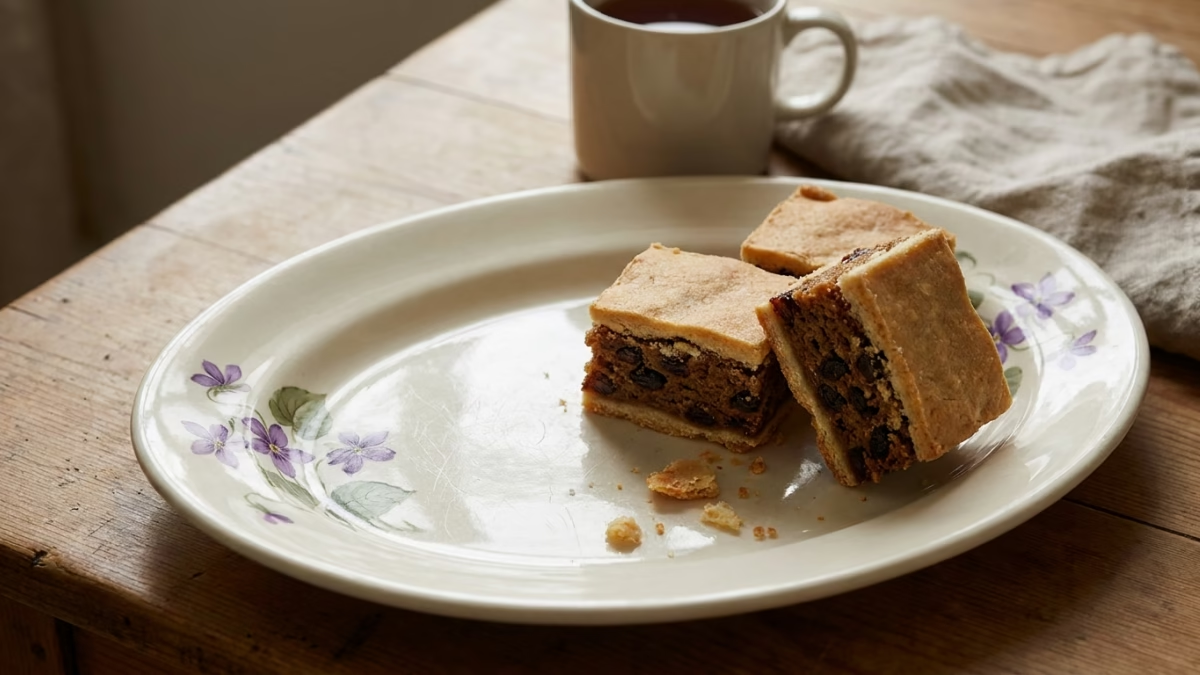
It’s a large, cream-colored platter with a raised edge and little purple violets decorating the inside. My father remembered it filled with soda bread, scones, gur cake, sausage rolls and all sorts of wonderful things coming out of Grandma’s kitchen on Christmas morning.
That platter lives in my home now.
I use it for family dinners and brunches with friends. Every time I take it out, I think about the meals Grandma made and the people she fed, most of whom I’ll never know. I wonder how many conversations happened around that platter, how many holidays it survived and how many people went back for seconds.
I’ve always loved setting a table. I love choosing the dishes, making the food and knowing that people I love are coming over. I especially love when everyone stays long after we’ve finished eating.
I wonder how much of that I inherited.
Of course, families pass down all sorts of things. Recipes, traditions, expressions, questionable opinions about how long to cook a turkey. We inherit ways of celebrating, showing affection, handling disagreements and deciding who gets the last piece of pie.
Some of those things we carry happily into our own lives. Others we reconsider along the way.
Sobriety has given me an opportunity to do a little sorting through my own inheritance. I’ve kept the good food, the storytelling and the pleasure of gathering people around a beautifully set table. I’ve changed what I’m drinking, discovered new ways to celebrate and let go of some things that no longer fit the life I want to live.
I love that I get to make those choices. That I can treasure where I came from and still have a say in what comes next.
November always brings my father’s Cemetery Days back to mind. With Thanksgiving approaching, many of us will be making familiar recipes and pulling out dishes that spend most of the year tucked away in cabinets. Others will be creating new traditions, perhaps for the first time.
All of which has me wondering:
What are you the keeper of?
Is there a recipe you make because someone you loved made it first? A family story you know by heart? An object that carries more meaning than anyone would guess by looking at it?
Or something you’ve created since getting sober that you hope someone else will cherish someday?
And what have you decided not to pass along?
I think about that last question quite a bit. There are things I’m grateful to have inherited and others I’m grateful to have left behind. Both have shaped the life I’m living now.
I don’t know whether Grandma ever imagined her platter would end up in my kitchen or that her great-granddaughter would be writing about her cooking all these years later.
But I think my father would be delighted.
He spent so much time making sure we knew where we came from. And here I am, telling you about his grandmother and sharing a recipe for one of the things she used to make.
Someone tells a story. Someone remembers it. Someone makes the cake.
And another place is set at the table.
From the Kitchen of Grandma Celina: Irish Gur Cake
Gur cake is an old-fashioned Irish bakery treat made with leftover cake or bread, dried fruit, spices and pastry. It’s a delicious example of making something special from what was already in the kitchen.
I don’t have Grandma’s original handwritten recipe, but I’m sharing this traditional-style version in her honor.
Ingredients
- 2 sheets shortcrust pastry
- 3 cups crumbled stale cake or bread
- ½ cup raisins or mixed dried fruit
- ½ cup packed brown sugar
- 1 teaspoon ground cinnamon
- ½ teaspoon ground ginger
- ¼ teaspoon ground nutmeg
- 2 tablespoons melted butter
- About ½ cup strong brewed tea, cooled
- 1 beaten egg or a little milk, for brushing
Instructions
- Preheat the oven to 350 F. Line an 8-inch square baking pan with parchment paper.
- Press half the rolled pastry into the bottom of the pan.
- In a bowl, combine the cake or bread crumbs, dried fruit, brown sugar and spices. Stir in the melted butter, then gradually add the tea until the mixture is moist and holds together without becoming soggy.
- Spread the filling evenly over the pastry, pressing gently into place.
- Cover with the remaining pastry, seal the edges and prick the top with a fork. Brush with beaten egg or milk.
- Bake for 35 to 45 minutes, until the pastry is golden and cooked through.
- Allow to cool completely before cutting into squares. The flavor is even better the next day.
Serve with a strong cup of tea, preferably with someone who has a good story to tell.

LIFESTYLE: How to Host a Hot Chocolate Tasting Party
THIRSTY FOR WONDER: at The Sober Curator, led by Anne Marie Cribben—a passionate recovery coach and spiritual companion based in Washington, DC—offers 1:1 coaching, spiritual guidance, and recovery support rooted in compassion and empowerment. As the creator of The Wellspring: A Celtic Recovery Journey, Anne Marie blends the Celtic calendar with sobriety, connecting participants to ancient wisdom and the rhythms of nature.
A fierce advocate for sobriety as liberation and self-love, she challenges the targeted marketing of alcohol to women and champions authentic, joyful living. Her work goes beyond addiction recovery, fostering a life of vibrancy, purpose, and connection.

SOBER LIFESTYLE: Sober lifestyle is about more than not drinking—it’s about how you actually live.
From fashion and identity to advice, creativity, relationships, sober dating ideas, and everyday routines, this page brings together The Sober Curator’s lifestyle coverage for people building a life that feels good without alcohol at the center.
Sometimes life gets really shitty. Resources are available. Please use them if you need them.
If you or someone you know is experiencing difficulties surrounding alcoholism, addiction, or mental illness, please reach out and ask for help. People everywhere can and want to help; you just have to know where to look. And continue to look until you find what works for you. Click here for a list of regional and national resources.
If your life or someone else’s is in imminent danger, please call 911. If you are in crisis and need immediate help, please call: 988.

