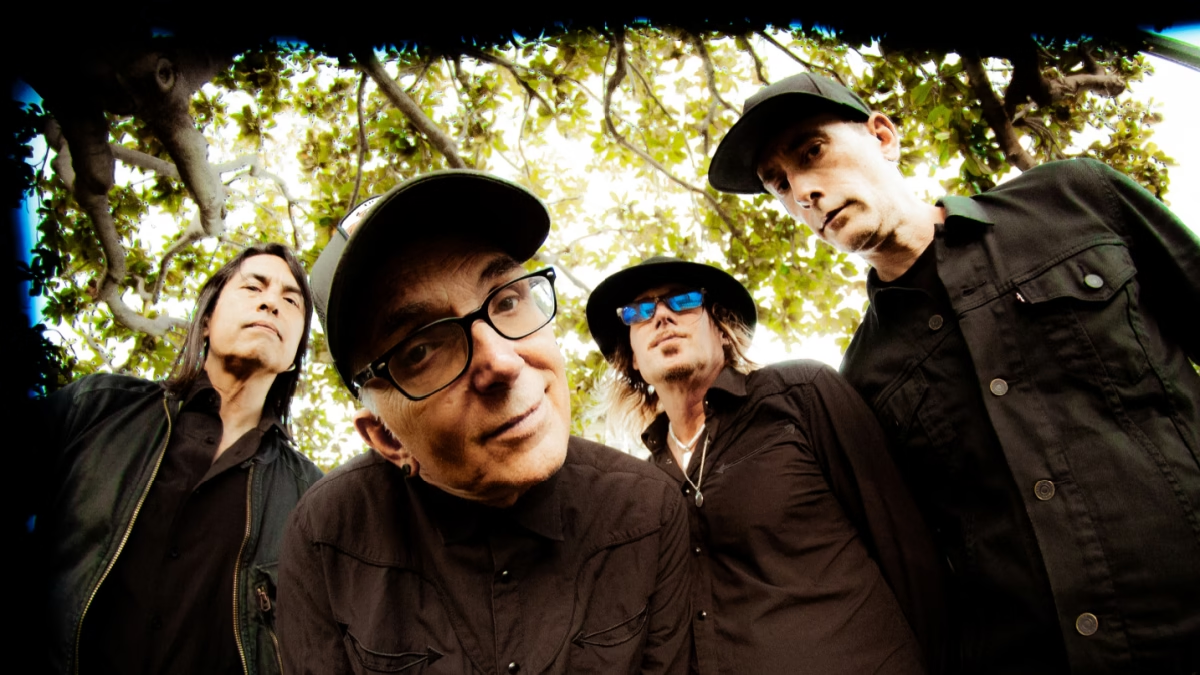
If you’ve followed Everclear at any point over the last three decades, you already know that beneath the sweet-sounding, radio-ready power pop of the Portland, Oregon outfit’s music, frontman Art Alexakis never sugarcoated a damn thing. He’s always been the guy who turned the ugliest parts of his life into songs, ones that just happened to be incredibly catchy and resonated with millions.
But hearing those tracks now, with everything we know in hindsight, you realize they weren’t just hits; they were flare-bright warnings and often brutally autobiographical. Alexakis lost his brother to a heroin overdose and his girlfriend to suicide before his teenage years even began. He tried to take his own life at one point, and when that didn’t work, he was swallowed by a different, yet just as deadly, form of self-destruction using hard drugs and alcohol to cope.
Eventually, and luckily, he entered the sober lifestyle.
And while many assume time smooths out the rough edges, the 63-year-old Alexakis is living proof that life doesn’t always stick to that script. Back in 2016, creeping up on three decades of sobriety – an achievement most would frame as the triumphant second act – he found himself facing a completely different kind of fight. A minor fender bender led to the discovery that a rare form of multiple sclerosis had been quietly sabotaging his body. When he let fans in on what was happening, it wasn’t an admission of weakness; it was him drawing a line, so nobody mistook his symptoms for a relapse.
These days, he’s still out there refusing to slow down. In 2025 alone, Everclear undertook a massive tour marking 30 years of Sparkle and Fade, the record that cemented the band as alt-radio staples, bringing “Santa Monica,” “Heartspark Dollarsign,” deep cuts like “Summerland,” and all the other catalog hits to audiences across the United States and Australia for over 100 shows. And come January, he’s starting all over again, with a string of dates already on the docket deep into the summer.
Over a several-week period, The Sober Curator sat down with Alexakis on three separate occasions to talk about his sobriety. Now 36 years sober and a dedicated member of Alcoholics Anonymous, he was frank and revealing about past struggles, the abuse he once put himself through, and how he’s kept on the path through it all.
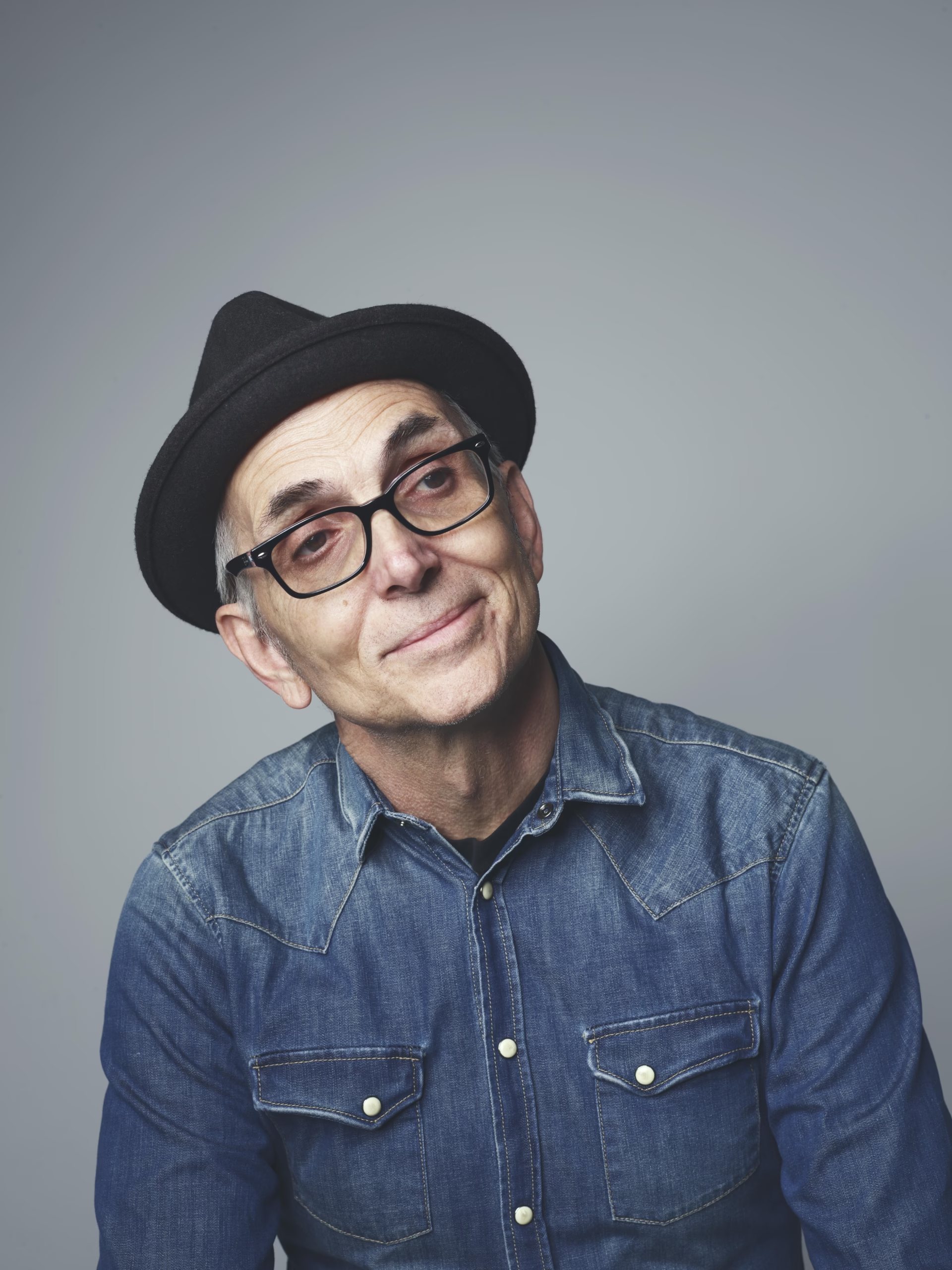
Michael Christopher: Do you know your sober date?
Art Alexakis: June 15th, 1989.
Wow.
I had the white-light moment that people talk about. Full on. And I had been in and out of the rooms for about four or five, almost five years, before that happened.
So, there were a lot of false starts.
Yeah…yeah, you could call it that. You could call it just like…I just wasn’t buying into it. I was holding onto my alcoholic way of thinking, and “I’m not an addict. My brother was an addict. I’m not an addict,” blah, blah, blah. “I’m not an alcoholic. I might be an addict, but I’m not an alcoholic. I might be an alcoholic, but I’m not an addict.” All that crap that most of us go through, and “Well, I can handle this. Let’s have drinks on Friday nights, right? Friday and Saturday nights. Oh, maybe I’ll drink on Sunday too in the morning. What about a beer in the afternoon after work?” You know what I mean? It’s that. That’s what the old school guys called “stinkin’ thinking.” And you’ve heard that term, right? That’s 40s, 50s, 60s, people from the 12-step program. Program people.
Was there anything specific that led to the decision, or was it just enough became enough?
So, some backstory: I quit doing hard drugs after a really bad overdose in June of ’84 – the same day my brother George died of an overdose [a decade prior]. June 15th. After that, I told myself I could still drink. “I’m not an alcoholic.” [laughs] By ’88, ’89, I was living in San Francisco, married, depressed, anxious, and drinking my way through a life I didn’t know how to deal with. I started having blackouts. One Thursday afternoon, I got off work early, saw a bar, figured I’d have a drink and go home. That’s the last thing I remember.
I woke up Sunday morning in my bed, naked, with a girl I didn’t know beside me. My wife was on the floor, seven feet away, crying. She’d been looking for me in the morgues. She thought I was dead. There was vomit everywhere. That was my bottom.
Two weeks earlier, I was killing time in a record store, waiting for the bar across the street to open. A guy working there looked at me and said, “Man, I just want to make sure you’re okay. You remind me of me five years ago.” He told me he was a recovering alcoholic and said he was pretty damn sure I was one too – hands shaking, sweating, watching the clock. He gave me his number. I tore it up and walked out.
Two weeks later, after that blackout, I went back. I told him I needed to go to a meeting – right now. He closed up, took the day off, and took me.
We went to meetings that day. And for the first time, everything I’d heard before finally applied to me. I stood up in a room full of people and said, “My name’s Art, and I’m an alcoholic,” and I meant it with my whole heart. I started crying. People hugged me. I didn’t like being touched back then. But something broke open. In all those meetings, just all the shit I’d heard in meetings before and heard alcoholics talk about, finally, I took those words and applied them to me, and I was like, “Oh my God.”
And that was it.
I stood up and said, “My name’s Art, and I’m an alcoholic.” And [that was] the first time I’d ever said that and meant it with my whole heart, and I started crying in a room, a huge meeting, like 75 people, a hundred people. I started crying, and people just started touching me and hugging me. And I didn’t like to be touched by people that I didn’t know. I wasn’t a huggy person. I am now. I have been my whole life. I just fought it because I had been abused as a kid and all the blah, blah, blah, blah, blah. But yeah, it was literally a white light moment.
This is all before you have success with Everclear.
Oh, yeah. I wouldn’t have had success with Everclear. I would’ve been dead. There’s no doubt. If I hadn’t drunk myself to death or someone wouldn’t have killed me sleeping with their wife or girlfriend or whatever, I would’ve put a gun in my mouth. Somewhere along the line, something would’ve happened.
When success hits, you obviously get all these things thrown at you, and some of them are you’re in all these parties, alcohol’s around, drugs are around. You are finding all the success, and it’s free for the taking, pretty much. How do you face that temptation when you are sober?
Okay, well, so the thing is there in step one, it’s basically, it is an act of surrender. So let me read you just the beginning of step one – just what it is. “We admitted we were powerless over alcohol – that our lives had become unmanageable.” That was it. I wasn’t a guy who could do moderation. I couldn’t do this, I couldn’t do that. It was getting in the way of my music. It was getting in the way of everything. And I had been like that pretty much since I was a kid.
Back in the ‘60s, in the dark fucking ages when I was three or four years old, people would give their kids little drinks of beer or alcohol or whatever. My mom would have a cocktail, and she let me taste it. It tasted like candy to me. Flat out. Usually, my older sister would make the face and everyone would laugh. I’d be like, [smacks lips] “It’s pretty good.”
And even as a child, I would go to parties, and we’d be upstairs, and then we’d be like, “Hey, can we clean up the drinks and stuff and help out and for a couple bucks?” And they’re like, “Yeah, sure.” We would take the drinks and go in the kitchen, and pound them – the bottom of the glass. There’d be cigarette butts in them. I didn’t care. My friends would be like, “Oh, I’m not drinking that.” I’d be like, throw away the cigarette butt, boom. It doesn’t taste as good as the one without it, but it does the trick. I was that kid at six, seven, eight, nine, and then I started smoking pot at nine and smoking cigarettes.
So, going back to the music business, I was not going to step over that line of using drugs and alcohol, but did I create dopamine? Was I acting like an alcoholic by sleeping with literally somewhere between 50 and a hundred different women a year? Yes, I did. And boy, it’s easy to do when you’re on the cover of Spin magazine, and on “Saturday Night Live,” and selling millions of records. Like shooting fish in a barrel. And I took advantage of that with lying and cheating and anything.
When you got sober, was there any feeling of dread about your creativity being stymied by sobriety? Like, “If I don’t drink, I’m not going to be able to write the way I used to write or play music the way I used to play music?”
No. I always thought that was a bullshit narrative, because I know that my best creative stuff came when I was sober and maybe even jonesing for a drink. Even a little bit anxious because the chemicals of my brain, the synapses, were firing. They were too busy when I was drunk; they were too busy being inundated by dopamine. And I think two weeks after I got sober and the shaking stopped, two, three days later, I felt like I was on fire creatively. Just think about all the artists who have used alcohol and drugs as a crutch, what they could have done without it.
What was your first time like on stage sober?
Afraid. Yeah. Afraid. But I had always had a level of fear, of stage fright, and anxiety. And this is right in that transition, that two, three-year transition from being a guitar player to being a singer-songwriter, guitarist, being the lead guy. So that created anxiety as well. But yeah, it was harder to do when you’re not wasted.
Did you try to keep the same group of friends and then ultimately realize you couldn’t travel in those circles anymore because it was too hard?
No…I mean, I had some friends who were not very sympathetic to it, but they weren’t really close. The one person who wasn’t very sympathetic to it or didn’t ever buy into it was my wife at the time, Anita, who was a wonderful person, but she just refused to quit drinking. And I couldn’t be with an alcoholic. But I had to learn to deal with drunk people because, at this point, I’m a guy who played in bars, and that was my dream, and I was going to do it. I even had a job for a while as a bartender – a barback, and a bartender.
But like I said, even though it looked delicious and I know it would make me feel better in the short while, the shame and pain and the knowledge that I couldn’t control myself, man, I had to create a line in the sand that looked like The Great Wall of China.
And that’s what I’m getting at, because my next question was going to be, you’ve been dealing with multiple sclerosis. Obviously, drugs and alcohol aren’t good for MS, but I’m wondering when you get a diagnosis like that, it’s one of those life events that can send you into a spiral. How do you face something like that and not want to go back to drinking? And I guess it’s because you have that wall in front of you.
Not only that, I have responsibilities. My wife, at the time when I got diagnosed, I was driving home and from the parking lot after the doctors told me their diagnosis, I FaceTimed her and we both started crying, bawling, because we were afraid we didn’t know what the hell MS was. For all I knew it was what Jerry Lewis did a big telethon for – which was not MS, but muscular dystrophy – totally different. But I didn’t know, I didn’t know anybody who had it, or did I? And then by the time I got home, she had my computer, her computer, my daughter’s computer looked like she was trying to hack into Fort Knox, and she’s like, “Baby, we got this. This is not going to kill you. This is manageable.” And it still is.
I think that it hasn’t challenged my sobriety. I mean, it’s challenged everything about me physically and emotionally. So, it’s in the mix, but it wasn’t specifically like, “Fuck man, I want to have a drink,” because I didn’t. I’ve got too much time and too much work put in to fall for that.
I mean, any guy, any sober guy that has time, you learn to not think of the Band-Aid as the cure for whatever’s ailing you right now. It’s like, “God, man, I had a hard day. My wife and me just didn’t get along. This guy in my band’s pissing me off. I want to have a drink.” I don’t think like that anymore. I don’t. Could I get there? Absolutely. [laughs] If I don’t do my work, if I don’t work my steps, I will get there, but I’m not in danger of that.
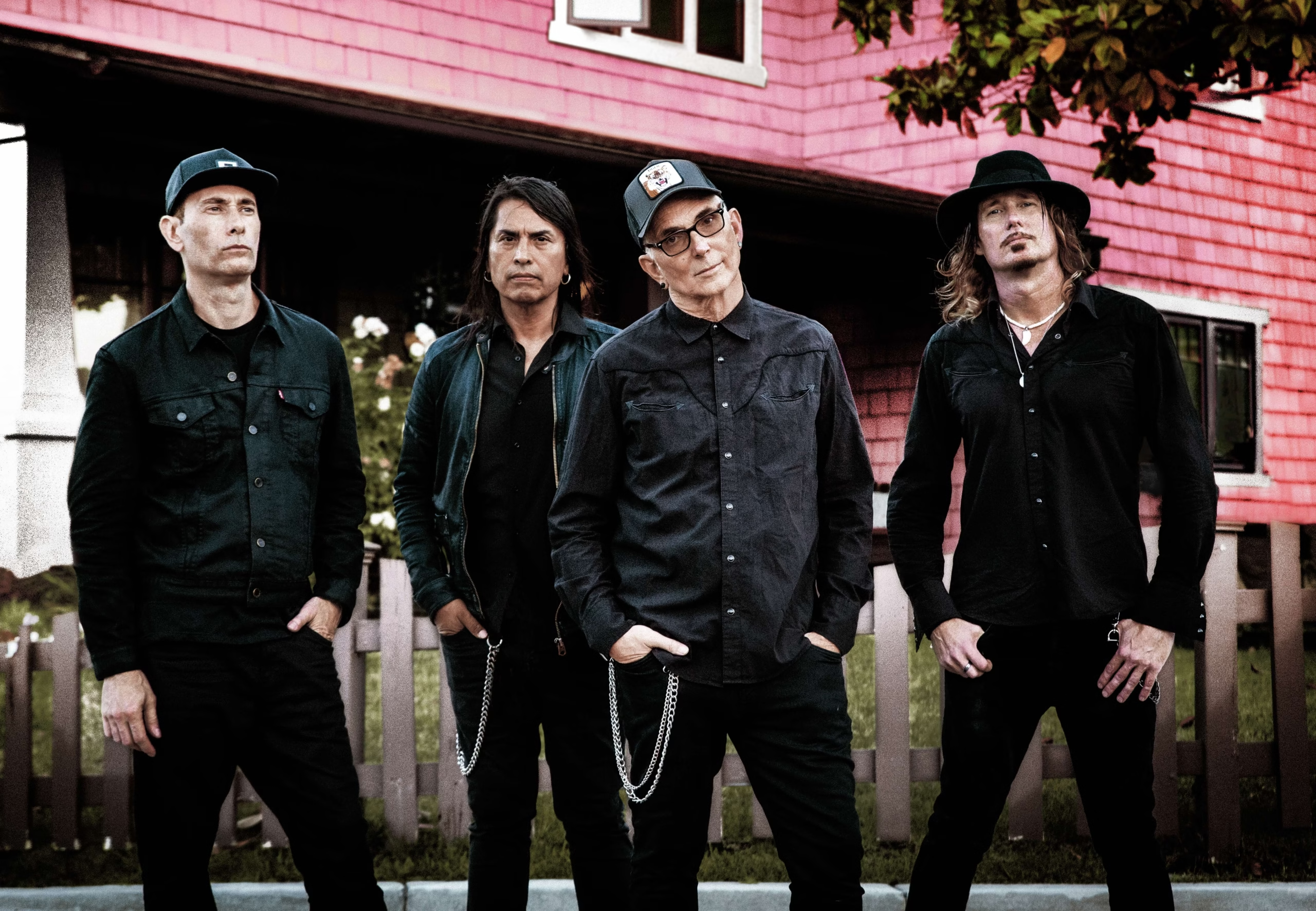
In the letter that you put out the fans, you specifically said, “If you see me stumbling, sweaty, looking tired and anxious at the same time…” it was due to MS. It wasn’t about you falling off the wagon. Why was it important for you to get that aspect across?
Because there was a situation where my brother-in-law, a man that I didn’t…I respected, but I never really liked. He was way on the other side of the political spectrum from me. And plus, he kind of always resented my success. He knew me before, and when I was just a 23-year-old drug addict loser, I think he resented it, but this is many, many years after I’ve been sober. This must have been right after I got diagnosed. So, in 2016, they’re down from Oregon – him and my sister – who was a lovely woman that just died the year after he did from cancer, just tragic. But he goes, “Hey, people in Portland… people are saying that you’re stumbling around on stage, and they’ve seen you walking, and they think you’re doing drugs again.” He said it with, like, a smirk, kind of like he wanted it to be true.
And I’m like, “Well, actually that’s one of the things I wanted to talk to you about…I got in a car accident, and the MRI found some lesions, and they found out – and I’ve been diagnosed by several neurologists – and I have MS, I have multiple sclerosis.” And my sister just started bawling at the table. And that really kind of just shut ’em up. But I had heard that from other people, too. And it’s funny, I got a t-shirt that I wore last night, “If you see me stumbling, I’m not drunk. I have MS. Be nice.”
Before you play the song “Strawberry” in concert, you talk about your sobriety.
Yeah. I talk about it, and the recurring line is, “Don’t fall down now, you’ll never get up.” And it’s not about just falling down, physically. It is that, but it’s also emotionally falling down. You can’t allow yourself to dwell. You have to find the fortitude one way or another, with hopefully a network of people or by yourself, or higher power in my case. But to be able to get back up, “Okay, what do you got next? Let’s go.” I haven’t seen any other way to do it. And I see people do it every day who, in my estimation, are heroes.
How important is it for you to share your story with your audience, and how do you strike a balance between sharing it and not being too preachy?
I dunno. I don’t know. “Who you calling preachy? Fuck you – how about that?” [laughs] “I can preach all the fuck I want. You’re paying money to hear me…” Look, without having an attitude about it, I agree. I don’t want to be too preachy about anything, about politics, about anything, but I am going to say what I feel, and it is my forum. It is my mic, and you are paying to hear me sing my songs. And if you don’t think my songs are political, you have not been paying attention from the very beginning. I could take you through every album. I haven’t changed. And when it comes to my sobriety, it is a part of what I do.
What I do is I come out, and I go, “I wrote this song when I was having a bad dream about going off the wagon when I was five years sober.” I make it very quick and succinct. I go, “People get cocky at five years. And I kept going back to sleep, waking up, going back into the same dream, happened three times, got up in the middle of the night, wrote the song, went back to bed, slept like a baby, and then got up in the morning, recorded the song. And then I go, I’ve recorded this acoustic, but can I play it for you guys now with the band? I think it sounds better.” And people are [mimics crowd cheering].
And then I go, “I want to dedicate this to all my sober brothers and sisters, in and out of the rooms, who are up there doing the work, and some of ’em [are] struggling. This goes out to them.” I get applause. I go, “I got diagnosed with MS about nine years ago. This goes out to my MS warriors, my cancer warriors, my wheelchair warriors, my heart disease warriors, anyone who’s dealing with something that makes doing the normal things that we take for granted a little harder, give it up for those people right now.” And I get applause, and I go, “This is called Strawberry.” And I go into the song; it’s not even a minute. I don’t even spend a minute doing it. I got the spiel down pretty good.
You hear these stories [with sober musicians] where there’s no alcohol allowed backstage, and sometimes you can’t have it in the venue. And that’s why I was curious as to whether it’s ever an issue for you if opening bands have it backstage.
I don’t care what other people do. I’m headlining, so they’re not going to do anything to piss me off. I’m the guy. Not being arrogant. It is what it is. They know I’m sober, but I don’t preach. If opening bands want alcohol on their rider, that’s their business. We don’t have alcohol on our rider. My drummer and guitar player might have a beer or two after a show, and that’s fine. I just ask them not to drink before we go on. They weren’t planning on it anyway.
For me, I know exactly what would happen. It would start with a couple of beers, then a bottle of whiskey, and within two hours I’d be out looking for dope. I don’t want that life. I’ve built too much to throw it away.
If I think about it every now and then, I call a sober guy. That’s what people who don’t understand the 12 steps miss. It’s not about preaching or God – it’s about having a network of people who’ve been through it, who listen, and who will tell you the truth when you ask for it.
There have been bands over the years who still act like it’s 1995 – drugs, drinking, girls backstage half their age. It’s sad. I don’t allow that when I’m headlining. If you want to do that, do it on your bus or in a hotel room. I don’t want stoned people wandering backstage. We’re grown men trying to do a job.
How sober is sober? And by that, I mean, a big buzzword right now is “California Sober.” Some people won’t even drink caffeine. They say it messes with their mind.
Sober is not using anything to create dopamine to use as a filter. Caffeine? I don’t drink caffeine because my system is so screwed up from shooting meth, coke, and stuff – and now, the MS. So, I haven’t drank caffeine for years. But do I think it’s bad? No. Do I think people overdo it? I’ve got guys on my crew drink 15 Monster drinks a day. They’re not drinking. Are they using that as a substitute? Yeah, but that’s their business. They get their job done. They treat me with respect. That’s all I get. That’s all I can do about. But do I think they’re not sober? No.
California sober? Not sober. Eating edibles? Not sober. You come into one of our meetings with that shit, and we’re going to tell you, “Brother, you don’t belong here because that’s not sober. You’re using that. You’re not using the gifts and the ability, the things that you have to soothe yourself and work through situations. You’re using that as a filter, and that isn’t sober.”
When I hear all the different people say, “Those 12 steps don’t work.” Yeah, man. And all those guys who do that, all those guys have been through 12 steps, and they don’t do the work. If you do the work, it does work. It works. It works. It works if you work it. It’s like, “This guitar won’t do what I want to do.” “No, man, you got to work on it. You got to practice. You got to play. It’s not magic.”
Where do you think you’d be today if you hadn’t gotten sober 36 years ago?
Are you listening to me?
I’m listening.
Dead. I’d be dead. I say that without any reservation. Either I would’ve killed myself, which is more likely. I would’ve gotten into a car accident. I would’ve gotten shot, or I’d be in prison. And if I was in prison, I’d kill myself. If I hadn’t gotten a sober way of thinking, ultimately it leads to death. I wouldn’t be 63, I’d be dead. And I’m grateful because I’ve been able to live my dreams and do it my way, write the songs my way. And I’ve been grateful to have that kind of career in life. And I made mistakes in my life. I’ve been married four times, but I’m in a really good place now. So no, I’d be dead.
What would you say is the single best part of your sobriety?
The reverse of what I just said. Being able to have the life that I want. Be able to have the tools that I have.
Art Alexakis is working on his memoir and a new Everclear album. The band will be on tour throughout 2026. For more information, visit their official website.
Portions of this interview have been edited for length and clarity.

Learn more about Sober Curator Contributor Michael Christopher HERE.
Want more of Art Alexakis? We don’t blame you…
Sober Curator Fun Fact: Art was on the Sober Dad Crew with Sober Curator Contributor Stephen Kimball back in 2024.
PLAY IT AGAIN is The Sober Curator’s curated playlist of sobriety anthems—songs that capture the essence of recovery journeys and lift the spirit. From timeless classics to modern hits, these tracks inspire, heal, and motivate, no matter what genre of choice. Each song is handpicked for its power to transport you to another state of mind and remind you why living alcohol-free rocks.
Got a favorite sobriety theme song? We want to hear it! Send your picks to thesobercurator@gmail.com and help us keep the playlist growing.
MUSIC – PLAY IT AGAIN! Sober Dad Crew’s Favorite Music of 2025: Punk, Love, and Transcendence

SOBERSCRIBE NOW!
Resources Are Available
If you or someone you know is experiencing difficulties surrounding alcoholism, addiction, or mental illness, please reach out and ask for help. People everywhere can and want to help; you just have to know where to look. And continue to look until you find what works for you. Click here for a list of regional and national resources.