


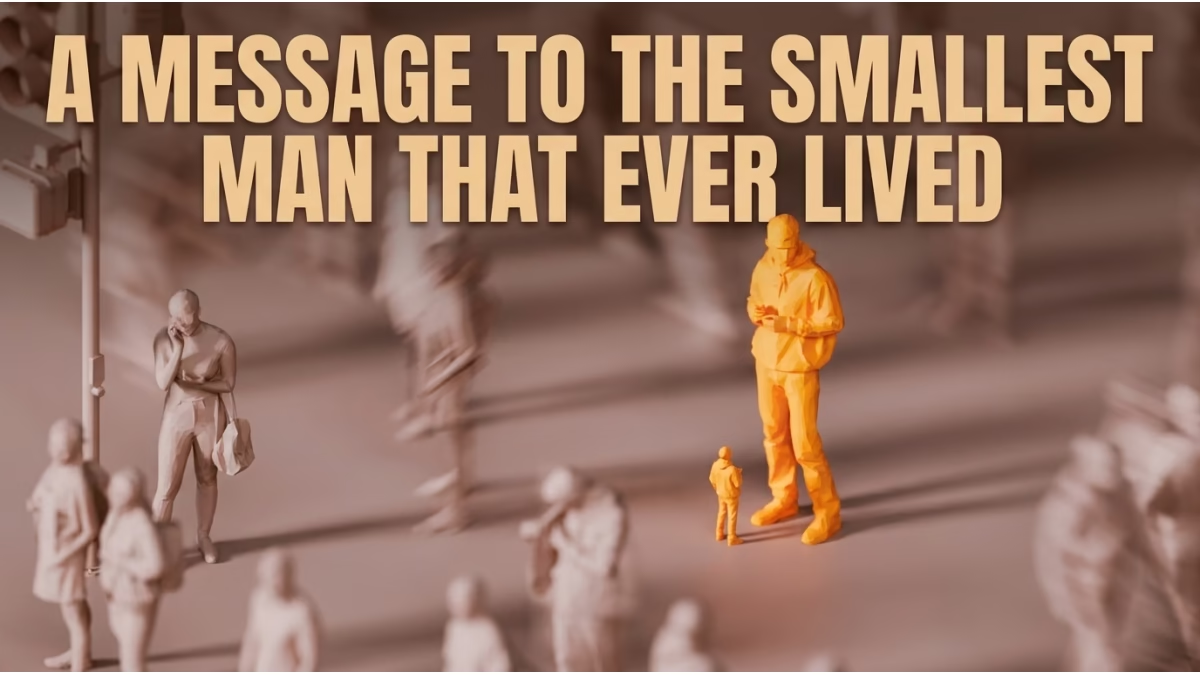

What TTPD Taught Me About Betrayal, Addiction and the Closure That Never Comes
A sober recovery reflection on Taylor Swift’s “The Smallest Man Who Ever Lived”
There is a specific kind of silence that follows a person who disappears on you.
It is not peaceful. It is loud. It fills every room you walk into. You check your phone at red lights. You refresh an inbox that is never going to hold the message you are looking for. You scroll obituaries at two in the morning because you cannot decide which answer would hurt less.
I lived in that silence for a long time. When “The Smallest Man Who Ever Lived” came out on The Tortured Poets Department, I sat in my car and did not move until it ended. Taylor wrote a song about a man who blew up a woman’s life then wandered off into his own. I already knew him. I had loved him.
Sobriety in pop culture rarely arrives labeled as such. It shows up sideways, inside a three-minute song about somebody’s worst year. Taylor called the album The Tortured Poets Department for a reason.
The Starry-Eyed Beginning Is Always the Setup
The song opens on a moment of pure infatuation. Someone looking at you like you are the only person in the room. Anyone who has ever fallen into a whirlwind knows that gaze. It is intoxicating. It is also the first drink.
My affair ended my marriage. I want to say that plainly because I have spent years softening it. In the beginning, it felt like a rescue. He looked at me like I was rare. I had not felt rare in a very long time.
Every Swiftie knows the feeling “cardigan” is built on. Forgotten somewhere dark for years, then pulled out and called somebody’s favorite thing. That is exactly what he handed me. And once you have been chosen like that after a long stretch of feeling invisible, you will do almost anything to stay chosen. That willingness is the part I had to look at later. Not what he did. What I was already starving for before he showed up.
What I could not see then is that the high and the person were the same substance. Addiction was already in the room with us. I just did not know it yet.
Ghosting Has a Body Count
There is a line in the first verse about someone getting ghosted then learning exactly how that feels. I laughed out loud the first time I heard it. Not because it was funny. Because it was familiar.
He would vanish. Weeks. Sometimes months. Not a fight, not an ending, just an absence with no edges. And every single time I would go somewhere very dark inside myself, running two thoughts on a loop. Is he okay? Is he alive?
That is a nervous system living in a permanent state of emergency. It took me years to name that as a mental health problem and not a character flaw. I told nobody what was actually happening because I was ashamed of what I had traded for it.
If you are reading this and that paragraph felt like a mirror, please hear me. What you are carrying is real. It has a name. It is not weakness.
I Did Not Want Him Back. I Wanted an Answer.
The chorus is the part that really hit for me. She is not asking for a reunion. She is asking a question. Was ruining me the point or was I just standing where the wreckage landed?
That was my exact ask for two years.
I gave up my marriage. I gave up stability. I gave up a version of my life I cannot get back. And I ended up alone with a question mark where a person used to be. I wanted him to tell me whether he had meant to do it. I told myself I could put it down if I just knew.
Here is what recovery eventually taught me. The answer was never coming. And even if it had come, it would not have given me back a single thing I lost.
Closure is not something another person hands you. Closure is something you build, usually out of very unglamorous materials. Meetings. Therapy. A journaling prompt. A friend who picks up at 11 p.m. One honest sentence said out loud to another human being. That is what self-care actually looked like for me. Not a bath. A phone call I did not want to make.
The Paranoia Was Not Irrational
The third verse goes somewhere almost absurd. Spy novels, secret weapons, government files. It sounds unhinged out of context. In context, it is one of the most accurate things ever written about betrayal.
When someone lies to you long enough, your mind starts generating theories to explain the gap between what you are being told and what you can feel. You are not losing it. You are pattern-matching with incomplete data because the truth has been withheld from you.
He Kicked Out the Stage Lights and Kept Performing
What an image, right? Someone who wrecks the venue then takes the show on the road.
He walked away and continued. New rooms, new people, no consequences that I could see. I stayed in the minefield and had to rebuild from it. That imbalance is one of the cruelest parts of loving an addicted person while you are unwell yourself. The damage is not distributed evenly. It almost never is.
I want to be careful here, because I am in recovery myself. I have been sick and cruel. I have been the person who left wreckage too. Holding both of those truths at once is some of the hardest work I have done. He was sick. He was also cruel. Both things sat in the same body.
If This Is Your Song Too
You do not need the answer to start healing. And you are allowed to want your sparkling summer back.
You are also allowed to build a better one.
At Swift Steps® we sit with a song every Saturday and let it open a door to emotions we do not even know are there. Sober recovery does not have to sound like a lecture. Sometimes it sounds like a bridge.
Taylor Swift – The Smallest Man Who Ever Lived (Official Lyric Video)

PLAY IT AGAIN is The Sober Curator’s curated playlist of sobriety anthems—songs that capture the essence of recovery journeys and lift the spirit. From timeless classics to modern hits, these tracks inspire, heal, and motivate, no matter what genre of choice. Each song is handpicked for its power to transport you to another state of mind and remind you why living alcohol-free rocks.
Got a favorite sobriety theme song? We want to hear it! Send your picks to thesobercurator@gmail.com and help us keep the playlist growing.
PLAY IT AGAIN! MUSIC: Sober Musicians Who Prove Recovery Rocks | Updated 2026
You’re not new to this. You’re ready for what’s next.
And not everyone gets here.
You’ve done the hard part.
You’re sober. You’re clear.
You’ve built a life that no longer revolves around alcohol.
Now you’re ready for something more.
You want better conversations.
More connection.
More culture.
More expansion.
You’re not looking for another recovery meeting.
You’re looking for a room that reflects who you are now.
This is for you if this sounds like you:
- You’re sober and stable.
- You’ve outgrown. traditional recovery spaces.
- You want more than support — you want connection, culture, and momentum.
- You’re ready for what comes after survival.
That’s exactly what BACKSTAGE was built for. LEARN MORE AND JOIN US TODAY →
SOBERSCRIBE NOW!
Resources Are Available
If you or someone you know is experiencing difficulties surrounding alcoholism, addiction, or mental illness, please reach out and ask for help. People everywhere can and want to help; you just have to know where to look. And continue to look until you find what works for you. Click here for a list of regional and national resources.

Follow The Sober Curator on TikTok
What inspired the article “A Message to the Smallest Man Who Ever Lived”?
The article is a reflection on Taylor Swift’s song “The Smallest Man Who Ever Lived” and its themes of betrayal, addiction, and the search for closure.
How does the article relate to sobriety and recovery?
The article explores the connection between emotional experiences and addiction, illustrating how personal stories of heartache can mirror addiction and the journey towards recovery.
What is the significance of the silence mentioned in the article?
The silence represents the void left by someone who has disappeared, highlighting the emotional turmoil and longing for closure that often accompany such experiences.
Why does the author emphasize the need for self-care in recovery?
The author highlights that closure and healing come from self-care practices like therapy and honest conversations, rather than waiting for answers from others.
What message does the article convey about closure?
The article suggests that closure is not given by others but is something one must build through personal recovery efforts and self-care.
