For over two decades, I cycled through incarceration and addiction within Vermont’s correctional system. This personal narrative examines how punitive policies, medication withdrawal and barriers to reentry deepen trauma and recidivism — especially for women with substance use disorder. It also outlines the inner mechanics of jail life, the costs of solitary confinement and the fight for dignity, reform and a second chance. I close with the post-release transformation that followed sustained sobriety, motherhood, entrepreneurship and advocacy.
I spent much of my life in and out of custody under the Vermont Department of Corrections for nonviolent, drug-related offenses — many of which are no longer criminal today. What began with a small charge expanded into an entrenched cycle of sanctions and setbacks. The system did not see substance use as a disease; it treated it as defiance. And being a woman made everything harder: harsher judgments, fewer resources and a system ill-equipped to support reentry.
Life inside was an education — just not the kind anyone needs. Jail became a revolving door where young, incarcerated women learned survival skills the hard way: how to move product, how to evade, how to numb. We bonded into a makeshift family and I’d catch myself thinking, as I returned again and again, Who’s in right now? A correctional officer once told me people like me were their “job security.” The message was clear: this machine expected us to come back.
“The most common way people give up their power is by thinking they don’t have any.”
Alice Walker (1983)
That line became a mantra. If power was something I’d been taught to surrender, I had to relearn how to claim it — through information, advocacy and relentless, lawful resistance.
The Revolving Door and the “Escape” That Wasn’t
Stability after release was nearly impossible. I completed countless job applications only to watch them get tossed. A few employers laughed and told me not to “waste a résumé.” My record overshadowed prior legitimate experience. I tried detox twice and stayed sober for 18 months each time, but release conditions often guaranteed failure.
Three of my five felonies were “Escape from Furlough” — not breaking out of a facility, but technical violations:
- First time: I went to the wrong grocery store two days after release.
- Second time: I missed curfew by 45 minutes.
- Third time: I took a day trip to Hampton Beach without permission, months into sustained sobriety and new motherhood. A CO recognized me, sent photos to my PO, and I was returned to custody. My drug screen was clean; I had been doing better than ever.
These were not violent or predatory acts; they were compliance errors and, at times, poor decisions born of a life reassembled with fragile scaffolding. Still, the consequences were catastrophic. I was forced to serve nine months and separated from my six-month-old baby — despite my clean screens, progress and exemplary parenting notes. The system could have offered GPS or increased check-ins. Instead, it escalated to incarceration.
“No Second Chances”: Barriers to Reentry
Reentry in Vermont often meant being released with no aftercare, no medical appointments and no employment support — then being judged for failing to thrive in 30 days. The message was: Hit the ground running — or else. When the ground is quicksand, running is not a plan; it is a setup.
Because I couldn’t secure legal income, I returned to what I knew. That is the quiet truth about recidivism: punishment without pathways reproduces the very behavior it condemns. Over time, the toll is not only legal — it is psychological. Shame intensifies, hopelessness cements and one’s sense of worth erodes.
“Foxtrot”: Punishment for a Disease
Women with addiction were often housed in Foxtrot, a restricted unit functionally designed as punishment for a medical condition. The conditions included:
- Locked-in status and staggered time out of cells
- No outdoor recreation
- Limited commissary (hygiene and OTC medications only)
- One weekly group run by an outside agency (often too brief and irregular to be therapeutic)
- Ongoing medication disruption during intake, segregation and transitions
For those detoxing — especially those with ADHD, anxiety or trauma — this “treatment” was destabilizing. Women were hungry enough to eat cough drops by the bag. Special diets were rarely honored at the time. Privacy was scarce; even showers were placed where officers could watch. The message was unmistakable: your disease is a disciplinary problem.
Solitary Confinement and the Psychology of Survival
Solitary confinement magnified everything: fear, shame, panic. The hole at CRCF was a place where time warped and coping meant inventing structure out of nothing. Built on a swamp, the facility attracted insects; I gave them names and stories to keep my mind from fracturing. I have never forgotten the cold of the metal bunk, the scrape of my pen on the underside of a bedframe, the way silence felt like a scream.
Worse than isolation was unmedicated isolation — being ripped off maintenance and mental-health meds without proper continuity of care. It was not a taper, it was a cliff. To someone whose worst enemy was her own mind, it was a kind of sanctioned cruelty. I understand why so many women lost hope.
Learning the Rules to Fight the Rules
If the system refused to see my humanity, I would insist on it — on paper, with statutes and within process. I became a law librarian whenever I wasn’t in Foxtrot or under suspicion. I helped women appeal furlough revocations, challenge disciplinary reports and file grievances — calmly, thoroughly and relentlessly.
In 2006, after turning myself in to serve 25 days, I was isolated in a “zero-pressure” room until officers secured a body-search warrant. My case made the papers across Vermont. That 25-day sentence became 3–6 years; I served three. My “violation”? Trafficking my prescribed medication and tobacco to avoid the predictable horror of abrupt medication discontinuation. It was a poor choice; I own it. But tripling my time did not constitute care, treatment or proportionality.
Fighting back never meant violence. It meant documentation, deadlines, evidence, policy and Title 13. I learned to present without rage and to end with receipts. Sometimes we won. Every win cracked the wall a little more.
The Gendered Reality of Jail Life
Women in custody face layered risks: sexual misconduct, coercion and the ever-present pressure to trade safety for silence. We also watched officers meet contacts to bring contraband inside. None of this made us heroes or villains; it made us human in a distorted economy of scarcity, pain and need. People do what they know to survive. In that environment, the underground market is not a surprise — it is an inevitability.
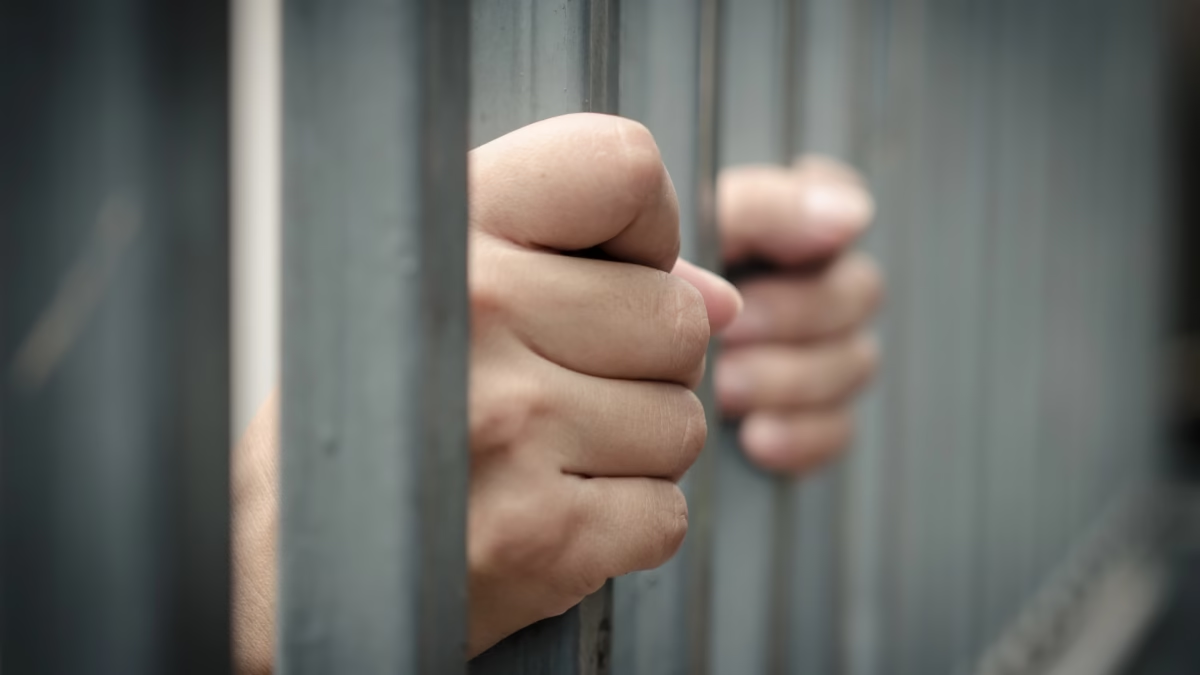
The cost of survival is steep. It breaks trust with oneself, burns bridges with family and can jeopardize parental rights. I witnessed mothers forced into termination proceedings not for violence, but for technical violations or housing loss. And then — weeks after relinquishing their rights because the jail “needed beds” — they were released to empty apartments with nothing. Most did not come back. They overdosed instead. I still see their faces.
The Case for Prison Reform in Vermont
Real reform is not cosmetic; it is structural. The system must:
- Guarantee continuity of care for mental health and MAT/maintenance medications during intake, segregation and release.
- Replace punishment-first “treatment” models (e.g., Foxtrot) with evidence-based, trauma-informed, gender-responsive care.
- Invest in reentry supports — housing, employment pipelines, childcare coordination and healthcare appointments pre-scheduled before release.
- Eliminate carceral responses to technical violations where public safety is not implicated; use graduated, community-based sanctions instead.
- Protect parental rights through reunification-first policies and robust family services.
- Expand oversight and accountability regarding staff misconduct, sexual abuse and contraband facilitation.
- Collect and publish transparent data on medication continuity, segregation use, revocations and post-release outcomes.
Addiction is not a moral failure; it is a medical, psychological and social condition. When systems treat disease with discipline, they worsen it.
From “Junkie” to Entrepreneur
I am nine years sober. I have two late-in-life children — my daughter and my son — who saved my life. I left my apartment for a shelter when I learned I was pregnant and haven’t used since. Once I finally maxed out of the system, I rebuilt fast. I bought a home, became a certified addiction recovery & life coach, and trained in Reiki, crystal and sound healing. I also became a certified credit counselor and started my blog, Progressing Not Perfecting, where I pour what I’ve learned into guides, tools, and community.
My goals are simple and fierce: give my children a childhood they don’t have to heal from, and be a woman they can be proud of — not for perfection, but for persistence, integrity and service.
Lessons: Fight If You’re Right
If incarceration taught me anything, it’s to fight — lawfully, strategically and persistently. Don’t shrink. Document everything. Learn the policies. Elevate to the highest accountable person. File the grievance and follow up on it. Don’t just let it disappear into a corrupt and failing system. Appeal the ruling. Show up at the hearing with evidence and a calm voice. You are not powerless. The system counts on your silence; change begins the moment you stop consenting to it.
I know some will judge this story. That’s fine. I write to help, to insp-otivate (inspire + motivate), and to empower anyone who feels trapped by a past or by a system designed to predict their future. I proved them all wrong. You can, too.
I spent twenty years doing “life on the installment plan.” Most of my charges were nonviolent, rooted in addiction and technical violations. The system did not rehabilitate me; it punished me. I have still never attended long-term treatment that wasn’t incarceration-based. What changed my life was not isolation, humiliation or fear. It was support, treatment, accountability with dignity and a reason to keep going — my kids, my work and my community.
Reform is not charity; it is justice. It saves lives, families and public resources. Vermont can become a model for gender-responsive, trauma-informed, evidence-based corrections. Start by treating addiction like the disease it is. Start by keeping mothers with their children. Start by making reentry a bridge, not a cliff.
I found my way out. I want that for everyone.
SafeSpot Overdose Prevention Helpline
I work as a helpline operator for an overdose prevention helpline called SafeSpot. This helpline saves lives every day, and I wish there was something like this before I lost so many that I loved. Please put the number in your phone, even if you don’t use, because you never know when someone you know might need it. 1-800-972-0590. If you are forced to get high alone, call us and we will make sure you use safely. We will hang out with you on the phone and call your emergency contact or emergency services if you become unresponsive. It is better to be safe than sorry.
Join the Community
If this story resonated, share your experience in the comments or join my judgment-free community at samanthabushika.com. We’re building a space where learners teach, teachers learn and everyone belongs — no prerequisites, no perfection. Together we can #provethemallwrong and #showthemwhatwecando.
For support, contact support@samanthabushika.com.
References
American Psychological Association. (2020). Publication manual of the American Psychological Association (7th ed.).
Centers for Disease Control and Prevention. (2023). Drug overdose death rates. https://www.cdc.gov/drugoverdose
National Institute on Drug Abuse. (2022). Substance use in women. https://nida.nih.gov/publications/research-reports/substance-use-in-women
Walker, A. (1983). In search of our mothers’ gardens: Womanist prose. Harcourt.

SPEAK OUT! SPEAK LOUD! at The Sober Curator is a celebration of authentic voices in recovery—echoing Madonna’s call to “Express yourself!” Here, readers and contributors take the spotlight, sharing transformative sobriety journeys, creative talents, and new avenues of self-expression discovered along the way. Through videos, poems, art, essays, opinion pieces, and music, we break the silence that often surrounds addiction, replacing it with connection, hope, and inspiration.
Your story matters—and we want to hear it. ✏️ Submit Your Story to Speak Out! Speak Loud! Reader-written essays and opinion pieces. We publish sharp, specific, witty writing about modern sobriety. Submit your story →
Disclaimer: All opinions expressed in the Speak Out! Speak Loud! Section are solely the opinions of the contributing author of each individual published article and do not reflect the views of The Sober Curator, their respective affiliates, or the companies with which The Sober Curator is affiliated.
The Speak Out! Speak Loud! posts are based upon information the contributing author considers reliable. Still, neither The Sober Curator nor its affiliates, nor the companies with which such participants are affiliated, warrant its completeness or accuracy, and it should not be relied upon as such.

Follow The Sober Curator on Facebook

Help is Available
THE SOBER CURATOR RESOURCE GUIDE: At The Sober Curator, we provide high-quality content centered around the vibrant and fulfilling lifestyle of sobriety. While our focus is on the positive aspects of sober living, we also acknowledge that life can present challenges without the aid of alcohol or substances. Coping with these challenges alone can be daunting, which is why we strongly believe in finding recovery within a supportive community because it is the opposite of addiction.
If you or someone you know is struggling with alcohol use disorder, substance use disorder, a co-occurring illness, or a behavioral health disorder, we urge you to seek help. While the task may seem daunting, it’s important to remember that support is readily available and that there are people out there who want to help.
It’s crucial to remain persistent in your search for assistance until you find the right solution for your unique situation. In some cases, it could be a matter of life or death, so it’s essential to never give up on finding the necessary help.
If your life or someone else’s is in imminent danger, please call 911. If you are in crisis and need immediate help, please call: 988.
You’ve got mail from The Sober Curator

Resources Are Available
If you or someone you know is experiencing difficulties surrounding alcoholism, addiction, or mental illness, please reach out and ask for help. People everywhere can and want to help; you just have to know where to look. And continue to look until you find what works for you. Click here for a list of regional and national resources.