


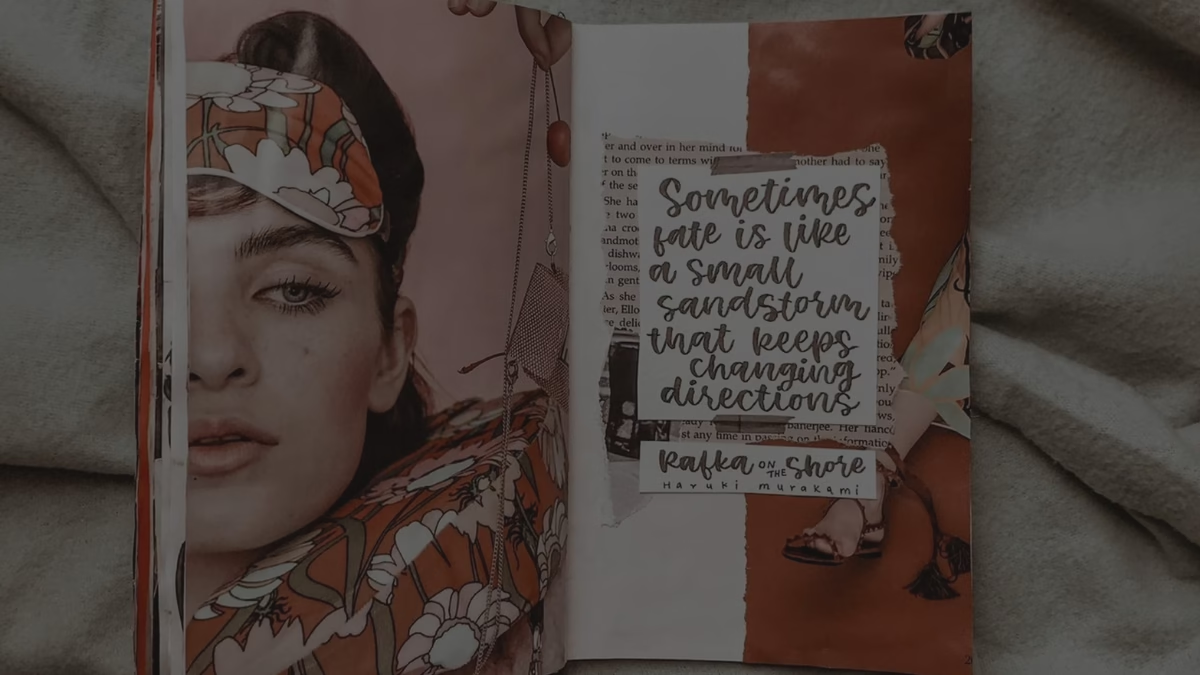

There are so many things I carried for a long time because I thought I had to.
Ways of coping.
Ways of performing.
Ways of staying small, agreeable, manageable.
Some of them made sense.
Some of them kept me safe.
Some of them I didn’t even realize I was holding.
Sobriety has a way of revealing the cracks in the things you used to hold onto so dearly.
You start to notice what feels heavy.
What no longer fits.
What doesn’t belong to you anymore.
The instinct is to replace it immediately.
To fill the space with something better. Healthier. More evolved.
But there is no rush. Not everything needs to be replaced ASAP. Sometimes just taking a minute to acknowledge what’s dragging you down, what’s holding you back is enough. It’s the place you get to start from.
Some things are meant to be set down.
Not with force.
Not with a big moment.
Just with awareness.

The Practice
Take a blank page, or a page you’ve already written on.
Write at the top: Things I No Longer Carry
Instead of making a clean list, write your words across the page in different directions. Let them overlap. Let them interrupt each other.
Don’t organize it.
Now begin to alter the page:
- Tear pieces from magazines, newspapers, or junk mail
- Tape or glue them over parts of your words
- Cross things out
- Rip or fold a section of the page if something feels ready to go
Then add:
- one color that feels like release
- one mark or shape that feels like space opening
Let some words disappear. Let some remain visible.
You don’t need to remove everything.
You’re just changing your relationship to what’s there.
Stop before the page feels clean.
The Reflection
- What feels lighter just by naming it?
- What are you no longer willing to carry—even if it hasn’t fully left yet?
- What happens when you don’t rush to replace what you’ve put down?
Some things can simply be set down.
Unpolished Supplies List:
- Spiral Bound Sketchbook
- Spiral Bound Artist Sketch Pad
- 100 Unruled 3×5 Index Cards Blank White Heavy Rounded Corners
- 60 Colored Dual Tip Markers
- Acrylic Paint Markers
- 36 Colors Acrylic Paint Set with Brushes & Palette

Unpolished Series by Krysty Krywko:
- Unpolished: The Messy Middle | Krysty Krywko
- Unpolished: Make It Anyway | Krysty Krywko
- Unpolished: When “I’m Fine” Is a Red Flag | A Creative Practice for Honest Self-Reflection
- Unpolished: Numb the Beige — An Art Therapy Journaling Practice for Sobriety
- Unpolished: A Bi-Weekly Creative Practice for Sober & Sober-Curious Women

TSC LIBRARY: Welcome to The Sober Curator Library! This isn’t your average stack of books—we’re talking full-on story immersion, Audible binges, and reviews with personality. Browse our four go-to genres: #QUITLIT, Addiction Fiction, Self-Help, and NA Recipe Books. And if you’re collecting recovery reads like rare trading cards, check out our Amazon #QUITLIT list—Early Sobriety Survival: Books for Your First 90 Days.
📘 Submit a Book for our #QuitLit Library: Welcome to the largest culturally-driven sober book collection on the internet. Memoir, fiction, criticism, quit lit, anything that fits a Gen X or Millennial sober reader past initiation. Submit your book →
SOBER EVENTS at The Sober Curator keeps you in the loop on alcohol-free gatherings happening nationwide. From sober comedy shows and non-alcoholic tastings to festivals, retreats, and sporting events, we highlight vibrant, community-driven experiences from coast to coast. Our goal? To keep you entertained, inspired, and connected—no matter where you live. Need more sober time than one event? We’ve got your back with our Sober Retreat Calendar.
📅 Submit a Sober Event: NA tastings, sober socials, recovery conferences, fitness meetups, alcohol-free festivals, virtual gatherings, and events of all kinds. Anything that gives our readers something worth showing up for. Submit your event →
SOBERSCRIBE NOW!
Resources Are Available
If you or someone you know is experiencing difficulties surrounding alcoholism, addiction, or mental illness, please reach out and ask for help. People everywhere can and want to help; you just have to know where to look. And continue to look until you find what works for you. Click here for a list of regional and national resources.

Follow The Sober Curator on Facebook
1. What is Unpolished?
Unpolished is a bi-weekly creative practice for sober and sober-curious women. Each post includes a short reflection and a simple, hands-on exercise designed to explore identity, creativity, and life after drinking.
2. Do I need to be sober to participate?
No. Unpolished is for anyone who is sober, sober-curious, or questioning their relationship with alcohol. The practice meets you where you are.
3. Do I need artistic experience?
Not at all. No art skills are required. The exercises are about honesty, not aesthetics. The goal isn’t to create something beautiful — it’s to create something true.
4. What materials do I need?
You only need a notebook or paper and a pen or pencil. Optional materials include markers, inexpensive paint, or collage materials like magazines or junk mail.
5. How does creativity support sobriety?
Sobriety removes the numbing. Creativity helps you process what surfaces. A simple creative practice can build self-trust, emotional awareness, and presence without turning your healing into another performance.
6. What if I feel disconnected after getting sober?
That experience is more common than people talk about. Many people feel restlessness, numbness, or uncertainty after quitting drinking. Unpolished is designed to gently explore that space rather than fix it.
7. Is this therapy or art therapy?
No. Unpolished is not therapy. It’s a personal creative practice meant to support reflection and self-awareness. It can complement therapy, coaching, or recovery work, but it does not replace professional care.
8. How often is Unpolished published?
Unpolished is a bi-weekly series offering a reflection and creative prompt every two weeks.
9. Do I have to share what I create?
No. This practice is private unless you choose otherwise. You don’t have to post it, polish it, or explain it to anyone.
10. Who is Krysty Krywko?
Krysty Krywko is seven years sober and works at the intersection of sobriety, identity, and beco
