


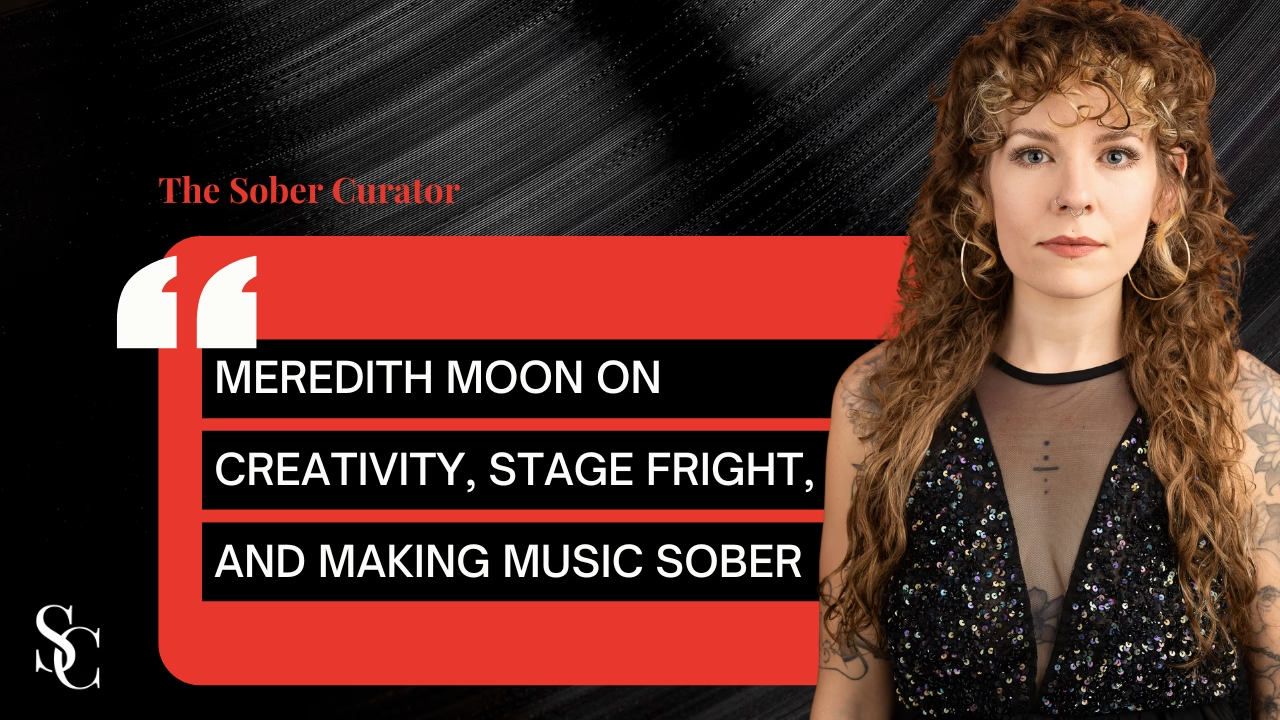

“I thought if I stopped drinking, I wouldn’t be able to write songs.”
Meredith Moon
It’s a fear whispered in green rooms, art studios, and late-night kitchens everywhere — especially among creatives. Alcohol has long been sold as the muse, the courage, the spark. For singer-songwriter Meredith Moon, that belief lingered for years. Until sobriety proved it wrong.
On The Sober Curator Podcast, Meredith opens up about what actually happened when she put the bottle down — and why her first fully sober album became her most honest, powerful work yet.
Meredith’s story doesn’t begin in polished studios or industry pipelines. She left school at fourteen. Left home at fifteen. She hitchhiked, rode the rails, and busked across Canada — learning music in real time, on real streets, with real stakes. Alcohol became part of that world too. Not glamorous. Just normalized.
Like many artists, Meredith believed drinking helped her push past fear — especially stage fright. Alcohol felt like the price of entry. The thing that made performance possible.
But sobriety didn’t take her voice away.
It gave it back.
“There was a fear for years,” Meredith shares. “If I stop drinking, I won’t be able to write songs. I won’t be able to play shows.” That fear wasn’t irrational — it was inherited. Music culture is saturated with the myth that suffering fuels art, that inhibition is the enemy of creativity.
The reality was different.
After getting sober, Meredith noticed something unexpected. The songs didn’t stop coming — they changed. Instead of hazy late-night recordings she’d have to reconstruct while hungover, she was fully present inside the creative process. Writing wasn’t something happening to her anymore. It was something she was actively part of.
Sobriety didn’t mute inspiration. It sharpened it.
There was a transition period, of course. For a couple of months, creativity felt quieter. But even then, Meredith wrote songs about missing alcohol — and they were still good. Honest. Real. Proof that creativity doesn’t disappear in discomfort. It adapts.
That presence became her new superpower.
Now, when inspiration hits, Meredith answers it immediately. Whether she’s at home or on the move, she steps away for ten minutes and gets the bones of the song down. She references a Neil Young quote about “answering the call” of creativity — because if you don’t, it doesn’t always come back the same way.
That relationship with creativity requires boundaries too.
Sobriety didn’t erase Meredith’s tendency to obsess — it just redirected it. Like many people in recovery, she noticed that passion can tip into overdrive. Writing nonstop. Pushing too hard. Forgetting balance.
Her solution is refreshingly human.
Sometimes it’s walking the dogs. Sometimes it’s stepping away on purpose. Sometimes it’s not keeping the “snack” within reach — a metaphor she uses brilliantly to explain how moderation works in sobriety. You don’t deny yourself joy. You just don’t let it run the house.
One of the most powerful shifts Meredith describes isn’t about music at all.
It’s about reading.
During heavy drinking, reading felt pointless. She couldn’t remember what she’d read. Her eyes were glazed over. Nights ended in passing out, not resting. Sobriety gave her cognitive clarity back. Now she can read a book a week — something she never imagined possible before.
Movement became another anchor. Not as punishment. Not as performance. Just as a way to channel anxious energy and create baseline calm. Meredith talks about how that constant low-grade anxiety faded over time — replaced by something steadier. A quiet confidence.
And then there was food.
In early sobriety, Meredith made a deal with herself: eat whatever you want — just don’t drink. Ice cream. Chips. Dopamine, without shame. Later, balance returned naturally. Nourishment followed self-trust.
What stands out most in Meredith’s story isn’t discipline or grit.
It’s gentleness.
Sobriety didn’t demand perfection. It offered permission — to feel fear without numbing it, to create without blurring it, to live without dulling the edges of experience.
Her latest album, From Here to the Sea, is the first one created entirely in sobriety. It’s not louder than her past work. It’s clearer. More grounded. More her.
Meredith Moon’s story dismantles the myth that alcohol is the gateway to creativity. What it actually does is keep artists one step removed from themselves.
Sobriety doesn’t take the art away.
It hands it back — fully formed, fully felt, and finally remembered.
???? Listen to the full conversation on The Sober Curator Podcast and discover why sobriety might be the most underrated creative tool of all. Follow along with Meredith Moon on her website meredithmoon.com and @MeredithMoonMusic on IG

Getting sober matters. Staying sober matters more. That’s the whole premise.
The Sober Curator Podcast brings sober lifestyle, pop culture and recovery to the mic with personality, perspective and a glitter bomb of honesty. Founder and host Alysse Bryson (sober since May 1, 2006, and self-described Kevin Bacon of Recovery) is joined by co-host and show producer Tamar Routly of Podcast Impact Studio, plus a rotating bench of global Sober Curator contributors who pull up a chair as co-hosts.
What we cover, episode to episode:
Happy Every Hour: zero-proof drinks, NA beer, spirits and cocktails, reviewed by people who actually drink them.
Health and Wellness: mental health, physical health and what recovery looks like on a Tuesday.
Lifestyle: dating, parenting, shopping, style and the everyday logistics of alcohol-free living.
Entertainment: quit lit, movies, TV, music, sports and celebrity sobriety, rated with our proprietary Sobees.
Spiritual Gangster: Jesus to astrology, stoicism to the Celtic calendar.
Travel: sober events, sober retreats, Sobriety in the City and global travel without a drink in hand.
We also review other sober podcasts on Recovery Podcastland, dig into sponsored product spotlights, and go deep with contributors on how they got sober and what keeps them there. New episodes drop as video on YouTube and audio everywhere you listen.
Want more? BACKSTAGE with The Sober Curator is our membership community with Media Nights, Studio Nights, Edutainment Nights and The Sober Curator Mixtape, a monthly mini-zine delivered in a cassette case. Details at https://thesobercurator.com/backstage-with-the-sober-curator/
Whether you’re sober curious or decades in, we’ve got you. We’re not here to help you get sober. We’re here to help you live sober and love it.
Rate, review and subscribe. It takes 60 seconds and we will love you forever.
Contact: thesobercurator@gmail.com
Everybody’s seen Intervention. Darren Hobbs is one of the guys who knocks on that door. Back in 2010, he was the guy behind it, eating jail bologna sandwiches and waiting on a sentence.
Now a board-certified interventionist on A&E’s Intervention and founder of The Firm Addiction Consulting in Nashville, Darren joins Alysse and Tamar to talk about what sober life hands you once you’re on the other side of the door. Honey buns at a prison picnic table. The stranger in khakis he hated, then trained with every morning for 11 years. And the knock that made him want to do this for a living.
In this episode:
- A fifth step at a prison picnic table (honey buns cut with an ID card)
- The halfway house that kept his last $1,000
- The stranger in khakis who became his best friend
- His first knock: “Daddy, what took you so long?”
- Why his job is helping families make it hard for their kid to die
- What an interventionist does when he needs a break
CHAPTERS
00:00 One of the guys who knocks on the door
01:57 What changed after getting sober?
03:11 A fifth step at a prison picnic table
07:19 The halfway house that kept his last $1,000
11:12 Are we less tough now?
14:05 The stranger in khakis
16:31 Onsite and his first “piece of work”
23:34 The first knock
26:36 Burn the boats
30:27 Matador of chaos
33:13 Intervention, with cameras
36:26 Mob TV and Uncle Jackie
39:35 When the helper needs a break
45:38 “Are you AI, Tamar?”
46:28 Knock gently
Sober Shots:
“You don’t have to have the perfect story or one ounce of talent to be useful.” (Alysse Bryson)
“Your family’s given me full permission to make it hard for you to die.” (Darren Hobbs)
Find Darren: – The Firm Addiction Consulting – Instagram + TikTok: @thedarrenhobbs – Die Sober podcast
Mentioned in this episode: – BACKSTAGE with The Sober Curator: https://thesobercurator.com/backstage-with-the-sober-curator/- S2E16 with Ben Coombes of Soberski: https://www.youtube.com/watch?v=NWV0Tt6YXpg&t=82s – Our Matthew Perry bonus episode: https://www.youtube.com/watch?v=uyo1cjpfLNs&t=500s
Getting sober matters. Staying sober matters more.
SEASON 2 MERCH: https://shopthesobercurator.com/
This episode is brought to you by Aura House. Save 10% with code TSC10: https://go.shopmy.us/p-64140200
SC RESOURCES: – Meet the Contributors – Alcohol + Substance Use Disorder Guide – Recovery Nonprofit Resource Guide – LGBTQ+ Recovery Resource Guide – Family Resource Guide
CONNECT: www.thesobercurator.com | The Sober Sip newsletter: https://www.thesobercuratornewsletter.com/ | @thesobercurator on Instagram, X, TikTok, YouTube + Pinterest
Love the show? Rate, review + follow. It takes 60 seconds and helps more people find us. Feedback + guest ideas: thesobercurator@gmail.com
Hosted by Alysse Bryson with co-host + producer Tamar Routly. For informational and entertainment purposes only; not a substitute for professional advice.
Music: TSC S2 theme “Sober Shots” created by Alysse Bryson using Suno AI, under Suno’s commercial license.

PLAY IT AGAIN is The Sober Curator’s curated playlist of sobriety anthems—songs that capture the essence of recovery journeys and lift the spirit. From timeless classics to modern hits, these tracks inspire, heal, and motivate, no matter what genre of choice. Each song is handpicked for its power to transport you to another state of mind and remind you why living alcohol-free rocks.
Got a favorite sobriety theme song? We want to hear it! Send your picks to thesobercurator@gmail.com and help us keep the playlist growing.
SOBERSCRIBE NOW!
Resources Are Available
If you or someone you know is experiencing difficulties surrounding alcoholism, addiction, or mental illness, please reach out and ask for help. People everywhere can and want to help; you just have to know where to look. And continue to look until you find what works for you. Click here for a list of regional and national resources.
