


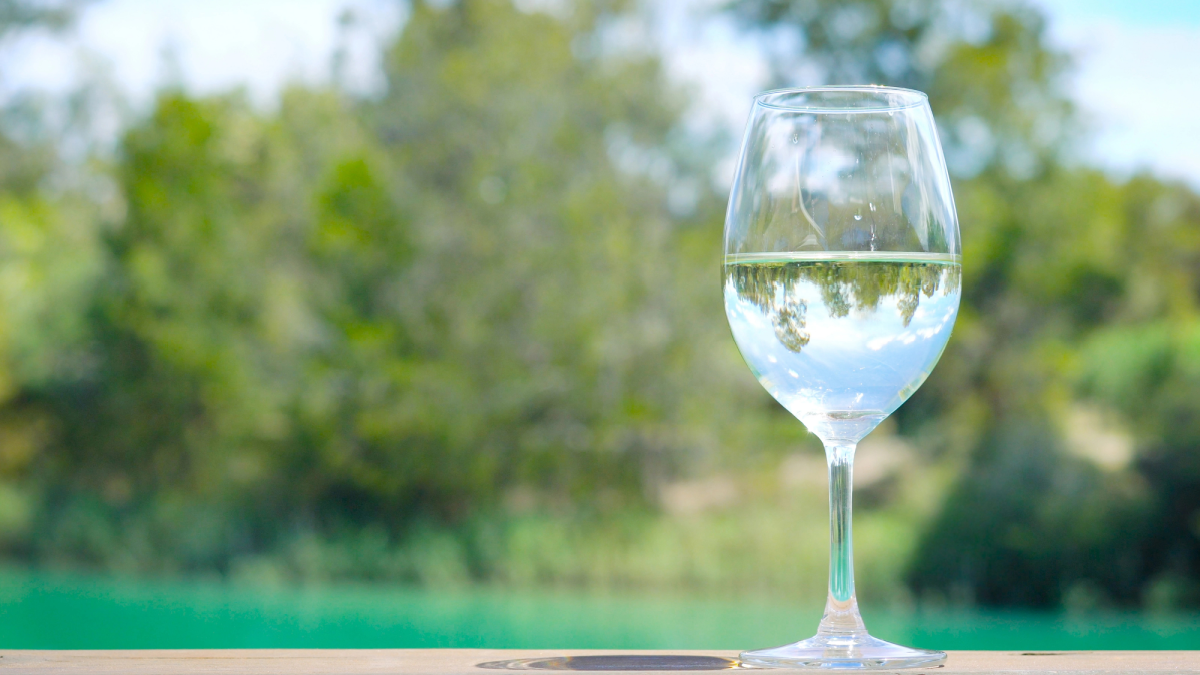

I did not expect to have opinions about water.
And yet here I am, remembering the exact moment I realized I could taste the difference between something pulled from an ancient iceberg and something drawn up through mineral-rich earth. Not in theory. In my body. On my tongue. One sip made me sit up a little taller and another made my shoulders drop.
I recently had the incredible privilege to stay at The Inn at Little Washington and met Cameron Smith, the water sommelier, who is also the Tea Master and Maitre du Fromage. Titles that could feel theatrical anywhere else feel entirely appropriate in his presence. Cameron meets water with genuine delight. He speaks about it with precision and care, and within a few minutes, you find yourself paying closer attention than you expected to.
We sat down for a tasting. A flight of waters sourced from completely different geographies, each carrying its own composition, its own story, its own way of landing in the body.
The first one that stayed with me was Berg.
Berg water is harvested from icebergs that have broken off from the Greenland ice sheet. These are not fresh formations. The water has been locked in ice for thousands of years, predating industrialization, predating modern pollution, formed in a different atmospheric era entirely.
That history is not something you “taste” in a literal sense, but there is a clarity that feels distinct. A near absence of minerality. Nothing pulling it in one direction or another. It moved across my palate with such lightness it created the sensation of lift, like my body didn’t have to work to receive it.
I kept noticing how little resistance there was. No edge. No density. It felt almost like drinking air that had briefly become liquid.
Then came Crazy Water No. 4.
Sourced from Mineral Wells, Texas, Crazy Water carries a completely different profile. High in minerals—magnesium, calcium, potassium—water that has spent time moving slowly through layers of rock, picking up density and structure along the way.
You can feel that.
There is weight to it. It lands. It stays. It asks your body to meet it.
I felt more oriented after drinking it. More here. More aware of where I was sitting, the temperature of the room, the sound of Cameron describing the next pour. It had a steadiness to it that I recognized immediately, even if I didn’t have the language for it before.
And then Vichy Catalan.
Drawn from a thermal spring in Catalonia, naturally carbonated and rich in sodium bicarbonate, this water arrives with energy.
The bubbles are fine, and almost electric. They move quickly, waking up your palate, bringing a brightness that feels celebratory without being overwhelming. There is a salinity to it as well, a savory quality that makes it feel closer to food than to something purely refreshing.
I understood immediately why people compare it to champagne. Not because it imitates it, but because it creates its own kind of occasion.
At some point during the tasting, Cameron started talking about how water is shaped by time and pressure. How it travels. How it rests. How long it remains in contact with the earth before it ever reaches a glass.
And that’s when the whole thing clicked for me.
This wasn’t about elevating water into something precious.
It was about paying attention to something we usually overlook.
There is an entire global community built around this kind of attention.
The Fine Water Society hosts the Fine Water Summit, a gathering of water sommeliers, producers, chefs, and enthusiasts who come together to taste and evaluate waters from around the world. The upcoming summit in Toronto will include guided tastings, pairing experiences, and discussions on sustainability, sourcing, and mineral composition.
There are competitions. Certifications. Structured tastings where water is evaluated on mouthfeel, balance, finish, and origin.
It sounds excessive until you realize how little attention most of us have ever given to what we drink every single day.
I used to think of beverages in terms of effect.
Would this relax me? Take the edge off? Help me feel different than I do right now?
Sitting there with those three waters, that framework didn’t apply.
Each one brought me closer to where I already was.
Closer to my body. Closer to the moment. Closer to the subtle shifts in sensation that are easy to miss when you’re not looking for them.
What surprised me most was not the taste.
It was the experience of caring.
Of slowing down enough to notice. Of letting something simple be interesting. Of realizing that pleasure doesn’t have to come from intensity. It can come from precision. From nuance. From the smallest differences becoming visible once you give them your attention.
I don’t know if water is the new wine.
I do know that I left that table more curious than when I sat down.
And that feels like a good place to start.
Welcome to HAPPY EVERY HOUR, your go-to hub for all things NA (non-alcoholic). We review alcohol-free beers, ciders, wines, spirits, RTDs (ready-to-drink), and share NA cocktail recipes that taste just as good—if not better—than the boozy originals. Whether you’re sober, sober-curious, or just taking a break, this is where great taste meets zero proof.
TRIGGER WARNING: People in early sobriety may want to proceed with caution. Always read labels. Please hydrate responsibly … #becausedrunkneverlooksgood.
Resources Are Available
If you or someone you know is experiencing difficulties surrounding alcoholism, addiction, or mental illness, please reach out and ask for help. People everywhere can and want to help; you just have to know where to look. And continue to look until you find what works for you. Click here for a list of regional and national resources.

Follow The Sober Curator on Instagram
Is there really a difference between these waters?
Yes! Differences in mineral content, source, and carbonation create distinct taste profiles and textures that can be experienced clearly when tasted side by side.
What makes iceberg water like Berg unique?
It originates from ancient glacial ice formed thousands of years ago, resulting in extremely low mineral content and a very clean, light profile.
Why does mineral water like Crazy Water taste heavier?
It contains higher levels of naturally occurring minerals like magnesium and calcium, which add structure and weight to the water.
What makes Vichy Catalan feel so different?
Its natural carbonation and high mineral content create fine bubbles and a savory, lively taste.
Is this just a luxury trend?
It can be, depending on where you encounter it. A guided water tasting at a place like The Inn at Little Washington is an experience, and it’s priced like one. Specialty waters can range from a few dollars a bottle to something much higher depending on sourcing and rarity. But the heart of it isn’t about exclusivity. It’s about attention.
