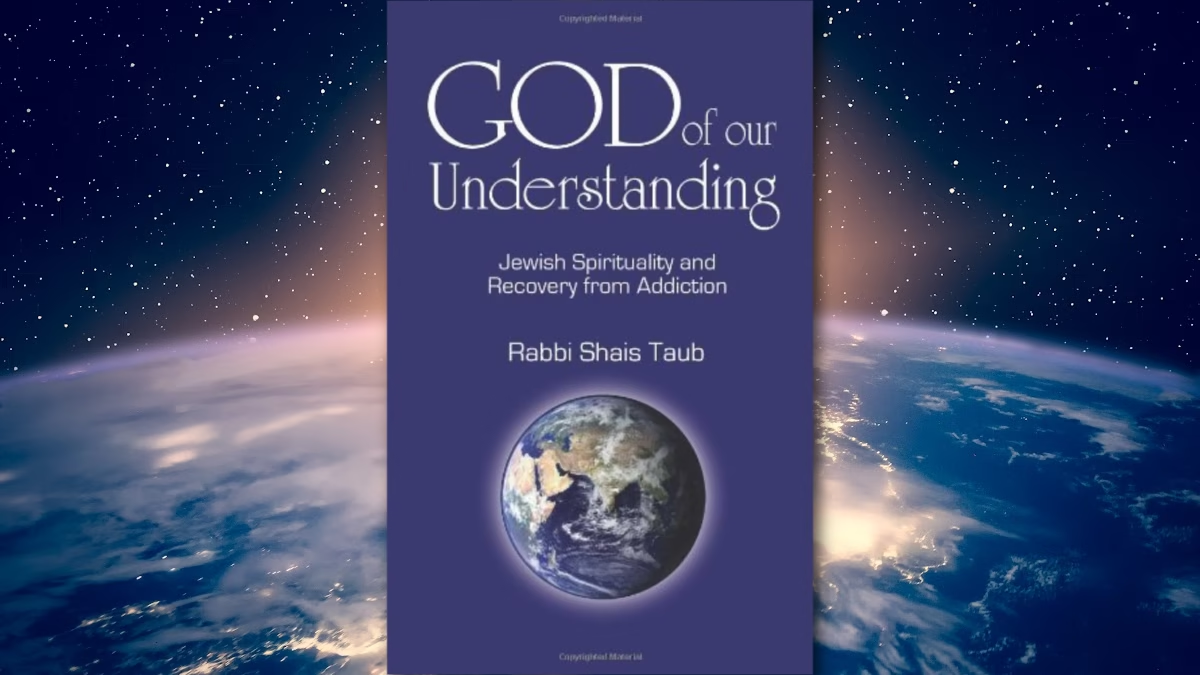
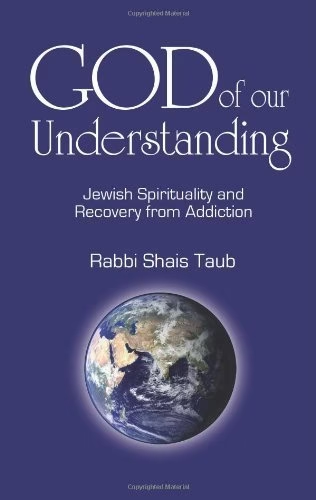
Rabbi Shais Taub wrote a book about the twelve steps that doesn’t sound like any other book about the twelve steps. Which is saying something, because there are approximately ten thousand books about the twelve steps, and most of them sound exactly alike.
This one’s different. Weirder. More useful. I am not Jewish and this is one of my favorite books on the 12-Steps.
What You’re Getting
“God of Our Understanding” takes the twelve steps and runs them through Jewish mysticism. Taub is an Orthodox rabbi who’s also been in recovery, and he writes from within both the Chasidic and Kabbalah traditions without flattening either into self-help nonsense.
The book breaks down each step through the lens of Jewish spiritual concepts. Not as metaphor. As actual working theology that happens to map onto the recovery process in ways that feel accidental and inevitable at the same time.
The God Problem
Here’s the thing recovery programs don’t say out loud enough: the steps require belief in something bigger than yourself, but they’re deliberately vague about what that something is. For people coming from religious backgrounds, this is either a relief or a cop-out. For people with religious trauma, it’s a minefield.
Taub doesn’t solve this. But he does show what it looks like when you take the God concept seriously as God—not as metaphor, not as group consciousness, not as your better self—and work the steps from there.
His God isn’t the punishing father-figure from Sunday school. It’s closer to the God of Spinoza or the Ein Sof of Kabbalah: infinite, unknowable, present in everything, accessible through practice. A God you can have a relationship with even if you can’t fully comprehend it.
This is surprisingly practical. Because one of the problems with “God as you understand Him” is that most people don’t understand anything, they just need to not drink today. Taub gives you a framework that’s specific enough to work with but expansive enough not to feel like you’re being handed someone else’s theology.
Where It Gets Interesting
The book really comes alive when Taub starts talking about bittul—self-nullification. Not the toxic kind where you erase yourself to please others. The mystical kind where you recognize your ego as construct and stop letting it run the show.
This maps directly onto Step One: admitting powerlessness. But Taub doesn’t treat powerlessness as defeat. He treats it as accurate information about the nature of the self. You’re not powerful because you were never supposed to be powerful in that way. You’re not the author of your own existence. You’re not even the main character.
For people in early recovery who’ve just finished running their lives into the ground through sheer force of will, this is either deeply comforting or completely terrifying.
He also does something smart with resentment. Most step work treats resentment as bad, something to inventory and remove. Taub explains resentment as disconnection from the divine flow—a kind of spiritual constipation where you’re holding onto something that was supposed to move through you. The solution isn’t to force yourself to forgive. It’s to restore flow. Let the thing pass. Get out of your own way.
That reframe helps. Because “you have to forgive your abuser or you’ll relapse” doesn’t land for most people. But “holding this is blocking your connection to something larger, and that blockage hurts you more than them” at least gives you a reason that isn’t moralistic guilt.
The Jewish Thing
You don’t have to be Jewish to get something from this book, but it helps if you’re comfortable with Jewish frameworks. Taub uses Hebrew terms without always explaining them. References Talmudic stories. Assumes a certain familiarity with prayer and ritual.
This is both strength and limitation. Strength because he’s not watering down the tradition to make it palatable. Limitation because if you’re coming from a totally secular background or a different religious tradition, some sections will feel like he’s speaking a language you only half understand.
But here’s what’s interesting: the Jewish mysticism stuff actually helps clarify the twelve steps in ways that Christian interpretations sometimes muddy. The steps were written by Christians but designed to be non-denominational. Taub shows how they work from a completely different theological starting point, which paradoxically makes them feel more universal.
What It Doesn’t Do
This isn’t a how-to manual. Taub doesn’t give you worksheets or action items or a clear roadmap through the steps. If you want that, buy a Big Book workbook. It’s also not particularly interested in addiction as disease, brain chemistry, or psychological pathology. Taub treats addiction as spiritual crisis first and everything else second. That’s going to frustrate people who need the medical model to make sense of their drinking. And it won’t help if you need recovery to be purely secular. Taub’s entire framework requires accepting that there’s something beyond the material world worth orienting yourself toward. If that’s not available to you—if you’re hardwired atheist or God-concept traumatized—this book might just piss you off.
Who It’s For
- Read this if you’re stuck on the God stuff in AA and need a more rigorous theology than “just pick something.”
- Read this if you’re Jewish in recovery and tired of twelve-step literature that assumes Christian frameworks.
- Read this if you’re intellectually curious about how mysticism and recovery might inform each other without collapsing into New Age mush.
- Don’t read this if you need recovery stripped of all spiritual content.
- Don’t read this if you want step-by-step instructions. Don’t read this expecting scientific rigor about addiction—that’s not what it’s offering.
The Bottom Line
“God of Our Understanding” is a strange, specific book that does one thing well: it takes the twelve steps seriously as spiritual practice and shows what they look like when refracted through Jewish mystical thought. Taub writes like someone who’s actually done the work—both the recovery work and the spiritual work—and isn’t interested in pretending they’re separate.
It won’t work for everyone. Probably won’t work for most people. But for the people it works for, it might crack something open that vaguer approaches to Higher Power couldn’t touch.
The steps keep saying “God as you understand Him.” Taub offers one understanding, drawn from centuries of Jewish mystical practice. You don’t have to adopt it wholesale. But having an actual theology on the table—something with depth and history and internal logic—beats the hell out of “just pray to the group” for people who need something to push against or lean into. Sometimes specificity is more freeing than vagueness. This book makes that argument by example.
#QUITLIT Sobees Score: 4.5 out of 5

A STOIC SOBRIETY: Welcome to A Stoic Sobriety. I am Tony Harte, and I believe that Empowering Recovery with Stoic Wisdom is the game-changer you’ve been looking for.
With over 36 years of continuous sobriety (since 1989) and professional experience in addiction treatment, I know that recovery isn’t just about quitting—it’s about evolving.
Here, we combine the tried-and-true approaches of the AA 12-Step Program with the ancient, logical wisdom of Stoicism. Whether you are an agnostic, a believer, or simply seeking strength, let’s embark on this path of enlightenment together.
Sober Curator Pro Tip: Want to see how Tony breaks down the 12-Steps through the lens of stoicism? CLICK HERE.

TSC LIBRARY: Step into The Sober Curator Library! Here, books are more than pages—they’re portals. We read them, listen to them, obsess over them, and then spill our thoughts in curated reviews.
Explore our four signature genres: #QUITLIT, Addiction Fiction, Self-Help, and NA Recipe Books.
Want even more inspo? Our Amazon #QUITLIT list of books written by Sober Curator Contributors.
Resources Are Available
If you or someone you know is experiencing difficulties surrounding alcoholism, addiction, or mental illness, please reach out and ask for help. People everywhere can and want to help; you just have to know where to look. And continue to look until you find what works for you. Click here for a list of regional and national resources.