Classy Problems is a daily post of thinking in motion by Dan T. Rogers. Each post stands alone as a thought-provoking piece, yet together, they create a puzzle of ideas. They invite you to see things from a different angle, rethink what you thought you knew, and explore what’s beyond your current understanding.
Classy isn’t just a read: it’s a practice. Read, listen, and join us for Classy Problems Live, a 15-minute, live virtual conversation held Monday through Thursday at 12:15 p.m. PT, where we gather to reflect on the Classy Problems post of the day. No need to prep. Just connect, explore, and reflect.

Spoons, Shovels, and Bulldozers
I treated every insight the same.
Same weight.
Same depth.
Same life-altering impact.
It didn’t.
It doesn’t.
Some things are meant to be tasted.
Others to be shared.
By the grace of theboss,
a rare few require me
to reorient the ground I stand on.
That’s why I started thinking in tools.
Not tools for solving.
Tools for filtering.
For making truth usable.
Spoons.
Shovels.
Bulldozers.
Each one has a place.
Each one has a purpose.
Each one has a price.
Spoons uncover.
They’re small.
They provide me nourishment.
They help me piece by piece.
They’re designed for working in solitude
when I’m working on me.
Shovels discover.
They’re shared.
They provide us leverage.
They help us move together.
They’re designed for working in a group
when two or more align as one.
Bulldozers discard.
They’re heavy.
They provide clearance.
They help reshape what fits.
They’re designed for working in aligned systems
when teams of teams orient together.
The tool isn’t the insight.
The tool is what makes the insight usable.
Spoons …
Most of my truths are too big to take in all at once.
They require a smaller tool.
Spoons
Most of my truths are too big to take in all at once.
They require a smaller tool.
One made for contact, not change.
Spoons uncover.
They invite me to partake.
Like warm soup on a cold day.
Or ice cream on a hot one.
Spoons deliver what fits.
A spoon gives me the next bite.
Not the whole meal.
What’s here now.
One layer at a time.
Spoons are for solitude.
When I’m working on me.
Uncovering the feeling I skipped.
The preference I pretended wasn’t there.
The ache I thought I’d already worked through.
For nourishment.
They’re light.
They carry weight.
They make it easy.
Thy help me hold one truth at a time
without choking on clarity.
Most of what’s changed me
didn’t arrive in bulk.
It arrived by spoon.
Shovels …
Some truths bring shared meaning to the surface.
They move more than one person alone.
Shovels
Some truths bring shared meaning to the surface.
They move more than one person alone.
They are not mine alone.
They live between us.
They emerge through us.
Shovels discover.
Shovels are for work.
Shared effort.
I’ll carry part of this with you.
They show up in trusted groups.
Two or more of us,
moving as one.
Like digging out a trail
to provide space for someone else.
A shared tool,
in a shared effort,
revealing what we’re both ready to see.
Shovels let us work at the speed of trust.
They’re made for teams.
Sidekicks who’ve aligned in direction,
even if not in pace.
Most of what I’ve discovered
didn’t happen in my own head.
It happened in moments
when the work became the relationship.
When we picked up the same shovel,
digging together.
Bulldozers …
Some truths don’t shape the work.
They reshape the ground it stands on.
Bulldozers
Some truths don’t shape the work.
They reshape the ground it stands on.
They shift the whole terrain.
Bulldozers discard.
They clear space for what’s next.
They move what no one person could carry.
What no single team could manage.
Bulldozers are for reorientation.
The heavy kind.
The kind that affects the whole system.
They’re not fast.
They’re not clean.
They’re not for show.
They’re for when we decide to change design.
By design.
They show up in aligned systems.
Teams of teams.
Organizations inside ecosystems.
When we’re coordinating.
Moving in cadence.
Risking forward motion.
Like rerouting an old road,
inviting others to join.
It’s not about elegant design.
It’s necessary process.
A bulldozer doesn’t arrive by accident.
It’s brought in when what’s been built
is no longer holding.
When we’ve outgrown the old frame.
Ready for next version of next.
Moving towards closer to right.
Most of what has evolved us
didn’t teach us something new,
it cleared out something old.
To make room.
For what we’re becoming.
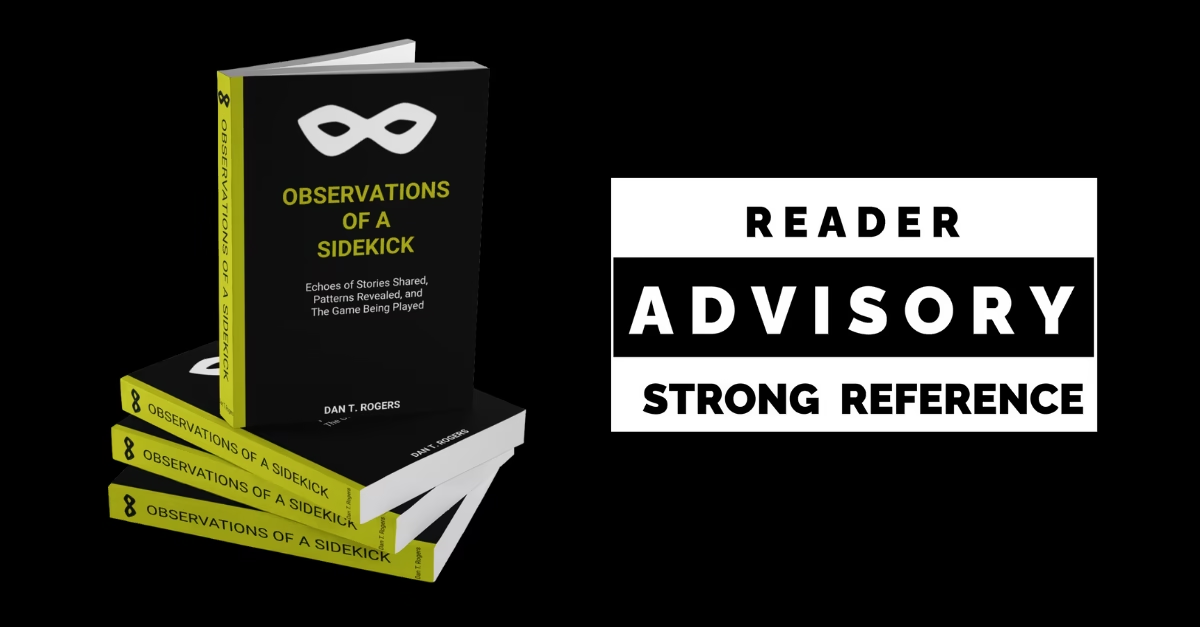
#ADDTOCART: “Observations of a Sidekick” is not a memoir or another survival story. It’s an invitation into what comes after survival: post-survival living. In a culture addicted to breakthrough moments and lightning flashes, author Dan T. Rogers encourages us to pay attention to the thunder that follows. The echo where transformation begins.

Classy Problems is a daily post of thinking in motion by Dan T. Rogers. Each post stands alone as a thought-provoking piece, yet together, they create a puzzle of ideas. They invite you to see things from a different angle, rethink what you thought you knew, and explore what’s beyond your current understanding.
What is a classy problem? A classy problem is when we’ve been afforded the opportunity to figure out what to do. Time to figure it out. Time to practice. Time to discern. When faced with the time to figure out a classy problem, it is more effective to focus on what NOT to do than trying to figure out what to do. In a word: restraint. JOIN US in exploring the distinction between what to do and what not to do in the pursuit of clarity.

SPIRITUAL GANGSTER: at The Sober Curator is a haven for those embracing sobriety with a healthy dose of spiritual sass. This space invites you to dive into meditation, astrology, intentional living, philosophy, and personal reflection—all while keeping your feet (and your sobriety) firmly on the ground. Whether you’re exploring new spiritual practices or deepening an existing one, Spiritual Gangster offers inspiration, insight, and a community that blends mindful living with alcohol-free fun.

SOBERSCRIBE NOW!
Resources Are Available
If you or someone you know is experiencing difficulties surrounding alcoholism, addiction, or mental illness, please reach out and ask for help. People everywhere can and want to help; you just have to know where to look. And continue to look until you find what works for you. Click here for a list of regional and national resources.