Classy Problems is a daily post of thinking in motion by Dan T. Rogers. Each post stands alone as a thought-provoking piece, yet together, they create a puzzle of ideas. They invite you to see things from a different angle, rethink what you thought you knew, and explore what’s beyond your current understanding.
Classy isn’t just a read: it’s a practice. Read, listen, and join us for Classy Problems Live, a 15-minute, live virtual conversation held Monday through Thursday at 12:15 p.m. PT, where we gather to reflect on the Classy Problems post of the day. No need to prep. Just connect, explore, and reflect.

But That’s Not All
You can’t have it all.
As if “all” is a fixed thing.
Frames the problem as volume,
not clarity.
The issue with “all”
isn’t that it’s too big.
It’s that it’s too vague.
Unexamined. Unsequenced. Unowned.
I don’t want all. I want most.
Or worse. I want the illusion of.
The illusion of all
without the strings attached.
I say I want patience.
What is patience?
Sitting quietly.
I don’t want patience.
I want the other person to agree with me.
But that’s not all.
I want them to say I’m right.
But that’s not all.
I want them to like me.
But that’s not all.
I want to be seen and heard.
But that’s not all.
I want to feel safe.
But that’s not all.
I want to control.
I want them to not leave.
That’s not all. That’s fear.
“All” is only possible
when I name it.
When I sequence it.
When I choose what comes first
and what can come later
and what I’m willing to live without.
Control, safety, validation.
Those aren’t all.
They’re not even the same kind of thing.
Control comes from agency.
Safety comes from shelter.
Validation comes from alignment.
None of that comes
from demanding all of it at once.
A better question is:
What do I want most
and what am I willing not to do
to have it all?
But Wait, There’s More
That’s the line.
Always delivered right before we thought it was over.
But wait. There’s more.
It sounds like a gift.
It’s a trap.
I didn’t ask for more.
It was offered anyway.
More content. More features. More options.
More ways to feel like we’re not quite there.
We learn to believe
that enough lives
on the other side of more.
The more we get,
the less it gives.
More doesn’t clarify.
More is not the goal.
More is not the problem.
More is the pattern.
It keeps us chasing.
Upgrading. Escaping. Never-arriving.
Fulfillment doesn’t come
from stacking value.
It comes from knowing
what matters most.
There’s always more.
It may or may not be
better, needed, aligned.
A better question is:
More of what?
Abundance Isn’t the Answer
Abundance is the problem.
I get the sentiment.
The abundance crowd means well.
They want more choices, more energy, more access.
More yes.
Less no.
Abundance is still framed inside a scarcity worldview.
In order for there to be abundance,
there must be scarcity.
Otherwise, abundance wouldn’t feel like more.
It wouldn’t feel like anything.
Abundance is not answer.
It’s preference.
Subjective. Personal.
When abundance comes in a form we like,
we call it freedom.
When it comes in a form we don’t,
we call it complexity.
Either way, it’s too much.
Too many options.
Too many inputs.
Too many priorities
pretending to matter equally.
Too much toomuchness.
It is a classy problem.
It looks like opportunity.
Feels like confusion.
Acts like overwhelm.
Simplicity doesn’t come from more.
Simplicity comes from choosing.
Refining.
Discarding.
Abundance isn’t the answer.
It’s the problem framed
as preference.
If You’re Not Growing, You’re Dying
That’s what they said.
I think they wanted to motivate me.
It felt like they were trying to inspire me.
To keep going.
If you’re not growing,
you’re dying.
Catchy, sounds good.
Feels urgent.
Totally misses the point.
Totally false.
Next example of tissue paper thinking.
Growth isn’t inherently good.
It’s inherently more.
More revenue.
More scale.
It’s also more noise.
More pressure.
Growth is quantitative.
Always.
Good is qualitative.
Sometimes.
Dying?
We’re all doing that.
Every minute.
That’s a fact.
Another fact is that we’re always growing something.
Nothing is something when it comes to growing.
We grow distraction.
We grow doubt.
We grow defense mechanisms.
The question isn’t, are you growing?
It’s, what are you growing?
A better question:
Why are you growing it?
That’s where growth becomes directed.
That’s where growth becomes intentional.
That’s when we stop calling it growth.
That’s where we start calling it development.
If you’re not growing,
you’re developing.
Easier to Give Than It Is to Receive
Advice is easier to give
than it is to receive.
That’s my first clue
that I’m not trying to connect.
I’m trying to solve.
I want to be useful.
I want to be helpful.
Useful isn’t always helpful.
Advice isn’t always aligned.
Advice is intent
based on my preference.
What is helpful is reference.
Something for you to see yourself in.
To align with.
To measure against.
Reference doesn’t provide an answer.
It helps determine what is here.
Advice is to the point.
Reference is something to point to.
Advice is a suggestion.
Reference is a question.
I use reference to notice.
Notice where clarity sharpens preference.
Where alignment starts.
Or stops.
Treat what you find here as reference.
You can trust your attention.
Help it uncover your intention.
Not mine.
It’s Not About You
It’s not you.
It’s me.
It’s not about you.
It’s about me.
You share something tender.
Something that aches.
Hurt. Shame. Fear.
Disappointment. Uncertainty.
I can’t hold it.
I have to fill it.
With something.
Anything.
Other than the discomfort.
Not yours.
Mine.
I think
I want to be useful.
I feel useful
only if it’s comfortable.
For me.
It’s not about you
when
it’s about me.
Happy for Me
You shared good news.
A win.
Your win.
I felt it.
Not how I wanted to.
I didn’t feel happy.
I felt smaller.
Like your happiness
came at this cost of mine.
Like there wasn’t enough to go around.
Like somehow
you getting yours
took some of mine.
Now I feel less than.
My own unspoken ache.
That’s not your fault.
It’s my contraction.
Thinking smaller.
Feeling smaller.
Acting smaller.
Getting caught up in me.
Forgetting
that thebossissupergenerous.
Even if it takes me a moment
to catch up
I am on your side.
Rooting for you.
Funny thing is,
happy for you
eventually
is happy for me.
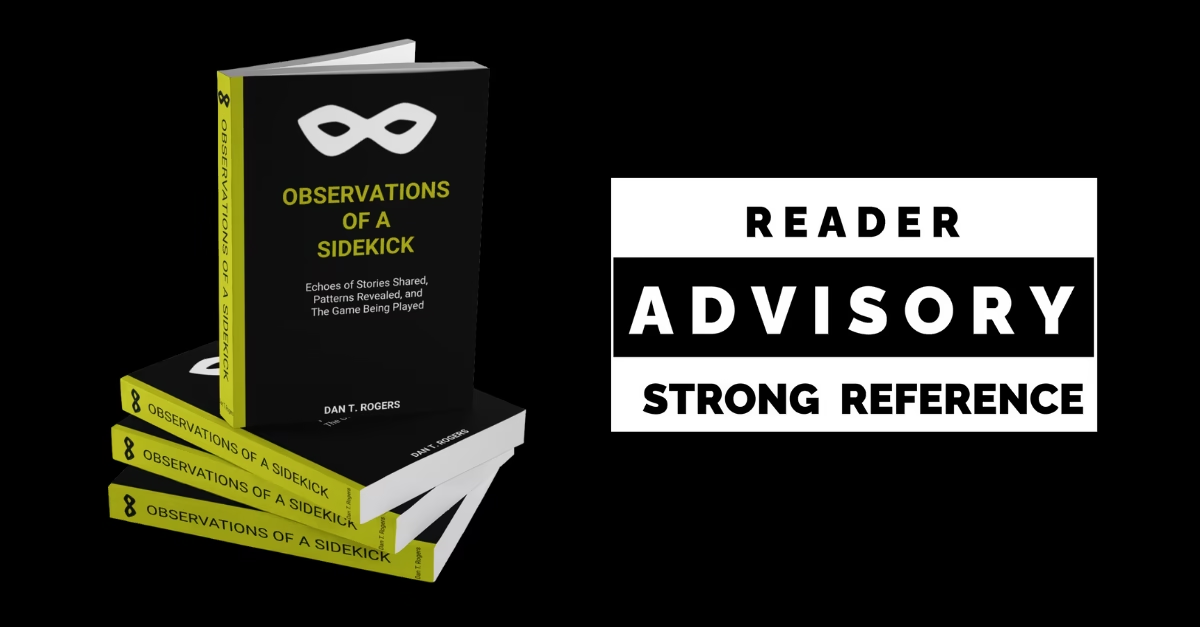
#ADDTOCART: “Observations of a Sidekick” is not a memoir or another survival story. It’s an invitation into what comes after survival: post-survival living. In a culture addicted to breakthrough moments and lightning flashes, author Dan T. Rogers encourages us to pay attention to the thunder that follows. The echo where transformation begins.

Classy Problems is a daily post of thinking in motion by Dan T. Rogers. Each post stands alone as a thought-provoking piece, yet together, they create a puzzle of ideas. They invite you to see things from a different angle, rethink what you thought you knew, and explore what’s beyond your current understanding.
What is a classy problem? A classy problem is when we’ve been afforded the opportunity to figure out what to do. Time to figure it out. Time to practice. Time to discern. When faced with the time to figure out a classy problem, it is more effective to focus on what NOT to do than trying to figure out what to do. In a word: restraint. JOIN US in exploring the distinction between what to do and what not to do in the pursuit of clarity.

SPIRITUAL GANGSTER: at The Sober Curator is a haven for those embracing sobriety with a healthy dose of spiritual sass. This space invites you to dive into meditation, astrology, intentional living, philosophy, and personal reflection—all while keeping your feet (and your sobriety) firmly on the ground. Whether you’re exploring new spiritual practices or deepening an existing one, Spiritual Gangster offers inspiration, insight, and a community that blends mindful living with alcohol-free fun.

SOBERSCRIBE NOW!
Resources Are Available
If you or someone you know is experiencing difficulties surrounding alcoholism, addiction, or mental illness, please reach out and ask for help. People everywhere can and want to help; you just have to know where to look. And continue to look until you find what works for you. Click here for a list of regional and national resources.
Follow The Sober Curator on X, the artist formerly known as Twitter