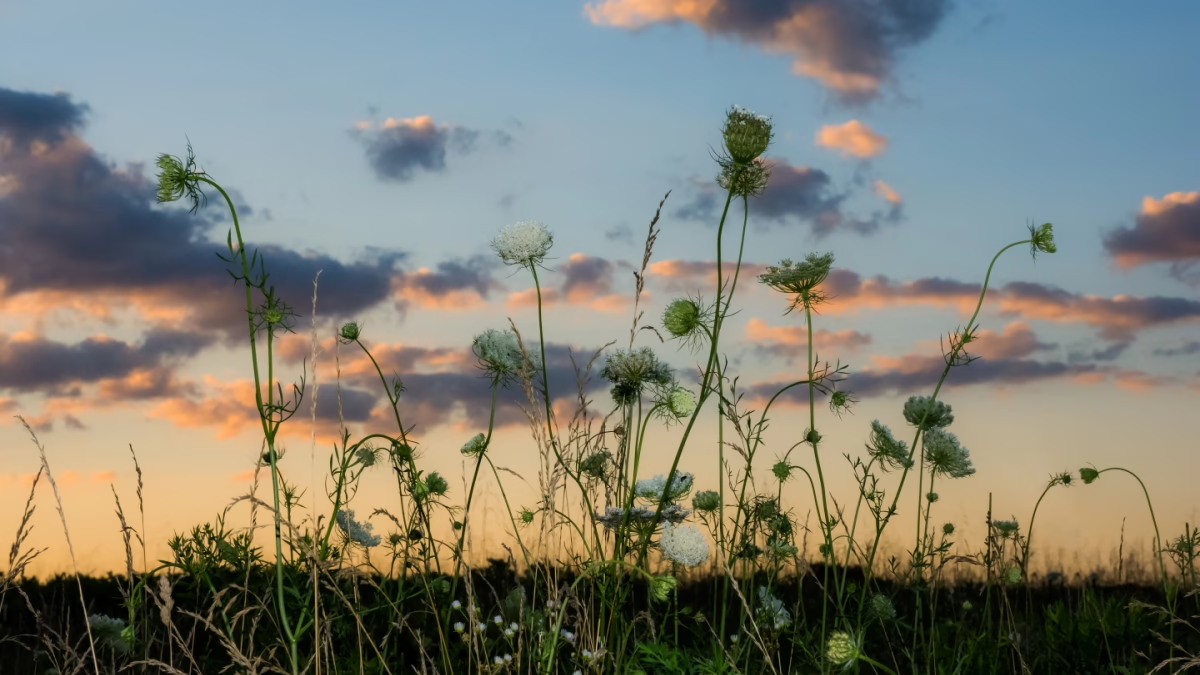
Right now, the sky barely lets go before 9pm. There’s a kind of seeing you only get this time of year, when the light reaches further than it does the other eleven months combined.
Old Irish midsummer bonfires worked the same way. Communities lit fires on hills on the same night, and the point was never just the fire in front of you. One hill lit its fire. The next hill over saw the flame and lit its own. Then the next, and the next, until a whole landscape of fires was answering each other across the dark. People weren’t only warming themselves. They were proving how far the light could travel. Stand on one hill and you could see exactly how far you’d come, because the proof was lit up in front of you, fire by fire, all the way to the horizon.
A day count works the same way as one of those fires. You need it, sobriety doesn’t happen without it, but it’s a single point of light, and if that’s the only flame you’re looking at, you miss the whole hillside.
Midsummer lights up more than the landscape. The conversation you didn’t run from. The apology you made without an excuse folded inside it. The holiday you got through without rehearsing an exit plan in your head the entire time. The friend you told the truth to instead of managing what they thought of you. None of that gets a number. None of it shows up on an app. But it’s fire too, and it’s burning whether anyone’s counting it or not.
This is what emotional sobriety actually looks like from a distance. Not one flame you can point to and say there, that’s the proof. A whole landscape of small fires, lit one at a time, most of them without you realizing you were doing anything remarkable at all.
So here’s the practice, and it doesn’t require anything you don’t already have. Go outside this week while it’s still light late, dusk if you can manage it, and just look. Then name three specific things that are different about you now that have nothing to do with the date you got sober. Not gratitude in general, not the caption version of “thankful for my journey.” Specific. The thing you said. The thing you didn’t say. The way you handled the thing that used to undo you completely.
That’s the whole exercise. No tools and nothing to buy. Just you, standing on your own hillside at dusk, finally able to see how far the light actually reaches.

THIRSTY FOR WONDER: at The Sober Curator, led by Anne Marie Cribben—a passionate recovery coach and spiritual companion based in Washington, DC—offers 1:1 coaching, spiritual guidance, and recovery support rooted in compassion and empowerment. As the creator of The Wellspring: A Celtic Recovery Journey, Anne Marie blends the Celtic calendar with sobriety, connecting participants to ancient wisdom and the rhythms of nature.
A fierce advocate for sobriety as liberation and self-love, she challenges the targeted marketing of alcohol to women and champions authentic, joyful living. Her work goes beyond addiction recovery, fostering a life of vibrancy, purpose, and connection.
Curated Summer Reads by Anne Marie Cribbin
- The Cult of the Cold Drink: Why Watertok, Mocktails, and Iced Coffee Rituals Are Taking Over Summer
- Famesick by Lena Dunham: A Review for the Curious and the Recovering
- Put Down the ACOTAR and Get Salty: 5 Ways Seaweed Can Enhance Your Recovery This Summer
- Get Ready for Analog Summer – Why Sober Curiosity, Offline Living, and Real Connection Are the New Seasonal Mood
What is “We Were Always This Lit” about?
“We Were Always This Lit” is a lyrical recovery reflection by Anne Marie Cribbin that connects Celtic midsummer bonfires with emotional sobriety. The piece explores how sobriety is not only measured by a day count, but also by the small, meaningful changes that show how far someone has come.
How does Celtic midsummer connect to sobriety?
The article uses Celtic midsummer bonfires as a metaphor for recovery. Just as fires once lit up hillsides and showed how far light could travel, small sober choices can reveal the wider landscape of emotional growth, healing, and change.
What is emotional sobriety?
Emotional sobriety refers to the deeper inner work of recovery beyond simply not drinking or using. It can include telling the truth, making apologies without excuses, staying present in difficult conversations, setting boundaries, and responding differently to situations that once felt overwhelming.
Why does the article say a day count is only one point of light?
A sobriety day count matters, but it does not capture every part of recovery. Anne Marie’s piece suggests that emotional growth, changed behavior, self-awareness, and courage are also signs of sobriety — even when they do not come with a number or public milestone.
What recovery exercise does the article suggest?
The article invites readers to go outside during the long light of midsummer or dusk and name three specific things that are different about them now that have nothing to do with their sober date. The point is to notice real changes in behavior, honesty, courage, and emotional resilience.
Who should read this piece?
This piece is a strong fit for readers in recovery, sober-curious readers, people interested in Celtic seasonal traditions, and anyone who needs a reminder that their progress is bigger than a number. It is especially meaningful for people learning to recognize the quiet evidence of emotional sobriety.