


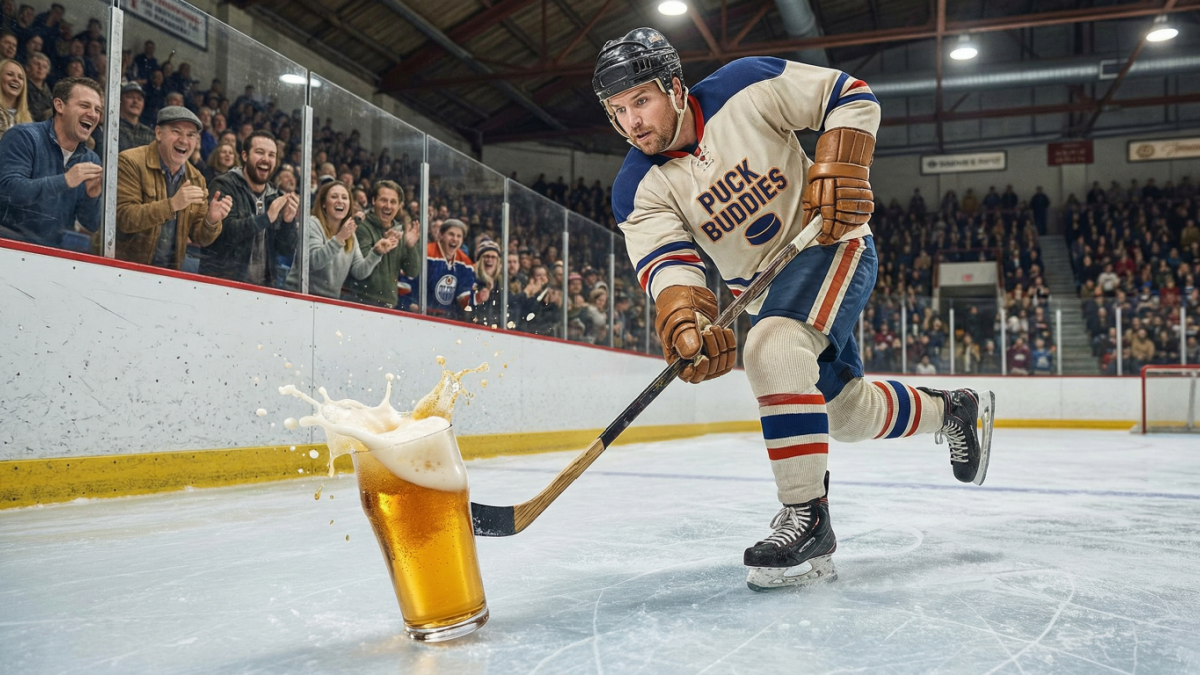

The tradition no one questions in professional sports is alcohol as celebration. In the National Hockey League, this is highly visible. The final whistle blows. Celebration begins on the ice. Then the locker room transforms. Plastic hangs from ceilings to protect lockers from champagne showers. Bottles are passed. Beer flows.
Alcohol has long been woven into hockey culture. This is not a moral attack. It is an honest examination of alignment between tradition and performance. As conversations around sobriety, the alcohol-free lifestyle, and athlete wellness grow, questions about alcohol’s role in professional sports culture are becoming harder to ignore.
Qualitative research with former professional ice hockey players confirms that alcohol was historically embedded in hockey culture. Players described beer in dressing rooms, alcohol on team flights, and drinking norms that began as early as junior hockey, shaping expectations about masculinity and belonging (Mair & Thompson, 2022). Hockey has not merely tolerated alcohol. In many eras, it normalized it.
Hockey culture emphasizes grit, pain tolerance, and toughness. Historically, alcohol has been tied to bonding and masculinity. Research on Canadian hockey masculinity suggests that toughness is socially constructed around risk taking, endurance, and conformity to team norms (Allain, 2008). Within that construction, drinking has often functioned as a symbol of belonging. Tough men work hard and play hard. Tough men drink together.
Research across team sports shows this is not unique to hockey. College athletes report higher rates of alcohol consumption than non-athletes, and drinking is frequently linked to team bonding and social cohesion (Martens et al., 2006; Nelson & Wechsler, 2001). When alcohol becomes associated with chemistry and unity, it shifts from personal choice to cultural expectation.
Culture shapes behavior more powerfully than policy.
Yet culture and science are not always aligned.
Scientific reviews demonstrate that alcohol negatively affects athletic performance and recovery. Acute alcohol intake interferes with hydration, thermoregulation, neuromuscular coordination, and overall recovery physiology (Barnes, 2014). In a sport built on speed, reaction time, and endurance, those variables matter.
More specifically, alcohol ingestion has been shown to impair post-exercise muscle protein synthesis, limiting the body’s ability to rebuild and adapt after training (Parr et al., 2014). In practical terms, alcohol can blunt the very physiological processes athletes train to optimize.
Sleep is another critical factor. Alcohol disrupts normal sleep architecture and reduces sleep quality, even when it initially induces sedation (Roehrs & Roth, 2001). Poor sleep impairs reaction time, cognitive processing, and recovery. For elite athletes, marginal losses accumulate.
In strength and conditioning, recovery is not optional. Hydration matters. Sleep matters. Muscle repair matters. The expectation of precision applies at every level of training. Yet alcohol remains culturally insulated from scrutiny in many team environments.
Beyond physiology lies social pressure.
Athletes in team sports often report higher binge drinking patterns compared to non-athletes, particularly in social settings (Turrisi et al., 2006). The locker room is a powerful social environment. Younger players seek acceptance. Veterans set tone. Drinking can function as a ritual of belonging.
Professional organizations have noted that team environments significantly shape alcohol norms. When drinking is normalized socially, individuals may adopt patterns without fully evaluating performance consequences (American Psychiatric Association, n.d.). What feels voluntary can quietly become conformist.
This creates tension. Hockey prides itself on toughness. Missing teeth. Playing through injury. Fighting through fatigue. Historically, that toughness has included partying hard.
But toughness is evolving.
Restraint requires strength. Discipline requires strength. Emotional control requires strength.
I once equated strength with excess. I worked hard and drank hard. I relieved stress through alcohol. Eventually, I hit rock bottom. In recovery, I learned that restraint demands more fortitude than indulgence. Self-control is strength. Like many people who adopt a sober lifestyle or alcohol-free lifestyle after addiction, I discovered that discipline compounds in ways excess never can.
In high performance sports, discipline compounds.
Sobriety offers measurable advantages. Clearer cognitive processing late in games. More consistent sleep cycles. More efficient recovery. Reduced inflammation. Stable identity off the ice.
This is one reason many sober athletes and athletes in recovery increasingly view sobriety not as a limitation, but as a competitive advantage.
For athletes exploring sobriety, or even a sober-curious lifestyle, the potential performance advantages are worth serious consideration.
The difference may not be dramatic in one night. But over seasons, marginal gains compound. Alcohol subtracts marginally. Discipline adds marginally. One percent matters.
I work as a full-time high school strength and conditioning coach, and in my weight room I teach one percent better daily. Athletes do not need to transform overnight. They need incremental improvement. With consistency, small gains multiply. The same principle applies here. Marginal physiological advantages accumulate across eighty-two game seasons and multi-year careers.
Hockey is evolving in analytics, training science, and load management. Cultural evolution may follow. The question is not condemnation. It is alignment.
In a league defined by speed, precision, and resilience, the competitive edge will belong to those disciplined in unseen hours. Culture will either reinforce that discipline or erode it.
One percent matters.
Notable Hockey Players Who Are Publicly Sober

???? Jordin Tootoo
- One of the most prominent sobriety advocates in hockey.
- First Inuit player in NHL history.
- Openly discussed struggles with alcohol and addiction following personal trauma and the death of his brother.
- Now speaks publicly about recovery and mental health.
He also wrote the memoir All the Way: My Life on Ice, which talks about sobriety and resilience.
???? Bobby Ryan
- Former Anaheim Ducks and Ottawa Senators star.
- Entered the NHL/NHLPA Player Assistance Program in 2019 to address alcoholism.
- Returned to the NHL and scored a hat trick in his first home game back, which became one of the league’s most emotional comeback moments.
His story is widely cited as a powerful recovery comeback.
???? Colin Wilson
- Former Nashville Predators and Colorado Avalanche forward.
- Wrote publicly about his addiction and recovery journey.
- Shared that he was over two years sober while reflecting on addiction in professional hockey.
His essay about addiction in hockey culture resonated strongly with players and fans.
???? Kevin Stevens
Stanley Cup champion with the Pittsburgh Penguins.
Struggled with opioid addiction after a severe facial injury.
Later entered recovery and now works in addiction advocacy through his foundation helping others.
???? Mark Parrish
Former New York Islanders and Minnesota Wild forward.
Has spoken openly about alcoholism after his playing career.
Publicly celebrated multiple sobriety milestones and now advocates for recovery awareness.
Sober Curator Fun Fact: a growing number of players are talking about sobriety openly, especially since the NHL created its Player Assistance Program in 1996 to support players dealing with substance use or mental health issues.
References
Allain, K. A. (2008). “Real fast and tough”: The construction of Canadian hockey masculinity. Sociology of Sport Journal, 25(4), 462–481.
Barnes, M. J. (2014). Alcohol: Impact on sports performance and recovery in male athletes. Sports Medicine, 44(7), 909–919.
Mair, H., & Thompson, K. (2022).Alcohol use and hockey culture: A qualitative study of former professional ice hockey players. International Journal of Environmental Research and Public Health, 19(23), 16089.
Martens, M. P., Dams O’Connor, K., & Beck, N. C. (2006). A systematic review of college student athlete drinking: Prevalence rates, sport related factors, and interventions. Journal of Substance Abuse Treatment, 31(3), 305–316.
Nelson, T. F., & Wechsler, H. (2001). Alcohol and college athletes. Medicine & Science in Sports & Exercise, 33(1), 43–47.
Parr, E. B., Camera, D. M., Areta, J. L., et al. (2014). Alcohol ingestion impairs maximal post exercise rates of myofibrillar protein synthesis following a single bout of concurrent training. PLOS ONE, 9(2), e88384.
Roehrs, T., & Roth, T. (2001). Sleep, sleepiness, and alcohol use. Alcohol Research & Health, 25(2), 101–109.
Turrisi, R., Mallett, K. A., et al. (2006). Heavy drinking in college students: Who is at risk and what is being done about it? Journal of General Psychology, 133(4), 401–421.
THE MINDFUL BINGE: “Heated Rivalry” – What All the Buzz Is About (A Sober Fan’s Love Letter)

SOBER SPORTS at The Sober Curator celebrates the connection between sobriety, wellness, and an active lifestyle. This section features articles, interviews, and personal stories from athletes and fitness enthusiasts who are thriving without alcohol. By showcasing the benefits of sober living—and the powerful role sports and fitness play in maintaining recovery—we’re reframing what wellness looks like and promoting a positive, empowering approach to life after booze.
Resources Are Available
If you or someone you know is experiencing difficulties surrounding alcoholism, addiction, or mental illness, please reach out and ask for help. People everywhere can and want to help; you just have to know where to look. And continue to look until you find what works for you. Click here for a list of regional and national resources.

Follow The Sober Curator on LinkedIn
1. Does alcohol affect athletic performance in hockey players?
Yes. Research shows alcohol can impair hydration, neuromuscular coordination, and recovery, all of which are critical for high-performance sports like hockey. It can also disrupt muscle repair and sleep quality, which can negatively impact reaction time and endurance during games.
2. Why is alcohol so common in hockey culture?
Historically, alcohol has been tied to team bonding, masculinity, and celebration in hockey culture. Studies of former professional players show that drinking often began early in junior leagues and became normalized as part of team identity and social cohesion.
3. Can sobriety improve athletic performance for hockey players?
Many athletes believe sobriety can provide a competitive edge. Avoiding alcohol may improve sleep, recovery, cognitive clarity, and physical consistency over long seasons, allowing athletes to maintain higher performance levels.
4. Why do athletes sometimes feel pressured to drink with teammates?
Team environments can create strong social norms. When alcohol becomes part of bonding rituals, younger players may feel pressure to participate in order to fit in or gain acceptance within the locker room culture.
5. Is hockey culture around alcohol starting to change?
Yes. As sports science, recovery strategies, and athlete wellness gain more attention, many athletes and organizations are reevaluating traditional drinking norms. Increasing numbers of athletes are exploring sober or alcohol-free lifestyles to support performance and longevity.
