


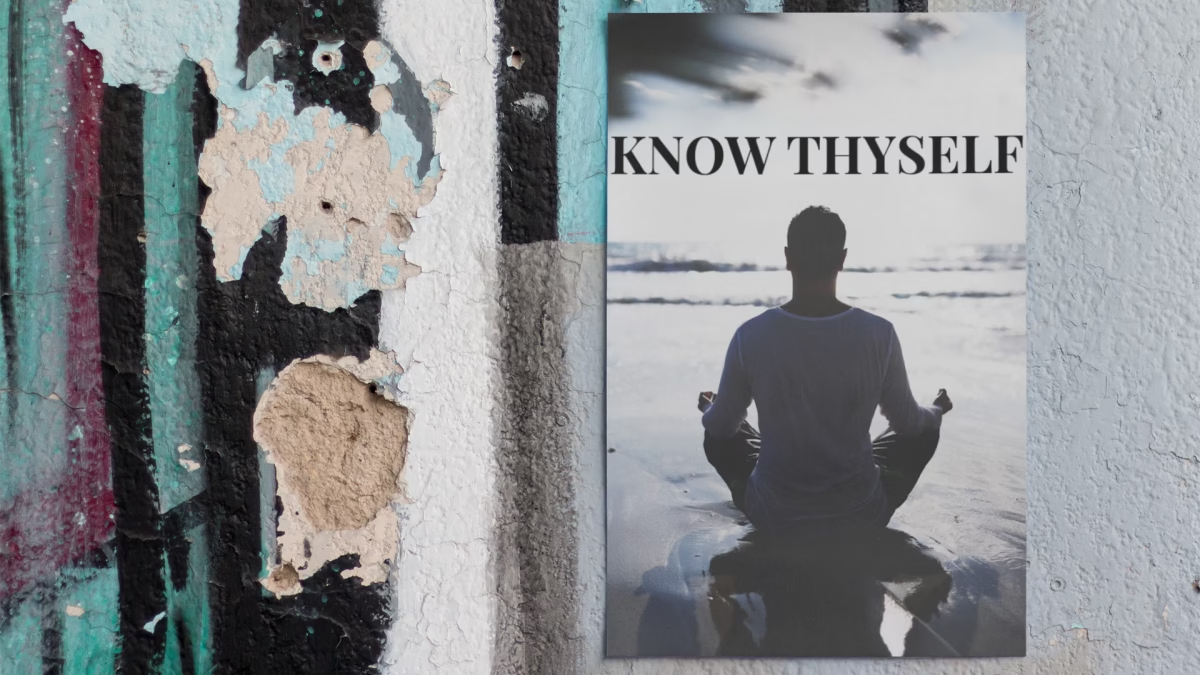

When we enter recovery, life often becomes harder before it becomes easier. Our greatest struggles begin in the mind. Everything changes, and we may find ourselves questioning how well we truly know who we are.
This experience is common among those recovering from addiction, but it is far from unique. The truth is that most people do not know themselves nearly as well as they believe. Genuine self-knowledge requires a level of honesty that many spend a lifetime avoiding. Addiction did not create that avoidance. It merely provided a place for it to hide.
This is not a modern problem. It is one of humanity’s oldest struggles.
Long before Alcoholics Anonymous, psychotherapy, or modern medicine, there were thinkers wrestling with the same questions about self-deception, character, and personal transformation. What they discovered still speaks to us today. And fortunately, they left behind a map.
What is Stoic self-examination in addiction recovery?
The Delphic phrase gnōthi seauton — “know thyself” — combined with Socratic questioning and the Stoic practice of prosoche (disciplined self-attention) gives us a framework for honest, ongoing self-inquiry. In addiction recovery, this practice is crucial if we want to reverse the damage active addiction did to our self-knowledge: the rationalizations, the blind spots, the gap between what we value and our actions. Where the Twelve Steps ask for a “searching and fearless moral inventory,” Stoic self-examination provides the daily discipline that makes that inventory a continuous practice rather than a one-time event (Step 10, right.)
“Know Thyself” Isn’t a Motivational Poster. It’s a Warning.
The phrase gnōthi seauton—know thyself—was carved into the stone at the entrance to the Oracle at Delphi. People traveled for days to take it in and receive divine advice. And the first thing they saw, before any oracle spoke, was that command.
Most people assume it was a warm invitation. It wasn’t.
In ancient Greece, it was a caution against hubris—but hubris, in the Greek sense, wasn’t just arrogance. It was something more specific and more dangerous. It was the act of overstepping our nature. Of reaching past what we actually were into territory that belonged to the gods. Pride alone wasn’t the sin. Forgetting our limits was.
The Greeks watched this pattern play out in their myths time and again. Icarus, who flew too close to the sun not because he was stupid, but because he forgot—in the exhilaration of flight—what he was made of. Oedipus, who believed he could outrun his fate through sheer cleverness and will. Every tragedy in the Greek tradition contains the same skeleton: a person who didn’t know themselves clearly enough, reached beyond what they actually were, and paid for it.
The inscription at Delphi was the warning posted at the door before any of that could begin.
It meant: before we ask the gods anything, understand our own limits. Know our place. Don’t mistake ourselves for something we’re not. Because the Oracle gave guidance—and guidance received by someone who doesn’t know themselves is more dangerous than no guidance at all. A person who believes they are wiser than they are is likely to take away the wrong meaning of the Oracle’s guidance. A person who believes they are stronger will hear permission where there is only description. Self-ignorance doesn’t just produce bad decisions. It makes the truth itself unusable.
The story of Croesus makes this concrete. Croesus was the king of Lydia—fabulously wealthy, militarily powerful, and convinced in the way that only the very successful can be that his good fortune reflected his own greatness rather than circumstance. He went to the Oracle at Delphi and asked whether he should attack the Persian Empire under Cyrus the Great. The Oracle told him that if he crossed the river Halys, a great empire would fall.
Croesus heard what he wanted to hear. He assumed the empire that would fall was Persia’s.
It was his own.
He didn’t know himself well enough to recognize his own wishful thinking. He didn’t know his limits well enough to question his assumptions. And so a true prophecy destroyed him as efficiently as a false one would have. The Greeks told this story not to mock Croesus but to use him. He was the cautionary example of what happens when you approach reality itself without first doing the harder work of knowing who you actually are.
That pattern didn’t die with the ancient world. Elizabeth Holmes built Theranos on a self-image so airtight—the revolutionary, the exception, the person who would change medicine—this blinded her to seeing what reality was presenting her. She had stopped knowing her limits. Stopped seeing the gap between what she believed herself to be and what was actually true. The Greeks would have called it hubris without hesitation. Not because she aimed high—aiming high isn’t the sin. Because she lost the ability to see herself clearly. And like Croesus, the fall was proportional to how long the self-deception had been running.
Socrates took the Delphic inscription and turned it into a way of life.
He walked around Athens—barefoot, annoying, relentless—asking people to examine their own beliefs. Not to tear them down, exactly. To see if they held up. A general who claimed to understand courage. A politician who claimed to understand justice. Socrates would ask one question, then another, and within an hour, the man would discover he didn’t actually know what he thought he knew.
And Socrates considered that discovery the beginning of real wisdom.
His most famous line—“I know that I know nothing”—gets misread as modesty. It wasn’t. It was a philosophical position: the person who thinks they have themselves figured out is sealed shut. The person who recognizes how little they actually understand about themselves is, for the first time, open to change.
The Delphic phrase wasn’t soft. It cut.
Why Addiction Is Specifically a Disease of Not Knowing Ourselves
Here’s something nobody says plainly enough: active addiction is, at its core, a constant divider between us and reality. Not consciously. Not maliciously. But systematically, the substance becomes the answer to every uncomfortable question about ourselves.
We feel something we don’t want to feel—use. We think something we don’t want to think—drink. Our behavior produces outcomes that contradict who we think we are—drink some more, and the difference softens.
The addict’s mind is one of the most creative minds in the room. It builds complex justifications, rewrites reality in real time, constructs airtight arguments for why the rules don’t apply today. This isn’t weakness—it’s a highly developed skill. It’s just pointed in exactly the wrong direction.
The problem isn’t only the substance. The problem is that the lens through which we see ourselves has been warped. Guidance can’t land. Consequences can’t teach. Even love can’t get through cleanly. Not because we’re beyond reach—but because all of that information is the wrong version of the real one.
The Greeks would have recognized it immediately.
Over time, the gap between who we say we are and who we are grows wide enough to drive a truck through. And because the substance is always there to blur that gap, we never have to reckon with it.
Then we get sober.
The noise goes quiet. And we’re left sitting with ourselves—whatever that is. Which turns out to be a much bigger question than anyone warned us about.
A guy seven months clean told me once that getting sober felt like walking into a house he’d never been in before, except it was supposed to be his house. Every room a little unfamiliar. Every corner slightly off. That’s not a metaphor for chaos—it’s a metaphor for not knowing ourselves.
What Marcus Aurelius Knew That You Haven’t Been Told
Picture this: Rome, sometime in the second century. The most powerful man in the world sits alone at the end of another day of managing an empire, wars on the border, plague spreading through the provinces, the Senate still scheming. And instead of reaching for comfort, he picks up a stylus and writes to himself—not to history. To himself. Privately. Honestly.
“You have power over your mind, not outside events. Realize this, and you will find strength.”
He wasn’t writing that for a motivational poster. He was writing it because he’d lost that understanding earlier in the day and needed to find it again.
Marcus Aurelius kept the Meditations as a personal journal of self-examination. He questioned his own anger. He cataloged his selfishness. He wrote reminders not to perform wisdom but to actually practice it. An emperor—a man with more external power than almost anyone in history—spending his private hours asking tough questions of his own character.
The stakes have changed. The psychological mechanism hasn’t.
What Marcus understood, what Socrates demonstrated with every frustrating conversation, what Epictetus—a former slave—hammered home from hard experience: we cannot govern anything outside ourselves if you don’t know what’s happening inside. Not our relationships. Not our recovery. Nothing.
Epictetus drew the clearest line of all. Some things are up to us, he said: our judgments, our desires, our responses. Everything else—other people, circumstances, outcomes—is not. Recovery asks for the same distinction. We can only work with what’s actually ours. But first we have to know what that is.
The Stoics called this self-examination prosoche—attention to oneself. Not obsession. Not navel-gazing. Disciplined, honest, ongoing attention to the interior.
Step Ten calls it a continued personal inventory. Different language. Same practice.
The Self-Inventory Protocol: Putting “Know Thyself” to Work Today
Not someday. Today.
Call this The Mirror Protocol—three honest questions, asked in sequence, practiced daily. Not a one-time event. A discipline, like any other.
Question One: What actually happened?
Not what you felt about it. Not what it meant. What literally happened—your behavior, your words, your choices. This is harder than it sounds. Most people’s internal account of events is edited before it’s filed. The Stoic practice here is stripping it back to facts first, interpretation second.
Question Two: What drove that?
Here’s where it gets uncomfortable. Not just “I was tired” or “they started it.” What inside you produced that response? Fear of rejection? The old story that you’re never enough? A pattern you learned watching your parents fight? The surface behavior is a symptom. The driver underneath is the thing worth knowing.
Question Three: What is actually mine to change?
Epictetus again. What belongs to you—your reactions, your patterns, your choices—is the only territory where real change lives. This question is a filter. It separates genuine accountability from either self-flagellation (owning everything, even what isn’t yours) or evasion (owning nothing).
Run these three questions at the end of each day. Not in a journal if you hate journals—in your head, in the car, in the shower. Five minutes. Honest. Without flinching.
This is not therapy. It is not Step work. It is a standalone discipline the Stoics practiced in some form for five hundred years, and the reason it still exists is that it works.
What the “Be Kind to Yourself” Advice Gets Wrong
Here’s the pushback that needs to be said out loud.
The recovery space—therapy, meetings, online communities—has developed a strong current of “be gentle with yourself,” “honor your journey,” “you’re doing the best you can.” And look, there’s something true in that. Shame is not a recovery tool. Beating yourself up doesn’t produce insight.
But comfort isn’t the same thing as healing. Not even close.
The problem with endless self-compassion—the unexamined kind, the kind that never gets around to asking hard questions—is that it produces the same result as denial. You feel better. Nothing changes. The pattern that drove the addiction is still running, just wrapped in more therapeutic language.
Croesus wasn’t undone by his enemies. He was undone by his own certainty. The same mechanism—the self-image held too tightly, the feedback loop that never actually loops back—is what keeps people stuck in recovery long after the substance is gone. We can be sober and still be running the same distorted map. The meeting attendance, the therapy, the daily affirmations—all of it passes through the same lens. If the lens is wrong, none of it corrects our course.
Socrates wasn’t gentle. He was kind, but he was not gentle. He asked the questions that made people squirm because thef squirming was where the growth actually lived. Marcus Aurelius didn’t write to himself with softness—he wrote with clarity. “Stop drifting. Stop deceiving yourself.” Those are his words.
The Stoic alternative to “be kind to yourself” is: be honest with yourself. Which is a harder, more useful, more genuinely compassionate act than endless validation.
Validation tells us that we’re okay. Self-knowledge tells us where we’re not, and gives us something to actually work on. Those are not the same gift.
It is no accident that the Alcoholics Anonymous preamble states “Those who do not recover are people usually men and women who are constitutionally incapable of being honest with themselves.”
We Won’t Finish This Work. That’s Not the Point.
Nobody arrives at complete self-knowledge. Not Socrates—who kept questioning until the day they made him drink the hemlock. Not Marcus Aurelius—who was still writing reminders to himself at the end of a distinguished life. Not the person with twenty years sober who still surprises herself with a reaction she didn’t see coming.
The work isn’t meant to end. It’s meant to deepen.
What changes over time isn’t the questions—those stay gnarly, stubborn, uncomfortable. What changes is our willingness to ask them. And then our comfort sitting in the silence before the answer arrives. And then our ability to act on what the answer reveals, even when it’s uncomfortable.
Three months sober looks like white-knuckling the questions. Three years looks like starting to trust the answers. Ten years looks like knowing which rooms you still avoid and being honest about why.
None of those are failure. All of them are the practice.
The good news—if we want to call it that—is that the work gets less frightening as we go. Not easier, exactly. Less frightening. We learn that the truth about ourselves, even the hard parts, is something we can live with. More than that: it’s something we can build from. The unknown corners of our own character are less dangerous once they’re known than they ever were while we were busy avoiding them.
The inscription at Delphi wasn’t a comfort. It was a directive.
We already know which question we’ve been avoiding. The one that comes up and then gets swallowed before it fully forms. The one we change the subject from in our own head.
Start there. Not tomorrow.
A STOIC SOBRIETY: Welcome to A Stoic Sobriety. I am Tony Harte, and I believe that Empowering Recovery with Stoic Wisdom is the game-changer you’ve been looking for.
With over 36 years of continuous sobriety (since 1989) and professional experience in addiction treatment, I know that recovery isn’t just about quitting—it’s about evolving.
Here, we combine the tried-and-true approaches of the AA 12-Step Program with the ancient, logical wisdom of Stoicism. Whether you are an agnostic, a believer, or simply seeking strength, let’s embark on this path of enlightenment together.
SPIRITUAL GANGSTER: at The Sober Curator is a haven for those embracing sobriety with a healthy dose of spiritual sass. This space invites you to dive into meditation, astrology, intentional living, philosophy, and personal reflection—all while keeping your feet (and your sobriety) firmly on the ground. Whether you’re exploring new spiritual practices or deepening an existing one, Spiritual Gangster offers inspiration, insight, and a community that blends mindful living with alcohol-free fun.
All the cool kids go to rehab…
Resources Are Available
If you or someone you know is experiencing difficulties surrounding alcoholism, addiction, or mental illness, please reach out and ask for help. People everywhere can and want to help; you just have to know where to look. And continue to look until you find what works for you. Click here for a list of regional and national resources.

Follow The Sober Curator on TikTok
What does “know thyself” mean in the context of addiction recovery?
In recovery, “know thyself” means developing genuine, honest awareness of our own patterns, motivations, and emotional drivers—not just our behavior. Addiction actively erodes this self-knowledge over time. Rebuilding it is not automatic when we get sober; it requires deliberate, ongoing self-examination of the kind both Stoic philosophy and the Twelve Steps prescribe.
How did Socrates use “know thyself” in his philosophy?
Socrates used the Delphic phrase as the foundation of his entire method. Through questioning, he showed people that they held beliefs they couldn’t actually defend—particularly about themselves. His position was that recognizing the limits of your self-knowledge was the beginning of genuine wisdom, not a failure. The goal wasn’t to embarrass people but to open them to real inquiry.
Can Stoic self-examination practices help with sobriety?
Yes, in practical terms. The Stoic practice of prosoche—disciplined daily attention to one’s own interior—maps directly onto what Step Ten asks for: a continued personal inventory. The Stoic framework also offers the dichotomy of control as a tool: separating what is genuinely ours (your responses, your patterns, your choices) from what is not (other people, outcomes, circumstances) is a precise and useful skill in recovery.
Why is self-knowledge so hard to develop in early sobriety?
Because for the duration of active addiction, the substance was performing a self-management function. It regulated emotions, blurred inconsistencies, and answered uncomfortable questions before they fully formed. In early sobriety, that mechanism is gone. The person is left confronting their own interior—often for the first time in years—without the tools or the practice to do it comfortably. That disorientation is normal. It’s also where the real work begins.
Is self-compassion in recovery compatible with Stoic self-examination?
They’re compatible when properly understood, but often get confused. Self-compassion means not weaponizing our own flaws against ourselves. Stoic self-examination means looking at those flaws honestly, without softening them. The two aren’t in conflict—but endless validation without honest examination is not self-compassion. It’s avoidance in gentler language. The Stoic approach is more demanding and, for most people in recovery, more genuinely useful.
