



Trigger Warning: Domestic Violence, Overdose, Loss
When I got sober, I thought I had cracked the code on life. I was down 20 pounds, booked a trip to Mexico, enrolled in college for the first time, and was walking around like sobriety Oprah handing out 24-hour coins like, “You get serenity! You get serenity!” to newcomers.
I was on fire for recovery, for Jesus, and quietly for an eating disorder, but that’s a whole other blog post.
What nobody told me is that in the years ahead I would lose my aunt to murder, my brother to an overdose, my uncle, my father, and my grandmother. All sober. Not because I am strong. Because I had tools, support, and people who had walked through it before me that I could learn from and lean on.
Those tools are the only reason I’m here writing this instead of in some bar pretending that another drink and some attention from men are going to fix my feelings.
A few days before my two-month soberversary, I pulled up to my mom’s house and she ran out screaming. She told me we had to get to my aunt’s house immediately. Her roommate had called his daughter saying he had killed my aunt.
My first thought was honestly, “God, my family is so dramatic.” There was no world where I could believe something that violent had actually happened to someone we knew. I didn’t even brace myself.
When we got there, I watched my mom fall to the ground in slow motion as a detective explained what they had found and that it was too graphic for us to see her.
My inner dialogue kicked in immediately: “Obviously you’re going to drink tonight. No one stays sober through a murder.”
Then I remembered a phrase I’d heard in a meeting: Pick up the phone before you pick up a drink.
I called every person who had given me their number, fully convinced they’d tell me I’d earned a relapse. Not one of them did.
Every single one said some version of the same thing: “Just get through tonight. You can drink tomorrow if you have to.”
I woke up the next morning still sober, and it felt like a miracle. That was the moment I realized you truly do not have to drink over anything.
I became even more insufferably Sober Oprah after that.
I wish that had been my only experience with loss. But once I got sober, it was like God said, “Ok, time to do real life now.”
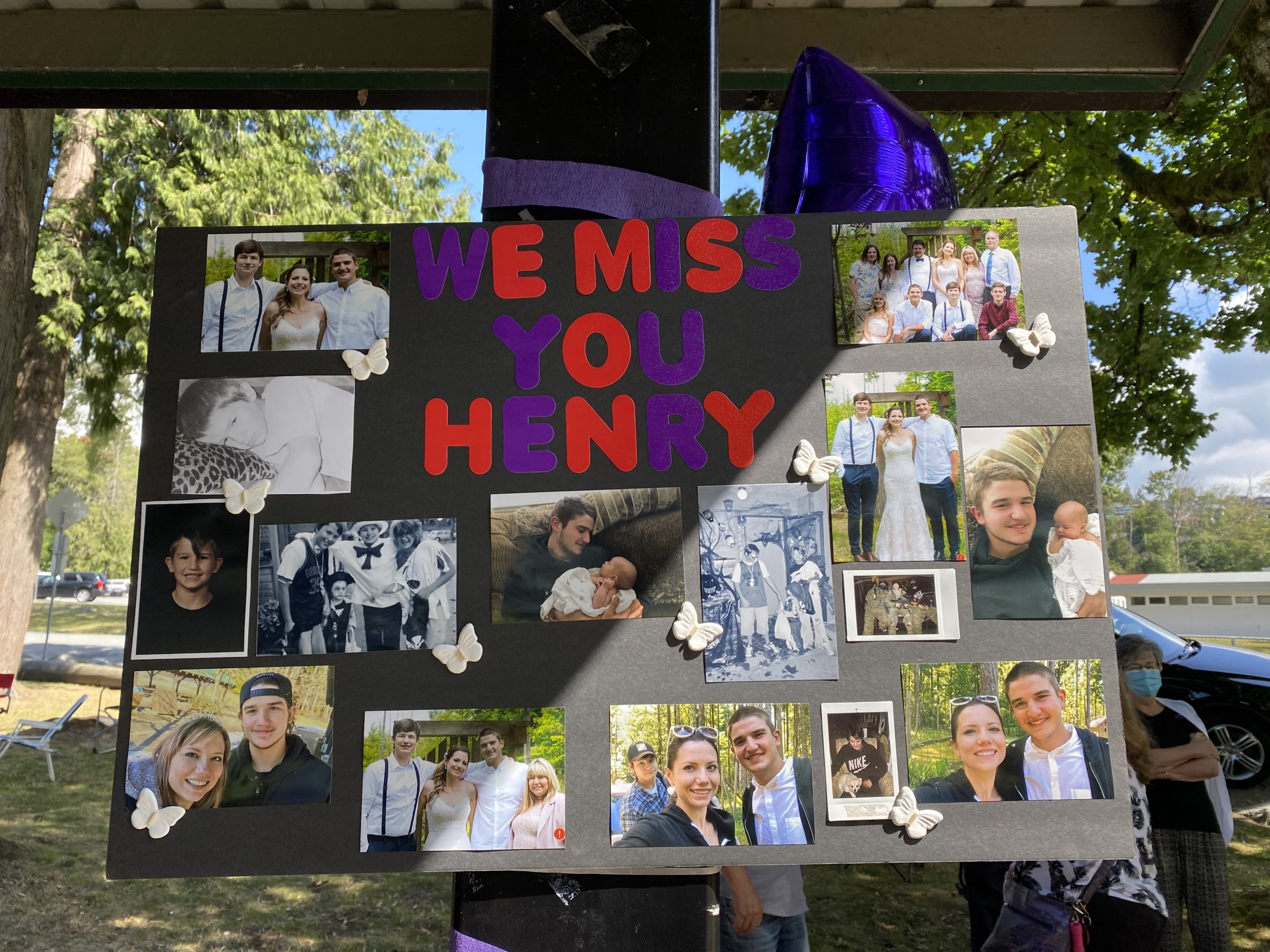
Losing my brother Henry was the one that broke me.
He was two days sober the last time I saw him, twerking upside down and making TikTok videos with my kids, the light completely back in his eyes. I finally let down my guard. I really believed he was going to find his way.
Two weeks later, my mom called at 9 a.m., and I knew before I even answered. He passed from toxic drugs at 23 years old.
I rushed to my mom’s house before they could take him away. I laid down on his body and prayed, God, you do miracles. Please give us one more chance.
I had not one single doubt that I was about to witness a resurrection.
When nothing happened, and they carried him out, I broke in a way I had never broken before.
I spent weeks crying so hard my face felt like it was detaching from my skull. The pain was so intense I would physically throw up. I got mad as hell at God and spent two years running on self-will and tarot cards, watching every area of my life implode, until I hit a spiritual bottom and the “Big G” smacked me over the head with signs I absolutely could not ignore.
Seven eagles flew over my car. An eagle statue waited at our Airbnb. Another one out front. Then I went to church for the first time in years and the sermon was literally about the symbolism of eagles in the Bible. A sign that God was bringing me back to Him.
I got the message.
When I found out my dad had six months to live, I was terrified. Not just of losing him, but of having to heal again. Of who I would be with another crater left in my heart.
His last words to me over FaceTime were, “Oh hey Brooke, I love you, I love you, I love you, you’re so beautiful.”
I had no idea that was the last time he would speak to me.
The day he was declining in the hospital, a doctor told me to go get food and not worry about being there for “the moment.” He said it wouldn’t be like the movies.
That doctor was full of it.
I stayed. We sang to him, played his favorite music, watched funny movies, and poured as much love into him as we possibly could.
Strange things kept happening. After I sang him a song I had written for him, the show on the TV played, “and then I go and spoil it all by saying something stupid like I love you.” The next show came on and a woman started calling out my late brother’s name: “Henry! Henry?”
Then The Masked Singer started playing “Don’t Fear the Reaper” right as my dad took his last few breaths.
I thought it would be the worst moment of my life. It was actually one of the most beautiful.
The room filled with so much love it felt like his spirit was taking up all the space. The birds outside went crazy. The sunset looked like heaven opening up just for him.
There is so much more to that story, but that one needs its own book.
The Different Shapes of Grief
In a strange way, it can be easier to grieve someone who has passed because death is final. There is a clear ending. But grief shows up in much messier ways too. We can grieve people who are still alive.
Relationship Death: Grieving a spouse during a divorce, watching the person you loved become a stranger, or mourning the end of a long friendship.
Identity Loss: Grieving the “old you,” a career, or the life you thought you’d have by now.
The Software Update: Grieving the version of yourself that didn’t know this kind of pain yet.
Living Grief: Grieving the version of a parent you never got to have.
Grief rewires your brain. It creates new pathways. If you cope with alcohol during that time, you are hard-wiring an addiction into a wounded mind. But if you stay sober, you wire in a strength you never knew you had.
Tools for the Trenches
1. The Ten-Minute Rule
When the pain is so deep your face feels like it’s detaching from your skull, don’t look at the rest of your life. Just focus on the next ten minutes. Tell yourself you can drink later, but right now you are just going to breathe. If you can outlast the peak of the wave, the craving will pass.
2. Accept the Self-Preservation Phase
After I lost my brother, I was not the nice girl anymore. I had to turn off my people-pleasing completely because there was no room in my nervous system for anyone else’s needs. I had to make my life very small just to survive.
Give yourself permission to be “selfish.” If you don’t have the energy for the phone call or the party, don’t go. Making your life small is sometimes the only way to keep your sobriety big.
3. Look for the Glimmers
Grief can feel like an alternate reality where you are completely alone. I started asking for signs out loud, demanding them actually, and they showed up. The seven eagles. The statues. The sermon. These glimmers are reminders that you are being guided even when you feel completely broken.
4. Prayer as a Raw Conversation
You do not have to be formal or polite about it. I have yell-cried at God and demanded to know why. I have not been graceful. Being honest about your anger is so much safer for your recovery than pretending you’re fine while quietly reaching for a bottle to numb the resentment.
If You’ve Already Picked Up a Drink
Please put down the shame. Shame is the fuel that keeps a relapse going for months instead of days.
Start over right now. You do not need a new week or a fresh “Day 1.”
Acknowledge the hurt. You are not weak. You are a human being navigating a deep wound.
Get back to your community. Show up at a meeting or call a sober friend. You don’t have to explain the “why” right away. Just get back into the safety of the group.
The Beautiful Aftermath
Grief is a software update you didn’t sign up for. It’s shitty and beautiful all at once. It strips away everything that doesn’t matter and leaves you with a raw, honest perspective on what does.
If you are in it right now, I am rooting so hard for you. You don’t have to drink to survive this.
Find any amount of good you can in your day, even something tiny, and hold onto it hard.
Grieving with clear eyes means you actually get to feel the love that remains. The light will come back. And when it does, you’ll be there to see it.
I promise.
SPEAK OUT! SPEAK LOUD! at The Sober Curator is a celebration of authentic voices in recovery—echoing Madonna’s call to “Express yourself!” Here, readers and contributors take the spotlight, sharing transformative sobriety journeys, creative talents, and new avenues of self-expression discovered along the way. Through videos, poems, art, essays, opinion pieces, and music, we break the silence that often surrounds addiction, replacing it with connection, hope, and inspiration.
Your story matters—and we want to hear it. ✏️ Submit Your Story to Speak Out! Speak Loud! Reader-written essays and opinion pieces. We publish sharp, specific, witty writing about modern sobriety. Submit your story →
Disclaimer: All opinions expressed in the Speak Out! Speak Loud! Section are solely the opinions of the contributing author of each individual published article and do not reflect the views of The Sober Curator, their respective affiliates, or the companies with which The Sober Curator is affiliated.
The Speak Out! Speak Loud! posts are based upon information the contributing author considers reliable. Still, neither The Sober Curator nor its affiliates, nor the companies with which such participants are affiliated, warrant its completeness or accuracy, and it should not be relied upon as such.

Recovery is hard 24/7, 365 – Please know that resources are available
If you or someone you know is experiencing difficulties surrounding alcoholism, addiction, or mental illness, please reach out and ask for help. People everywhere can and want to help; you just have to know where to look. And continue to look until you find what works for you. Click here for a list of regional and national resources. If your life or someone else’s is in imminent danger, please call 911. If you are in crisis and need immediate help, please call: 988.
Follow The Sober Curator on TikTok
What does grieving sober actually look like?
Grieving sober means feeling loss without numbing it with alcohol. It can look messy, emotional, spiritual, angry, quiet, and deeply human, but it also allows real healing to happen.
How do you deal with grief without drinking?
Start small. Focus on getting through the next ten minutes, call someone safe, lean on your sober community, and give yourself permission to simplify your life while you heal.
Why is grief such a trigger for relapse?
Grief overwhelms the nervous system and can make alcohol look like a quick escape hatch. But drinking often adds more pain, regret, and instability to an already devastating situation.
Can you stay sober after losing someone you love?
Yes. It may feel impossible in the moment, but many people stay sober through profound loss by using support, structure, honesty, and community one day at a time.
What if I already drank while grieving?
Put down the shame first. A slip does not erase your progress. Start again immediately, reconnect with your support system, and focus on the next right step instead of spiraling.
Is grief only about death?
No. You can grieve divorce, friendship breakups, identity shifts, family estrangement, lost dreams, or the version of yourself that existed before pain changed you.
How can sober support help during grief?
Support can remind you that you do not have to go through loss alone. Meetings, sober friends, sponsors, therapists, and faith communities can all help hold you up when your own strength runs low.
What are some healthy tools for coping with grief in sobriety?
Helpful tools include calling someone before you drink, taking life in ten-minute increments, resting more, praying or journaling honestly, noticing small moments of comfort, and staying connected to community.
2 Comments
Brooke – just a note to thank you for sharing your heart in this piece. You have a way with words my friend.
Thank you so much for writhing this article. I lost my husband 3 years ago. I was a dry drunk as I stopped for him when he was told he had alcoholic liver disease. When he died I had no reason to not pick you a drink. For some reason, is it odd or is it God. I found AA and haven’t looked back. 17th June 2026, God willing, is my 3rd “sober” birthday.